On November 6, 2026, Google DeepMind said its AI agents, guided by human cryptographers, found two weaknesses in an old kind of encryption called 1024-bit RSA. RSA is one of the oldest ways to lock data and check who sent it. The “1024-bit” part is the key size, and bigger keys are harder to break. The work was done with researchers from UC San Diego and Inria. The headline numbers sound scary, but most of them are estimates, not tests. This article separates what was tested from what is only on paper.
The 1,600x claim
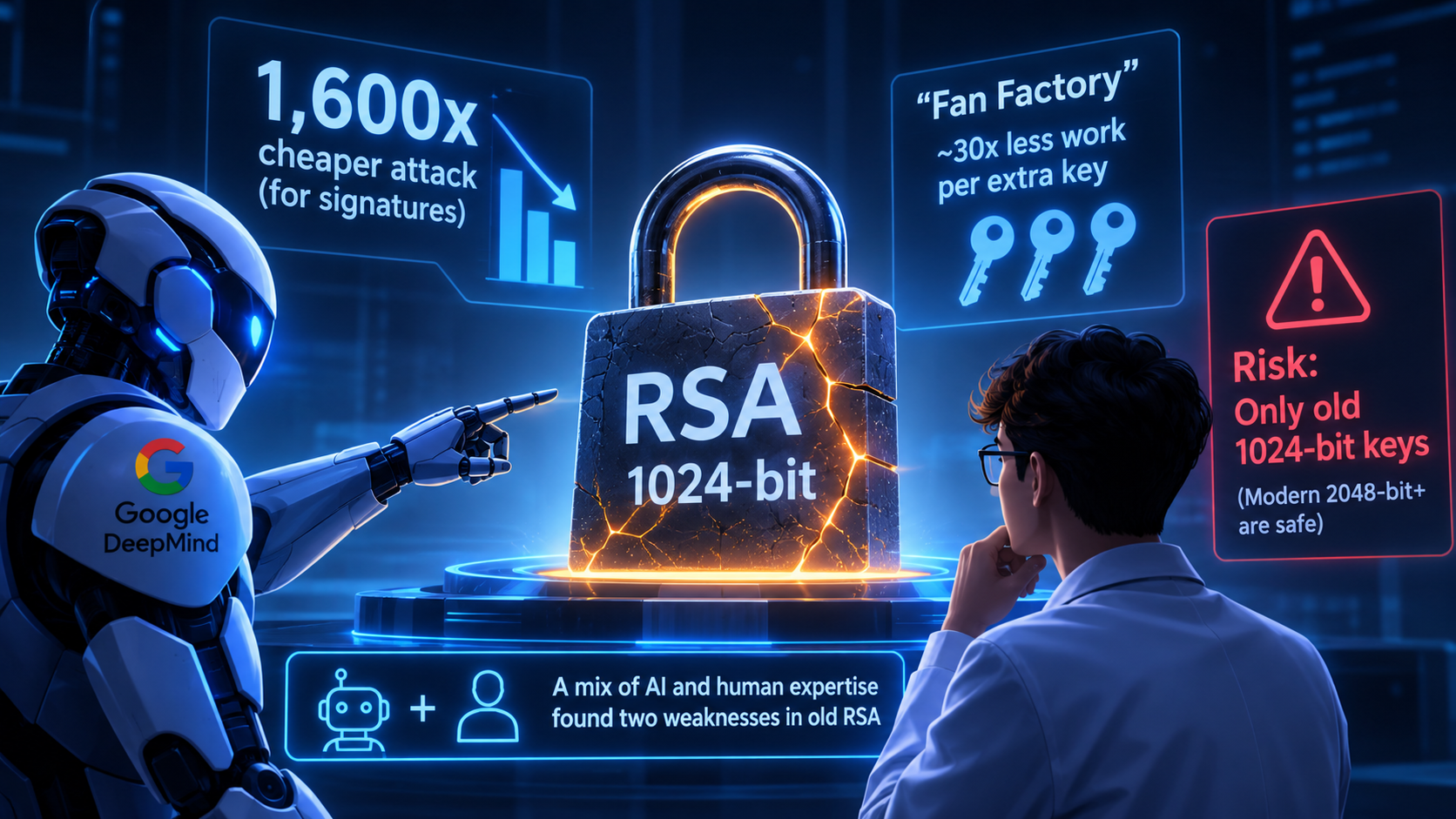
The first weakness is about forging digital signatures. A signature proves a message came from a certain sender. The attack works when the attacker controls part of the signed data, like a 32-byte hash. A hash is a short fingerprint of a file. DeepMind says its method is about 1,600 times cheaper than the best earlier one.
But that number is a theoretical estimate. It comes from math, not from running the attack at full size. What the team actually tested was smaller. Two AI agents re-ran a known attack on a 1024-bit test key that other researchers had already broken in September. The agents finished in under four days and used about 3.5 times less CPU time than the original team. That is the tested result.
The “fan factory”
The second weakness is about breaking many keys at once. Normally, each new key costs about as much work as the first. DeepMind’s “fan factory” idea pays a big setup cost one time. After that, each extra 1024-bit key costs about 30 times less than the best earlier batch method.
The paper says no fan factory has been built. The shared setup would need a huge table, so building one would be hard. It is a cost estimate, and it only helps an attacker going after lots of keys, not one target.
What humans and AI each did
Some headlines say “AI broke RSA.” That is not what happened. The project was led by DeepMind’s Dj Dvijotham and Abhradeep Thakurta. The cryptographers Nadia Heninger, of UC San Diego and Inria, and Emmanuel Thomé, of Inria, were co-authors. One report says the agents got about 20 short messages from a human researcher. The paper says the agents worked as a pair, where one wrote the proofs and the other checked them.
Who is at risk?
Modern security is not at risk. DeepMind says keys of 2048 bits and larger are not affected, and almost all modern systems use those. NIST also stopped accepting 1024-bit RSA for new signatures back in 2013.
The risk is for old systems that still use 1024-bit keys. Researchers outside DeepMind are still checking the math. For companies, this is a good reason to find any 1024-bit keys they still have and replace them.
The interesting part is not that old keys got weaker. It is that AI agents helped cut the cost of a known attack, and humans still had to work out which parts held up.