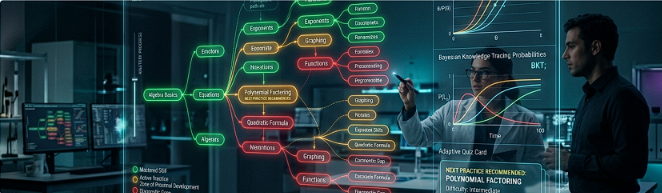
When public school districts deploy commercial artificial intelligence applications—from adaptive math tutors to generative writing coaches—parents typically assume that federal privacy frameworks like the Family Educational Rights and Privacy Act (FERPA) and the Children's Online Privacy Protection Act (COPPA) protect their children's digital footprint. In practice, however, these statutory protections are routinely circumvented through a legal mechanism known as the "School Official Exception" under 34 CFR 99.31(a)(1)(i)(B) (Regan & Steeves, 2019)[cite: 23, 25, 27].
Under this provision, school districts designate commercial EdTech vendors as school officials with legitimate educational interests
From Passive Gradebooks to Continuous Telemetric Ingestion
Historically, educational software recorded discrete, final outcomes—a test score, a submitted essay, or an assignment completion timestamp
As critics of surveillance capitalism articulate, behavioral surplus harvested from captive student users is transformed into prediction products that forecast cognitive trajectories and commercial engagement
The Four Tiers of Student Data Harvested in Classrooms
Comprehensive forensic audits of artificial intelligence learning platforms identify four distinct layers of data extraction operating in secondary schools
-
Tier 1: Explicit PII and Identifiers: Legal names, birth dates, district student identification numbers, biometric voiceprints, IP addresses, and unique device hardware identifiers
-
Tier 2: Cognitive and Behavioral Telemetry: Micro-level interaction data including item response curves, Bayesian Knowledge Tracing states, scrolling velocities, and tab-switching frequencies
-
Tier 3: Creative and Intellectual Work: Raw student conversational prompts, personal confessions shared with artificial intelligence tutors, creative writing drafts, and unvetted audio speech queries
-
Tier 4: Inferred Psychometric Profiles: Algorithmic classifications estimating cognitive working memory capacity, frustration tolerance thresholds, emotional stability, and probabilistic risk flags for neurodivergence or disengagement
The De-Identification Fallacy and Re-Identification Threats
When challenged regarding student privacy, EdTech developers overwhelmingly retreat to the claim that student data is de-identified, anonymized, or aggregated
A student's typing rhythm, vocabulary distribution, pacing through curriculum modules, and local IP temporal patterns form a unique behavioral signature
The Lifelong Algorithmic Shadow
Data harvested from a 12-year-old student does not simply evaporate at graduation
What Families Must Ask: The Seven-Point Due Diligence Framework
Parents, guardians, and local school board trustees must actively interrogate EdTech adoptions across seven critical operational dimensions
-
Intellectual Property and Prompt Rights: Does the district contract explicitly guarantee that student creative writing, math solutions, and prompts remain the exclusive intellectual property of the student?
-
Commercial Model Training Ingestion: Are student inputs, conversational queries, or telemetry used to train, fine-tune, or evaluate public or proprietary foundation models?
-
Telemetric and Biometric Scope: What passive data is collected beyond explicit academic answers, such as keystroke latency, hesitation timestamps, webcams, or audio?
-
Enforceable Purge Schedules: What is the exact data retention schedule, and do families have a certified legal right to request complete data expungement?
-
Third-Party Trackers and SDKs: Does the application embed commercial advertising pixels, analytics trackers, or third-party cloud subcontractors?
-
Academic Non-Penalty Opt-Out: If a family declines participation, is the student guaranteed an equitable, non-stigmatizing alternative offline curriculum?
-
Independent Algorithmic Audits: Has the application undergone annual third-party SOC 2 Type II security audits and independent algorithmic bias evaluations?


