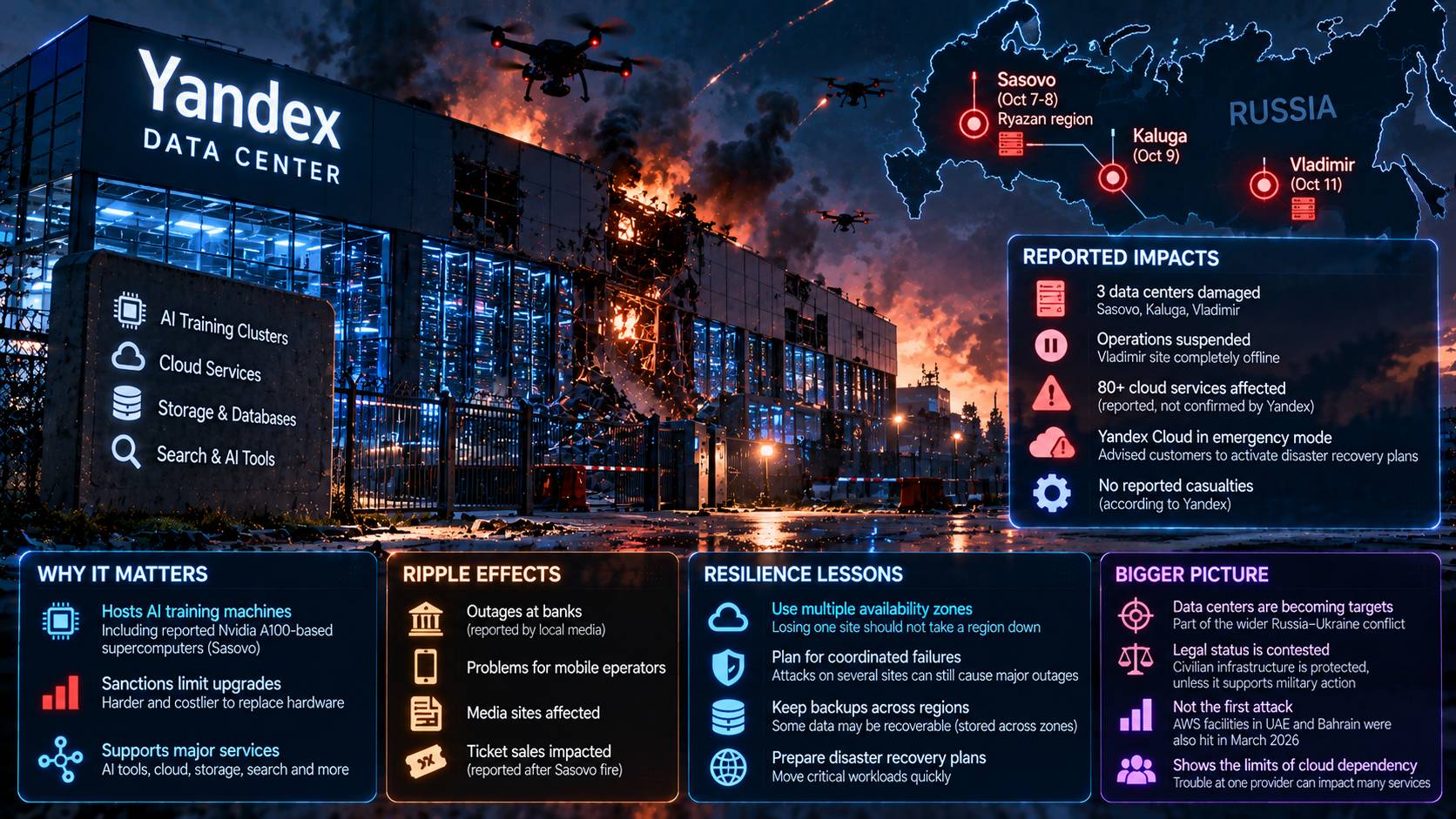
Between October 8 and 11, Yandex said drone attacks had damaged three of its data centers in Russia. Yandex is the Russian technology company sometimes called “Russia’s Google,” and it is heavily involved in Russian AI development. Ukraine’s president said the strikes were a response to Russian attacks on Ukrainian data centers. This article reports what each side and the media have said. Independent checking of the damage is limited. The focus is on what the events suggest about AI infrastructure, not on taking a side in the war.
What Has Been Reported
The first reported strike hit Sasovo, in Russia’s Ryazan region, overnight on October 7 to 8. Al Jazeera and the Moscow Times reported that it shut the site and that it houses two of the three supercomputers used to develop Yandex’s AI model. Ukrainska Pravda reported that Yandex said it could not confirm the equipment there can be repaired. On October 9, Yandex told Interfax that several modules at its Kaluga data center were disabled.
On October 11, Yandex said a drone attack damaged its Vladimir data center and that operations there were “completely suspended.” Al Jazeera reported that Yandex’s service alert told customers to activate disaster-recovery plans, with the cloud platform in emergency mode. The Vladimir governor said a drone hit an “infrastructure facility” and caused a fire. Yandex said no one was hurt. Ukrainian outlets, citing monitoring channels, reported more than 80 cloud services were affected, including Yandex’s AI tools. Yandex has not confirmed that count.
Volodymyr Zelenskyy said, “We always respond in mirror-like fashion,” adding that Russia has been hitting Ukrainian data centers. Al Jazeera reported that Russia has struck several Ukrainian data centers and telecoms sites over the past month. Tom’s Hardware counted data centers of at least eight Ukrainian companies damaged or destroyed since September 23. Russia’s Defense Ministry has said one such site was used to store dual-use goods, according to Meduza.
Not the First, but a New Kind of Target
Data centers have been hit before. In March, drone strikes hit Amazon Web Services facilities in the Middle East. The Register reported that AWS judged its Bahrain site unrecoverable. Euronews quoted experts who warned that more data centers are likely to be targeted in future conflicts.
What stands out in the Yandex case is the reported presence of AI-training machines. Tom’s Hardware described the two Sasovo supercomputers as Nvidia A100-based and said Western sanctions limit Yandex’s ability to upgrade them. Reports differ on how many of Yandex’s three supercomputers are out of action, and Yandex has not said.
The legal question is contested. Vincent Boulanin of the Stockholm International Peace Research Institute has said civilian infrastructure is protected from direct attack unless it supports military action. Whether a commercial data center qualifies is disputed.
What It Means for AI Infrastructure
Cloud providers split a region into availability zones, which are separate data centers with their own power, cooling and networking. Losing one should not take the region down. Yandex Cloud’s status pages reportedly showed two availability zones down within days, and Yandex advised customers to move workloads elsewhere. Meduza reported that customer files are stored across four zones, so some data may be recoverable.
The lesson is about limits. Redundancy is built for one site failing, not several at once. The Register noted that industry advice is to spread workloads across geographically dispersed zones and suppliers. Yandex has five large data centers, and three were reportedly hit in four days. Training clusters are also costly to rebuild, and Tom’s Hardware noted that sanctions already limit upgrades to Yandex’s machines.
Cloud dependency adds another layer. Yandex said its key consumer services stayed up, while users reported problems with its mail, storage and payment services, Tom’s Hardware reported. The two accounts differ, so the real effect on users is not yet clear.
What Comes Next
In the near term, the open questions are factual: whether Sasovo can be repaired, whether Vladimir comes back, and what independent checks show.
The longer question is whether data centers become routine targets. That is a prediction, not a finding. Operators may respond with more dispersed zones, multiple regions or several providers. For anyone running AI services, the practical step is simple: know where your zones are, and test what happens when one disappears.