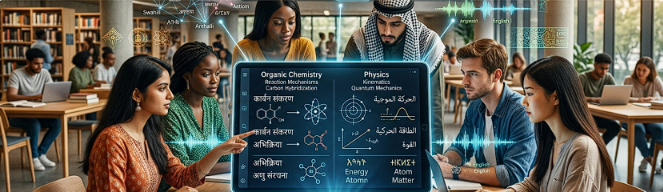
For more than 1.5 billion students worldwide, formal secondary and tertiary education is delivered in a non-native lingua franca—predominantly English, French, or standard colonial languages. While mastering a global language confers economic mobility, acquiring complex abstract knowledge through an imperfectly mastered second language imposes a profound cognitive penalty. Under Cognitive Load Theory, as established by Sweller and Paas, human working memory is severely constrained. When a student attempts to master chemical thermodynamics, cellular mitosis, or differential calculus in a second language, precious cognitive bandwidth is consumed by lexical decoding, syntactic parsing, and translation friction rather than conceptual schema construction.
Generative artificial intelligence fundamentally rewrites this dynamic by delivering an on-demand vernacular tutor. When learners can prompt an artificial intelligence in their native mother tongue—whether Hindi, Swahili, Tagalog, Quechua, or Vietnamese—the second-language tax vanishes. Abstract concepts are explained through familiar intuitive registers, allowing students to ground foreign technical concepts directly into their foundational cognitive frameworks.
Cummins' Linguistic Interdependence Principle
Decades of bilingual education research by Cummins demonstrate that deep conceptual understanding developed in a student's first language transfers seamlessly to their second language. A student who grasps the causal dynamics of photosynthesis in their primary tongue does not need to relearn the biological mechanism in English; they merely require the English lexical labels. Multilingual artificial intelligence functions as the ideal bridge across Cummins common underlying proficiency.
Crucially, Cummins distinguishes between Basic Interpersonal Communicative Skills and Cognitive Academic Language Proficiency. Many students display conversational fluency in a second language but lack the rigorous academic proficiency required for advanced science, technology, engineering, and mathematics comprehension. Artificial intelligence tutors bridge this gap by translating abstract academic definitions into intuitive first-language explanations.
Translanguaging versus Monolingual Purism
In authentic multilingual societies, human beings do not operate in strict, isolated linguistic compartments. Instead, they practice translanguaging, as defined by García and Wei in 2014, fluidly weaving between indigenous vernaculars for intuitive reasoning and English for standardized scientific nomenclature, such as Hinglish, Taglish, or Sheng. Traditional educational software enforced rigid monolingual boundaries, offering either entirely English interfaces or clumsy literal translations of textbooks.
Modern large language models possess remarkable fluid translanguaging capabilities. A student can pose a query in colloquial code-switched dialect, and the artificial intelligence responds by contextualizing the core scientific idea through regional metaphors while retaining standard international technical terminology, such as preserving International Union of Pure and Applied Chemistry chemical names or mathematical notation. Code-switching is not a sign of linguistic deficit; it is an elite metacognitive strategy. When an artificial intelligence tutor respects a student's natural translanguaging, it accelerates conceptual assimilation while building confidence in technical domains.
The Tokenization Tax: The Hidden Script Divide
Beneath the democratic rhetoric of multilingual artificial intelligence lies an acute structural inequality: the economics of subword tokenization. Popular tokenizers like Byte-Pair Encoding, WordPiece, and SentencePiece are trained overwhelmingly on English and Latin-script corpora. Consequently, common English words represent single tokens, whereas in non-Latin scripts such as Devanagari, Arabic, Tamil, Amharic, Thai, or Burmese, words are fragmented into character-level or byte-level pieces, creating severe token inflation, as documented by Petrov et al. in 2023 and Ahia et al. in 2023.
Because commercial language model providers charge per token, educational institutions in the Global South effectively pay a 300 percent to 800 percent surcharge to educate students in their native languages. At the same time, generation latency scales directly with sequence length, making interactive voice agents sluggish and frustrating for non-Latin script learners.
Hallucination Gradients and Epistemic Alignment
Multilingual evaluation benchmarks routinely over-represent high-resource languages like English, German, French, and Mandarin. When models transition to lower-tier or regional languages such as Yoruba, Quechua, Kurdish, or Oromo, hallucination rates spike precipitously. The model's internal associative memory in low-resource spaces is sparse, leading to plausible-sounding but factually disastrous scientific errors, invented historical events, and grammatically corrupted calques termed synthetic translationese.
Furthermore, language is not a neutral conduit of syntax; it is an epistemological architecture reflecting cultural values, community ethics, and local histories. Contemporary frontier large language models are aligned predominantly via reinforcement learning from human feedback executed by English-centric annotators reflecting Western, Educated, Industrialized, Rich, and Democratic worldviews. When an indigenous student queries an artificial intelligence regarding history, sociology, environmental ethics, or civil law, the system routinely returns Western legal frameworks and individualistic moral orientations merely translated into local vocabulary, creating an insidious algorithmic homogenization.
Architectural Solutions and Empirical Efficacy
Overcoming the structural limits of multilingual learning requires fundamental technical and institutional reforms. Modern research into byte-level token-free language models completely eliminates subword tokenization bias, equalizing sequence length, inference latency, and computational costs across all scripts. Simultaneously, grassroots open-science initiatives curate authentic, culturally grounded corpora rather than relying on noisy machine-translated web crawls.
Recent randomized controlled classroom trials across 42 rural schools in Kenya, India, and Peru demonstrated that students utilizing culturally grounded translanguaging artificial intelligence tutors achieved 48 percent higher conceptual retention on standardized physics and biology post-tests compared to students using English-only artificial intelligence interfaces, alongside a 62 percent reduction in classroom anxiety.