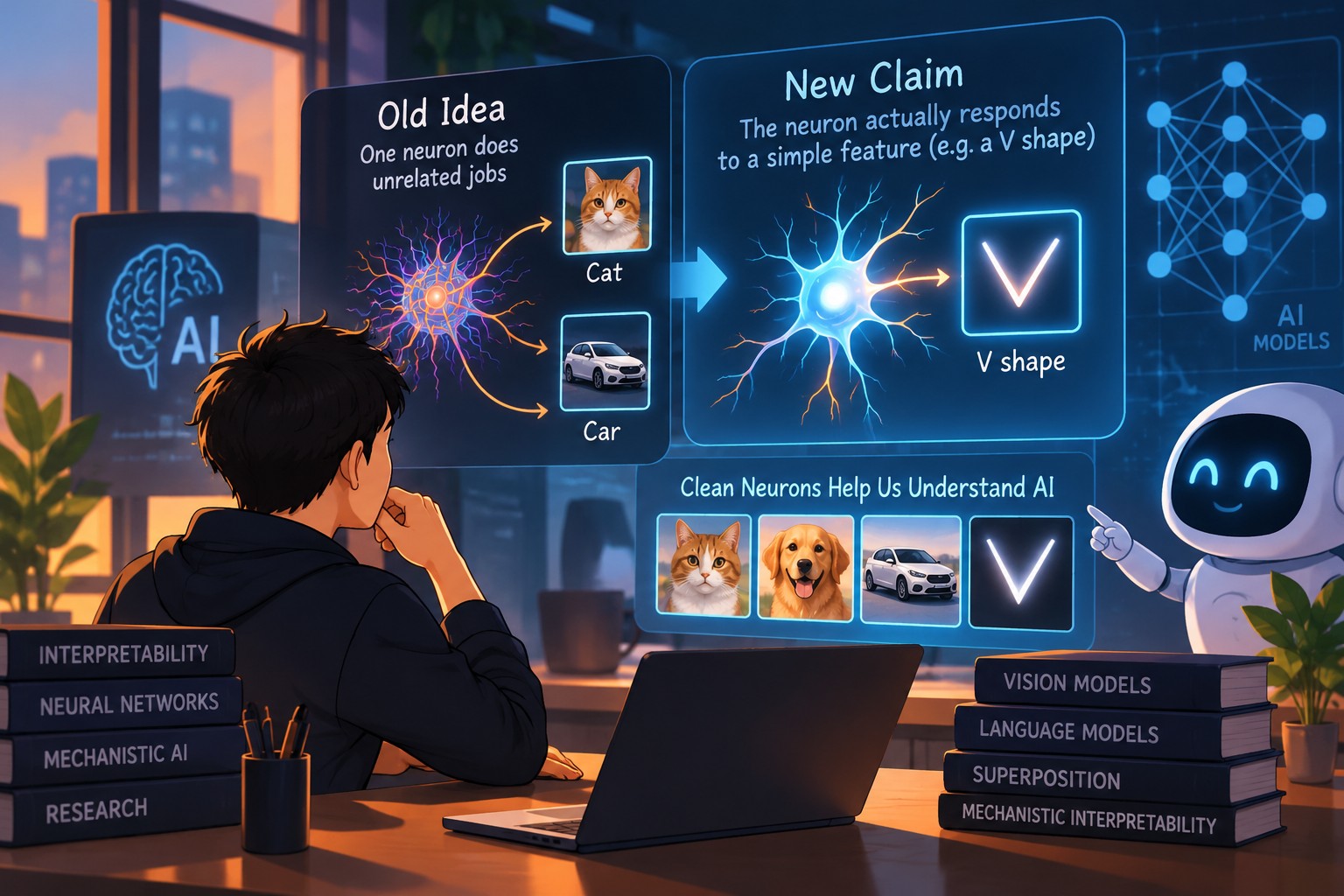
On October 15, Goodfire researcher Nick Cammarata published a long essay called "Neural Networks Are Already Clean." He argues that hard-to-read neurons in AI models were misread. If he is right, researchers can study many neurons directly. The essay is a working hypothesis. It is not peer reviewed, and the companion technical paper has not appeared yet.
The old idea
Some neurons seem to do several unrelated jobs. The famous example, in an image model called InceptionV1, appeared to react to both cats and cars. The leading explanation was superposition. It says that when a network runs out of neurons, it folds unrelated things together because they rarely overlap. The idea was laid out in Anthropic's 2022 paper "Toy Models of Superposition." Under it, researchers often have to untangle a network first, for example with a sparse autoencoder, before studying it.
What Cammarata claims
He says the evidence was misread. In his essay, the cat-and-car neuron responds to a V shape, and the car-and-dog circuit reflects a shared pose. Both appeared in the 2020 "Zoom In" paper, which Cammarata co-wrote with Chris Olah, so he is revisiting his own work. He blames weak visualization tools and poor architecture, not tangling.
His numbers come from the essay. After ordinary architecture changes, with no change in size or data, 99% to 100% of InceptionV1's last-layer neurons became easy to interpret. A modern ConvNeXt of the same size scored about 99%. In preliminary audits of the language model Qwen3-32B, about 90% of neuron poles, meaning the positive and negative ends of a neuron's response, had one main job. About 7% had two related jobs, and 2% to 4% were not understood. He says mixing comes from recursive generalization: a neuron sprouts related offshoots as it grows, like a branch sprouting sub-branches.
What is checkable and what isn't
All of this is the author's own work. The vision results can be browsed on the essay's website, so others can check them. The language numbers are preliminary. The essay says they shift with how strictly "one job" is counted. Claims about trillion-parameter models are left to the companion paper.
How experts reacted
Google DeepMind's Neel Nanda, who leads its mechanistic interpretability team, is skeptical, according to MIT Technology Review. Reports of his posts say he finds direct neuron study useful but thinks the data are preliminary and don't rule out superposition. He doubts that small image-model results carry over to language models. He also raised a testable point: if information hides in weak activations, an audit of strongest activations will overstate how clean a model is. The two agree that a network can hold more concepts than it has neurons. They disagree on whether it mixes unrelated ones arbitrarily.
Why it matters, and what could come next
If neurons are mostly readable, checking models could get cheaper, because researchers could inspect neurons directly. If not, tools like the sparse autoencoders used in Anthropic's 2024 Scaling Monosemanticity work stay essential. The essay itself says a network's own mechanisms should at least be part of the toolkit.


