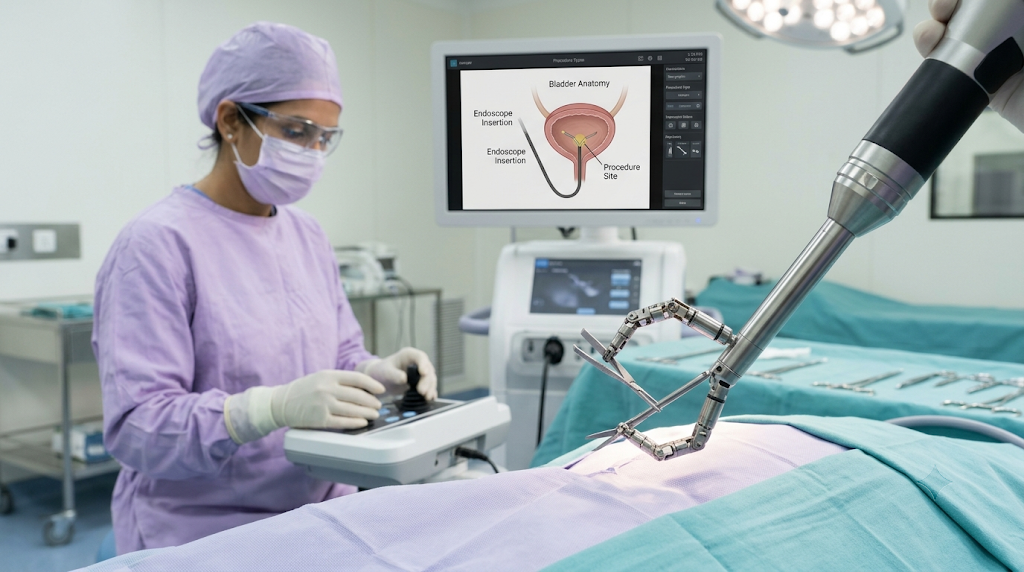
Imagine trying to cut a small piece of fruit inside a narrow pipe using straight tools. Surgeons face a similar challenge when removing bladder lesions. A company called Virtuoso Surgical has developed a robotic system to make this work easier.
On November 10, 2026, the company announced that its Virtuoso Endoscopy System had received authorization from the US Food and Drug Administration (FDA).
What Does the FDA Authorization Mean?
The FDA uses a process called De Novo to approve new types of medical devices that do not have a similar device already on the market.
Virtuoso received this authorization in October 2026 and announced it in November.
The system is designed to help surgeons remove bladder lesions in adults. These tissue samples help doctors check for bladder cancer.
The robot is controlled by trained surgeons. It does not perform surgery on its own.
How Do the Tiny Robotic Arms Work?
The Virtuoso system uses two robotic arms that are about the size of needles.
These arms fit inside a thin medical tube called an endoscope. Doctors insert this tube through the urethra, the passage that carries urine out of the body.
The arms are made from a flexible metal called nitinol. This metal can bend and return to its original shape.
The surgeon controls the arms from a console.
One arm can hold the tissue while the other cuts it. This helps surgeons remove a lesion in one piece instead of smaller pieces.
Why Is Removing Tissue in One Piece Important?
During traditional bladder surgery, doctors often remove tumors in small pieces.
This can make it harder to study the tissue properly.
Removing the lesion in one piece may help doctors understand how deeply the cancer has grown.
In an early study called VIABLE, researchers tested Virtuoso on 20 patients in Hong Kong.
The company reported that important bladder muscle tissue was found in 94% of removed lesions.
Doctors could also examine the edges of 93% of cancerous lesions.
No problems were reported during the surgeries.
What Are the Limitations?
The early results look promising, but the study included only 20 patients.
It also did not directly compare Virtuoso with traditional surgery.
Earlier research has shown that standard surgical methods can also collect good tissue samples.
Some studies have also reported complications during one-piece bladder tumor removal.
So, researchers still need to prove whether Virtuoso offers better results and safety.
The cost of the system and the training surgeons will need are also unclear.
What Happens Next?
Virtuoso plans to introduce the system at selected US urology centers in 2027.
For now, its authorized use is limited to removing bladder lesions in adults. Other medical uses are still being studied.
Virtuoso is an important development in robotic surgery. However, larger studies are needed to understand whether it can improve treatment and help patients in the long term.