Security teams rarely lose control of regular employees, because onboarding, permissions, and offboarding follow strict directory rules. AI agents are different. They often connect to SaaS apps and internal APIs using hardcoded keys or random user tokens that nobody tracks. On September 22, 2026, at its Oktane conference, Okta CEO Todd McKinnon introduced new Okta for AI Agents features and a multi-vendor group called the Blueprint Alliance. The goal is to use Okta's identity platform, which already manages human access, to find, sign in, control, and shut down AI agents in real time. Instead of treating bots like loose scripts, Okta registers every agent as an identity in Universal Directory, right next to human employees.
How Okta for AI Agents Works
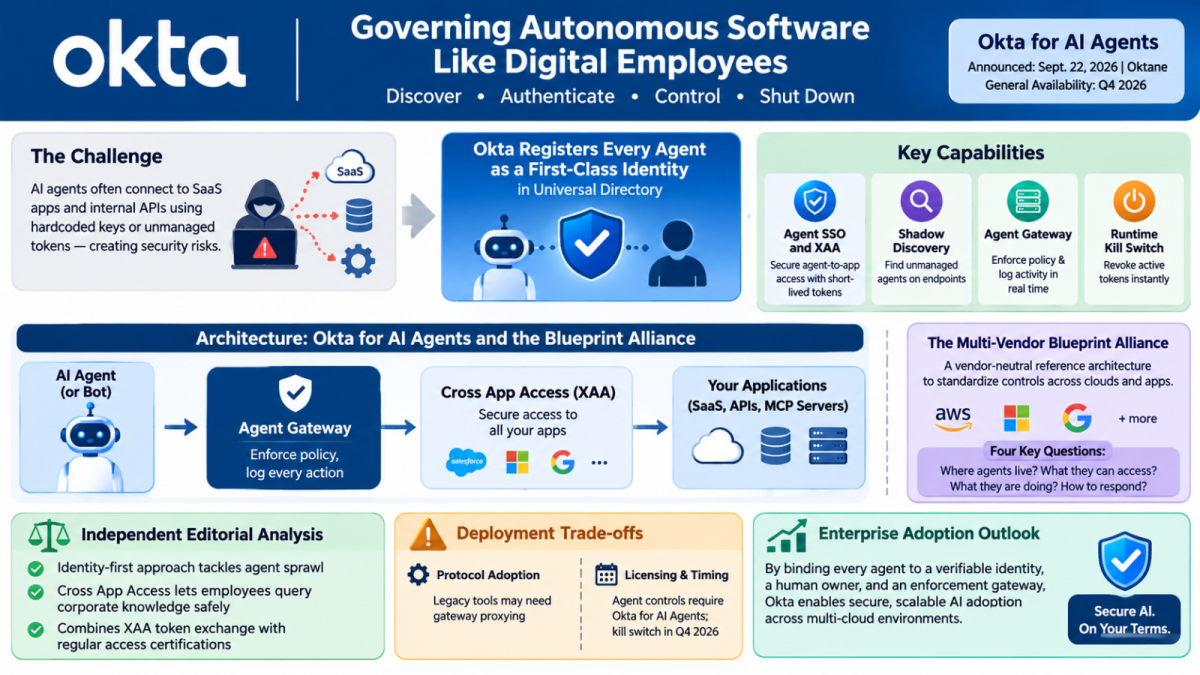
According to Okta's September 22 press releases and support documentation, the platform pairs an open reference architecture with four main controls.
The first is Agent SSO and Cross App Access (XAA). Agent SSO is available in regular workforce Single Sign-On plans, and it's built on XAA, an open protocol for safe agent-to-app connections. Admins register agents and replace static API keys with short-lived tokens that follow policy and are tied to a human sponsor. This way users don't get asked for consent again and again, and agents only get the least access they need.
The second is finding hidden agents. Shadow AI Agent Discovery for Endpoints scans employee devices for agents running locally, which adds to the browser-based discovery. Admins can then use Configuration Designer to map out and limit how agents hand off to resources, and Resource Access Certifications review standing permissions over time.
The third is Agent Gateway and the planned kill switch. Agent Gateway sits in the path between an AI agent and every tool or Model Context Protocol (MCP) server it calls, enforcing policy and logging each interaction. Okta says it already has deactivation controls that block new agent sessions across connected apps and APIs. It plans to bring its kill switch into the gateway in Q4 2026, so admins can cancel active tokens held by a hacked agent in the middle of a task.
The fourth is the Blueprint Alliance. Okta teamed up with 11 founding partners, including Amazon Web Services, CrowdStrike, Google Cloud, Proofpoint, Salesforce, ServiceNow, and Zscaler. Together they're turning Okta's March 2026 security framework into a reference architecture that isn't tied to one vendor. It's built around four questions: where agents live, what they can access, what they're doing, and how teams respond when something goes wrong.
What I Think About It
To me, Okta is making a different bet from the other two ways of governing agents. Cloud companies like AWS and Google Cloud mostly govern agents inside their own infrastructure, and SaaS companies like Salesforce and ServiceNow set guardrails inside their own apps. An independent identity provider tries to sit underneath all of those connections at the token level. SiliconANGLE said in its September 22 coverage that pairing an inline gateway with a 12-vendor alliance makes identity a neutral control point, but how well it works depends on whether rival platforms honor shared threat signals.
Still, security architects have two risks to watch.
First, older apps might not fit. Agent SSO is available now, but smooth token exchange only works if the target apps support XAA through the Okta Integration Network, SAML, or OpenID Connect. Older internal tools still have to go through gateway proxying.
Second, licensing and kill switch timing matter. Basic Agent SSO comes in standard workforce SSO plans, but agent-to-agent governance needs Okta for AI Agents or Okta Identity Governance. Also, since the Agent Gateway kill switch is only planned for Q4 2026, security teams need to plan for the gap between today's session-level deactivation and full mid-call token revocation.
What Happens Next
By tying every autonomous agent to a directory identity, a human owner, and an inline gateway, Okta is building a practical identity control center for companies that use many clouds. Security teams that combine XAA token exchange with regular access reviews can adopt agents faster without bringing back the API-key mess from early cloud migrations.