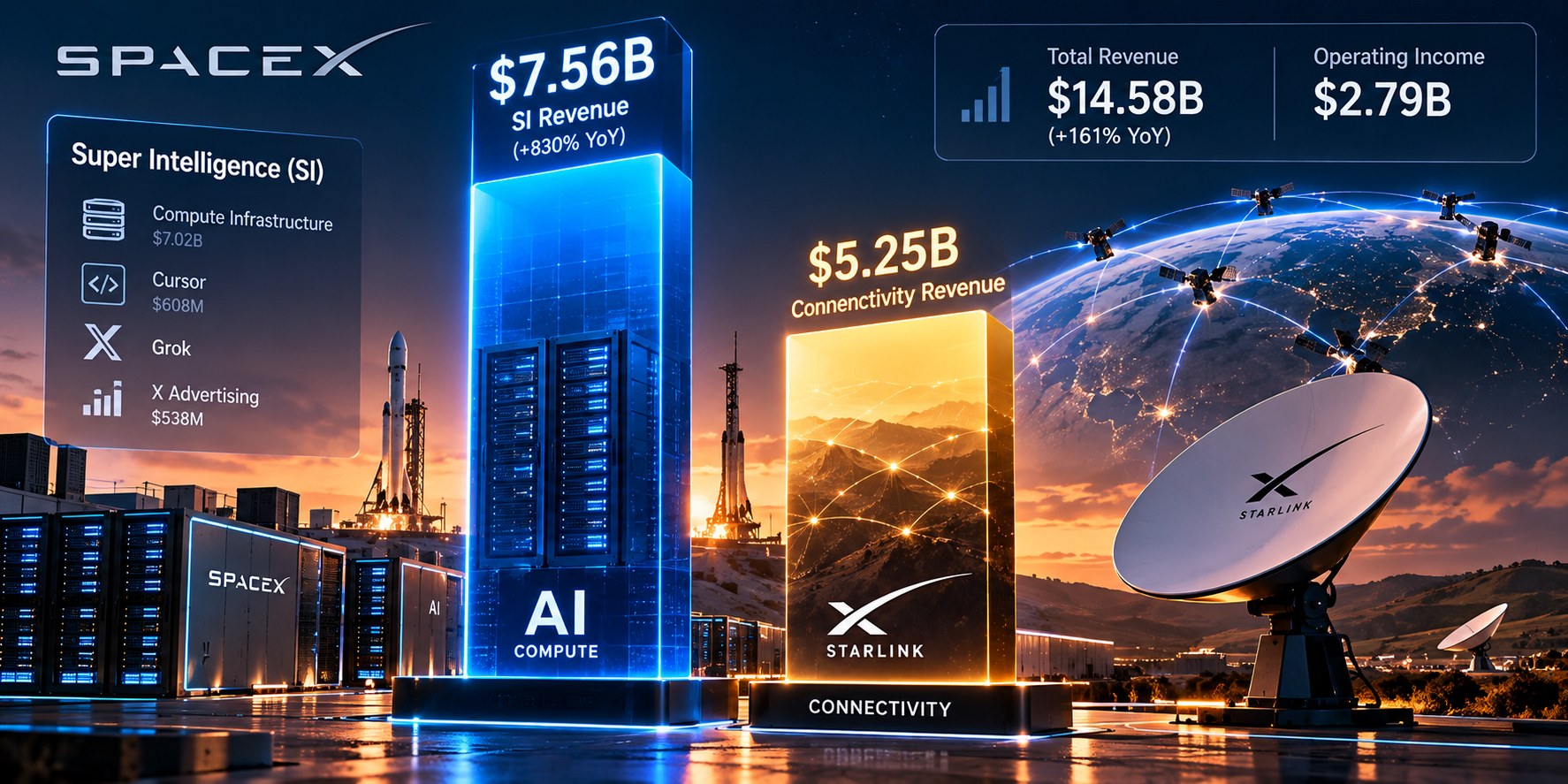
On October 20, SpaceX reported that its AI segment, now called Super Intelligence (SI), earned more revenue than Starlink. But Starlink still makes most of the profit, and “AI” here mixes compute rental, the Cursor coding tool, Grok and X advertising. This article separates what SpaceX’s filing shows from what it leaves open.
What the Filing Shows
SpaceX’s earnings release, filed with the SEC, reports revenue of $14.58 billion, up 161%, and operating income of $2.79 billion. SI revenue was $7.56 billion, up 830% from a year earlier. Of that, $538 million was advertising and $7.02 billion was “solutions and infrastructure,” which includes $608 million from Cursor since it joined on August 14. Connectivity, mostly Starlink, earned $5.25 billion.
Profit tells a different story. SI’s operating income was $431 million, after $1.2 billion of stock pay tied to Cursor. Connectivity earned $2.37 billion. SI also took $16.4 billion of the $19.6 billion in capital spending, and nameplate compute reached 1.7 gigawatts. These figures are unaudited and reported by the company.
Who Is Buying the Compute?
The release names no customers. Earlier reports of SpaceX’s filings name Anthropic, which pays $1.25 billion a month for the Colossus 1 data center, and Google, which pays $920 million a month starting in October. Reuters also names Reflection AI. Google’s payments start after the quarter, so they should not be in these results.
Here is our arithmetic, not a reported figure: if Anthropic’s contract ran all quarter, it would be about $3.75 billion, roughly half of SI’s revenue. Anthropic, which makes Claude, is one of the named customers. Customer concentration for Q3 should appear in SpaceX’s quarterly report.
The Related-Party Question
Grok and X are SpaceX’s own products, not clients. The three segments add up exactly to consolidated revenue, so no sales between segments are visible in the release.
Related parties do appear elsewhere, but not as revenue. The statements show related-party debt of about $12.9 billion, $351 million of related-party interest expense and $480 million of related-party equipment purchases over nine months. Whether any revenue comes from Musk-linked companies is not broken out. Nor does the release explain how cloud revenue is recognized. It does show deferred revenue of $17.5 billion, up from $12.1 billion at the end of 2025, which suggests customers pay ahead. These are the questions to press.
What Comes Next
This contrasts with the neocloud financing stress seen earlier this month. SpaceX holds about $89.9 billion in cash and securities. But Fortune reported that its main compute contracts can be cancelled on 90 days’ notice, so demand is not locked in. Whether it holds is a forecast, not a finding. Watch the quarterly report for customer concentration, intersegment sales and recognition policy.


