Imagine a surgeon using robotic arms to perform an operation through small cuts in a patient's body. This is how Medtronic's Hugo surgical robot helps doctors during surgery.
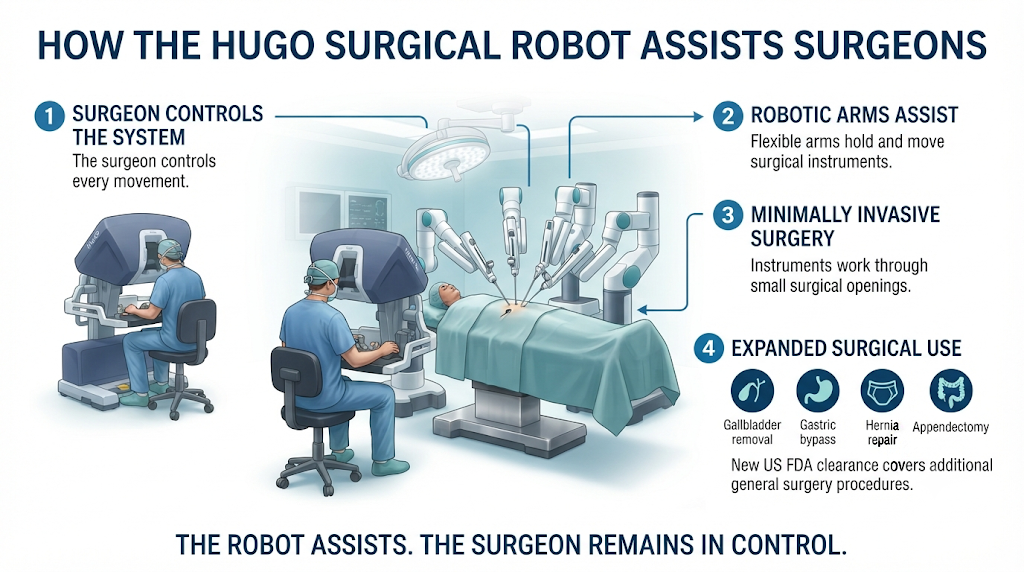
On November 17, 2026, the US Food and Drug Administration (FDA) cleared Hugo for more types of operations.
Earlier, Hugo was cleared in the US only for urology procedures involving organs like the kidneys, bladder and prostate.
What Surgeries Can Hugo Perform?
Hugo can now be used for several abdominal surgeries.
These include gallbladder removal, gastric bypass, hernia repair, appendix removal and surgery involving the small intestine.
Medtronic estimates that these procedures represent around 3.5 million surgeries every year in the United States.
However, this number represents the potential market, not surgeries already performed using Hugo.
For comparison, around 2 million US procedures were performed using Intuitive Surgical's da Vinci robots in 2025.
How Does the Hugo Robot Work?
Hugo uses separate robotic arms that doctors can position around the patient.
This design allows surgical teams to arrange the arms based on the operation.
A trained surgeon controls the robotic instruments from a console.
The robot does not perform surgery independently.
Instead, it helps surgeons operate through small cuts using special instruments.
Medtronic says the open console also helps surgeons communicate with their teams.
Hugo can use the LigaSure RAS Maryland instrument, which was cleared in September 2026. This tool helps seal and cut blood vessels during surgery.
Why Is FDA Clearance Important?
FDA clearance allows Medtronic to sell Hugo for these additional surgical procedures in the US.
However, it does not mean every hospital will immediately start using the robot.
Hospitals must consider equipment costs, staff training and patient needs.
Medtronic expects Hugo to reach more than 50,000 procedures and 250 installed systems by the end of April 2027.
Meanwhile, Intuitive Surgical's da Vinci system has already been used in more than 20 million procedures worldwide.
This shows that Hugo still has a long way to go.
What About Other Surgical Robots?
Medtronic is not the only company developing surgical robots.
Johnson & Johnson's Ottava received FDA authorization for upper-abdominal surgery in July 2026.
Unlike Hugo, Ottava has robotic arms built into the operating table.
Stryker also announced a partnership in October to sell CMR Surgical's Versius robot in the US.
These companies are competing in a market where da Vinci is already widely used.
What Are the Challenges?
Hugo's new clearance does not prove it is better than traditional keyhole surgery or other surgical robots.
More research is needed to compare patient results, safety and costs.
Surgeons must also receive proper training before using the system.
What Happens Next?
Medtronic has also requested FDA clearance for Hugo in gynecologic surgery, which focuses on women's reproductive health.
That application still needs a separate review.
Hugo's expanded clearance is an important step for Medtronic. However, its future success will depend on hospital adoption, costs and patient outcomes.