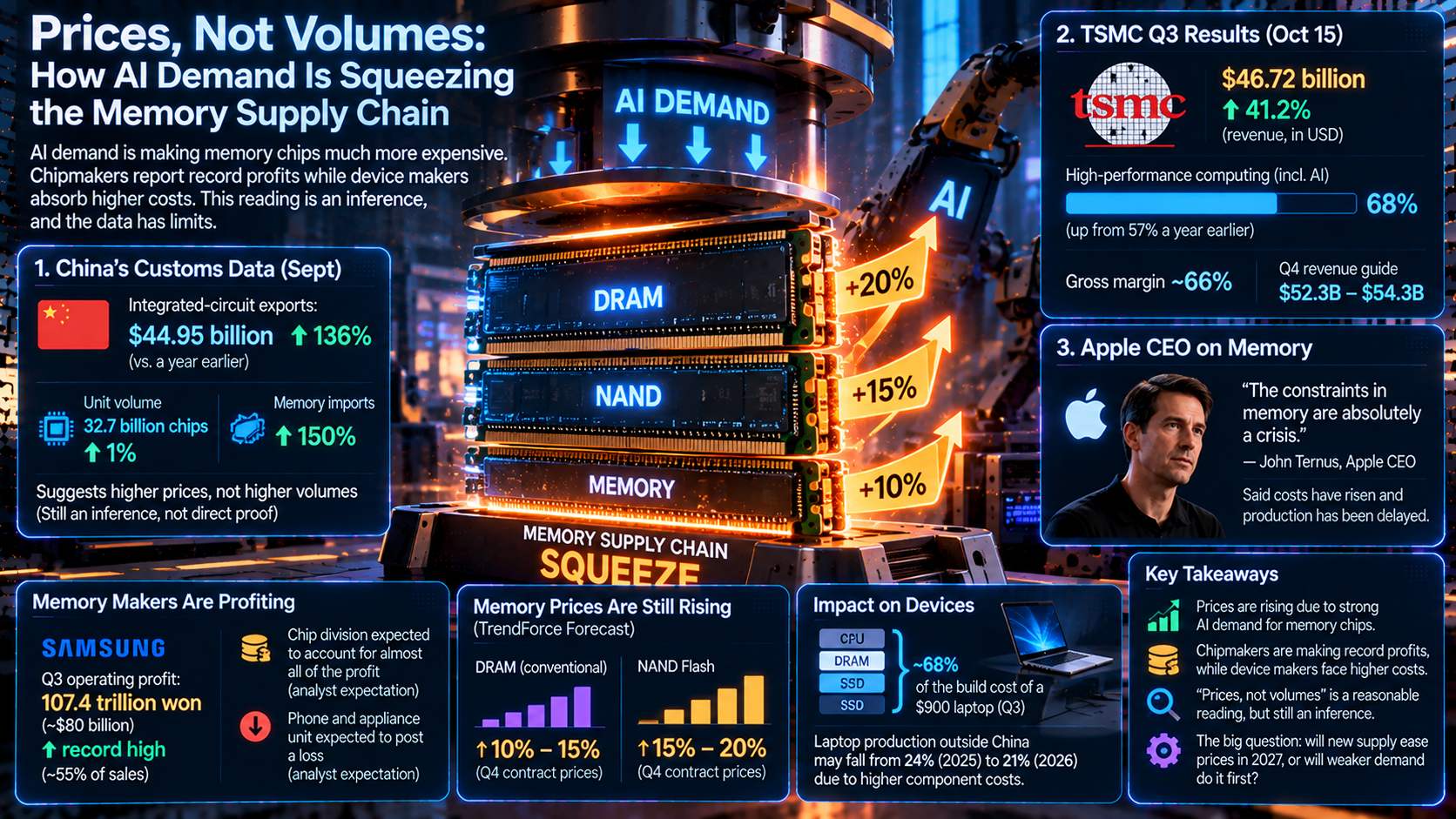
AI is not only buying more chips. In some parts of the market, it is making chips cost much more. This week brought three data points from different sides: China’s customs data, TSMC’s earnings and Apple’s new CEO talking about memory. Together they suggest the cost of the AI buildout is flowing through the memory supply chain to device makers and buyers. That reading is an inference. No single source says it outright, and the article is clear about where the evidence stops.
Three Data Points
First, China’s customs data, released on October 14. September integrated-circuit exports hit a record $44.95 billion, up 136% from a year earlier. Unit volume rose only 1%, to 32.7 billion chips. The South China Morning Post attributed the jump to higher prices amid a memory shortage. Over the first nine months, China exported about 275.2 billion chips worth nearly $302 billion, up 108%. Also over those nine months, memory imports rose 150% and exports of data-processing equipment such as servers rose 7.2%.
Second, TSMC reported third-quarter revenue of $46.72 billion on October 15, up 41.2% in US dollars. High-performance computing made up 68% of revenue, up from 57% a year earlier. That category includes AI accelerators but is not an AI-only measure. TSMC’s gross margin was about 66%, and it guided fourth-quarter revenue to between $52.3 billion and $54.3 billion.
Third, Apple CEO John Ternus, who took over on September 1, told TIME that “the constraints in memory are absolutely a crisis” and that all options should be on the table. He was answering a question about reports that Apple had tested memory chips from a Chinese company, which a bipartisan group of senators had criticized. TIME described the shortage as having raised costs and delayed production.
Where the Margin Lands
Memory makers are collecting much of the gain. Samsung said its preliminary third-quarter operating profit was 107.4 trillion won, about $80 billion, a record and roughly 55% of sales. According to TrendForce’s reporting, analysts expect its chip division to account for almost all of that profit, while its phone and appliance unit is expected to post a loss. That last point is an analyst expectation, not a Samsung statement. TSMC, upstream of the squeeze, kept a gross margin near 66% while its AI-heavy segment grew.
Prices are still rising. TrendForce expects fourth-quarter contract prices to rise 10% to 15% for conventional DRAM and 15% to 20% for NAND flash, as suppliers favor AI servers. For device makers, the squeeze is already visible in the parts bill. TrendForce says CPU, DRAM and SSD made up about 68% of the build cost of a mainstream $900 laptop in the third quarter. It expects laptop production outside China to slip from 24% in 2025 to 21% in 2026, because higher component costs make diversification harder to justify. It also says the main risk in 2027 shifts from supply to weaker demand. Gartner forecast in February that PC prices would rise 17% and smartphone prices 13% versus 2025, as summarized by Technology.org.
What the Customs Data Can and Cannot Say
“Prices, not volumes” is a reasonable reading, and the SCMP makes it. It is still an inference. Unit counts blend very different products. A shift toward higher-value chips, such as memory, could raise the average value of an exported chip even if no individual chip got more expensive. Customs data also cannot separate AI-related shipments from everything else, as one trade report noted.
Other data points the same way. TrendForce’s contract-price forecasts and Counterpoint’s estimate that memory prices rose 80% to 90% in the first quarter, as summarized by one outlet, both describe price increases. But those are different datasets. Together they make a price effect likely. They do not prove that it explains the customs numbers.
What Could Come Next
In the near term, watch fourth-quarter contract prices, SK Hynix’s late-October results and whether Apple does buy Chinese-made memory, given the political pushback. The longer question is whether new memory supply eases prices in 2027 or weak demand does the job first. TrendForce itself says either could change the picture. That is a forecast, not a finding. For now, the evidence shows who is being paid more, and who is being squeezed.


