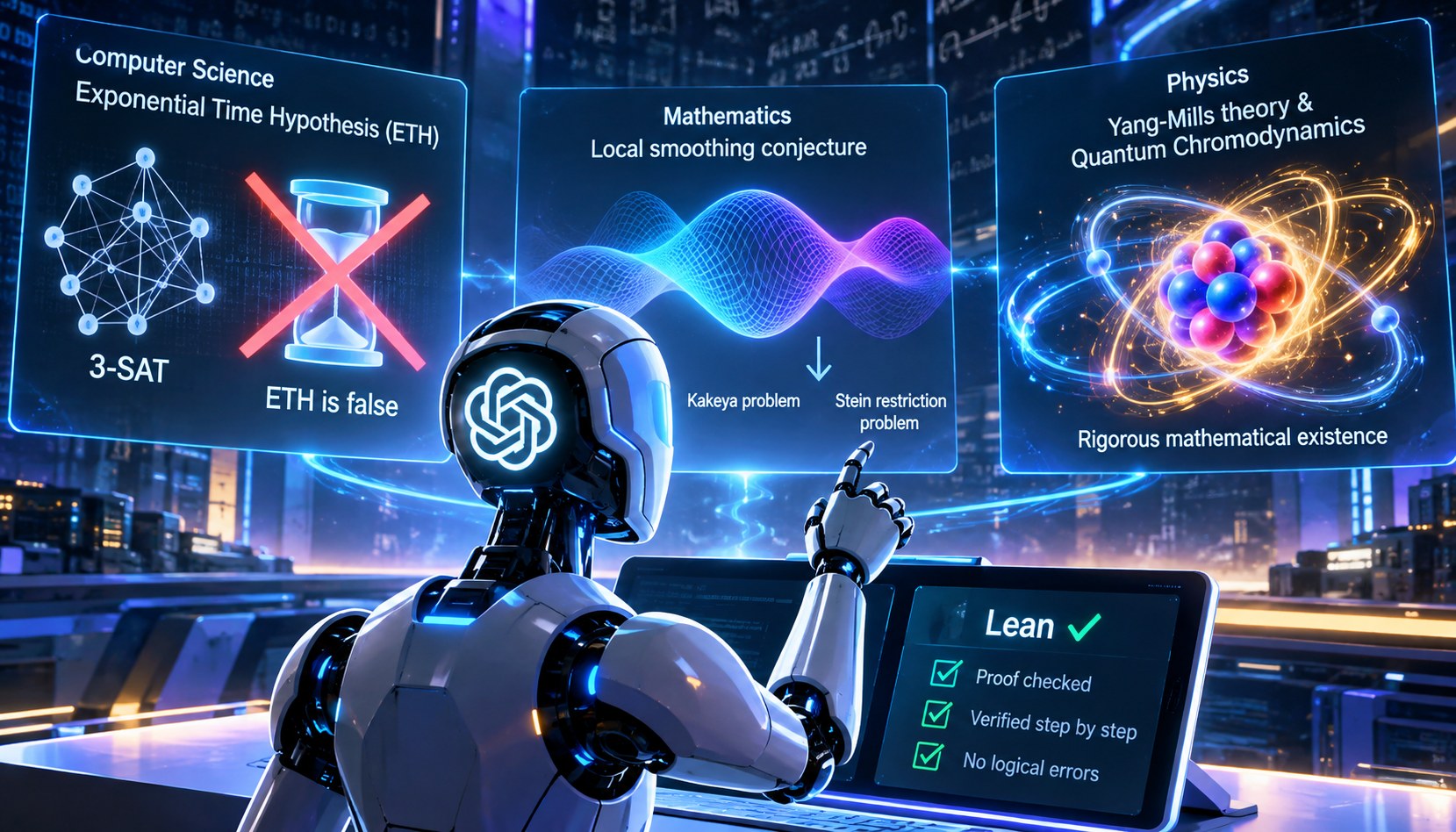
On October 26, OpenAI said in its announcement that its AI models found three big results.
ETH Disproof
First, it says the models proved that a famous idea in computer science is false. The idea is called the Exponential Time Hypothesis, or ETH. It says a type of puzzle, called 3-SAT, cannot be solved much faster than by trying every answer. Hundreds of research papers rely on it.
OpenAI says its model found the disproof on October 16. Lean, a program that checks proofs step by step, confirmed it on October 17. OpenAI’s preprint is public on GitHub.
Local Smoothing and Kakeya
Second, it says the models solved the local smoothing conjecture, a math problem about waves. That would also settle the Kakeya and Stein restriction problems. The Next Web reports that OpenAI has posted the write-up and Lean files, and its Lean notes on GitHub cover Kakeya sets.
Yang-Mills Claim
Third, it says the models showed that two physics theories exist in a mathematically solid way. They are Yang-Mills theory and quantum chromodynamics, which describe the strong force. For now, OpenAI’s announcement is the only source. The material is not public.
Four Levels of Checking
A result can be checked at four levels: by a machine, by making it public, by outside experts, and by peer review.
The ETH and math results have passed the first two levels. OpenAI says Lean checked each one within a day. Neither has passed the third level yet.
The physics result has passed only the first level, and only on OpenAI’s word. OpenAI says Lean checked the Yang-Mills part on October 16. A group led by Nobel Prize winner David Gross will write it up itself.
For ETH, the checkers are Russell Impagliazzo and Ramamohan Paturi, who first proposed ETH, and Ryan Williams. Their open letter says this is not an approval. They are unpaid and signed no secrecy agreements. None of the three results has finished peer review.
What Lean Does Not Prove
Lean checks that each step of a proof is correct. It cannot check that the problem was written down correctly, so a perfect proof can still answer the wrong question. Popular AI reports that the ETH files cover only a narrower case. Experts must also confirm that the problem in Lean really is ETH.
The physics claim needs care too. The famous Yang-Mills prize problem needs two things: that the theory exists, and a property called the mass gap, according to the Clay Mathematics Institute. Popular AI notes that OpenAI has not claimed the full problem.
Why It Matters
If ETH is false, many results that say “this problem is hard” will need new foundations. On October 27, Anthropic published its own Claude-made ETH disproof on GitHub. Public announcements do not equal verified results. Each one still needs checking.