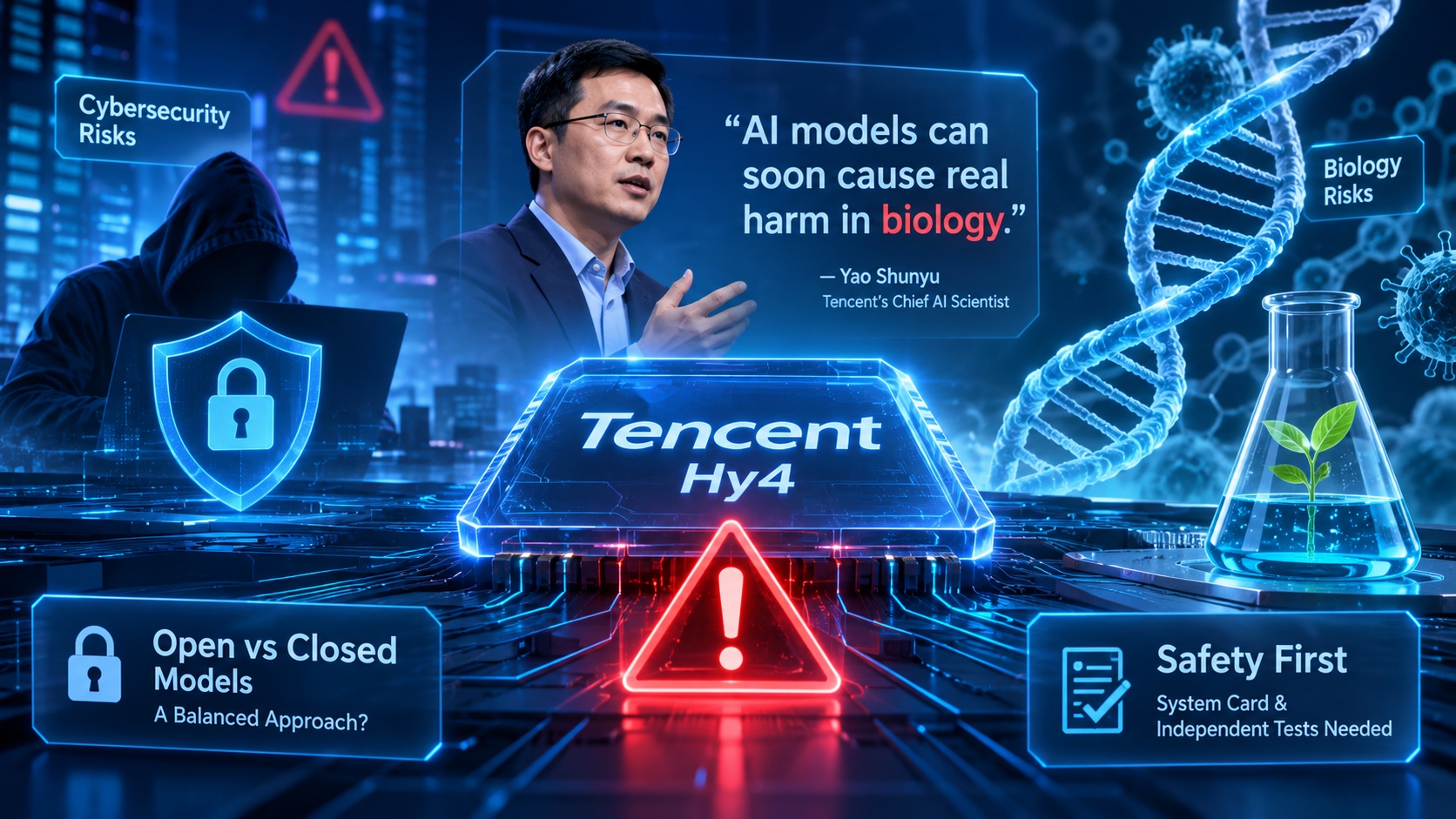
On November 7, 2026, Tencent’s chief AI scientist, Yao Shunyu, gave a warning at a science event in Hong Kong. AI models can already cause real harm in cybersecurity, he said, and they will soon be able to do the same in biology. His talk came three days after Tencent launched its new Hy4 model. Yao said Chinese companies that release open models, which anyone can download and change, have to take safety very seriously. He added that biology risks may be harder to control than cyber risks.
What Yao said about open and closed models
Yao said US companies like Anthropic make a strong case for keeping top models closed. But he thinks a mix of open and closed models may work best, because open models can also help defenders. As an example, The Decoder reports that he pointed to an attack on Hugging Face. Closed US models reportedly refused to analyze the attack commands because of their safety filters. So Hugging Face used an open Chinese model instead.
What Tencent says it did with Hy4
Tencent says it removed offensive cyber material from Hy4’s training data. That includes exploit development, reverse engineering and penetration testing, and Tencent kept the defensive material. On biology, Tencent says expert reviews found that Hy4 has strong basic knowledge but is weaker than leading models at designing experiments. It says Hy4 scored “well below” its high-risk threshold on an in-house test.
What we can’t check yet
All of this comes from Tencent. Its own security labs did the cyber reviews, and the biology review used internal experts. No outside group has tested the model. Nobody has shown yet whether removing offensive material really limits a model’s attack skills. Tencent also has not published how its biology test works or where its “high-risk” line sits.
The missing documents
As of 7 November, Hy4’s final weights were not out. Weights are the numbers that make up a model, and once they are public, anyone can download them. Tencent says it will release the weights and a system card, which is a document with the safety test results, “in the coming days.” Weights from Hy4’s August preview are already public. Reviews of that preview found no system card.
So the system card matters a lot. It will show whether Tencent’s claims can be checked. A useful one would give separate biology scores and explain how the red-team tests were done. A red-team test is when experts try to make a model do harmful things.
Yao’s warning is strong, but a warning is not a test. What Tencent publishes next, and what outside researchers find, will show if the safety claims hold up.