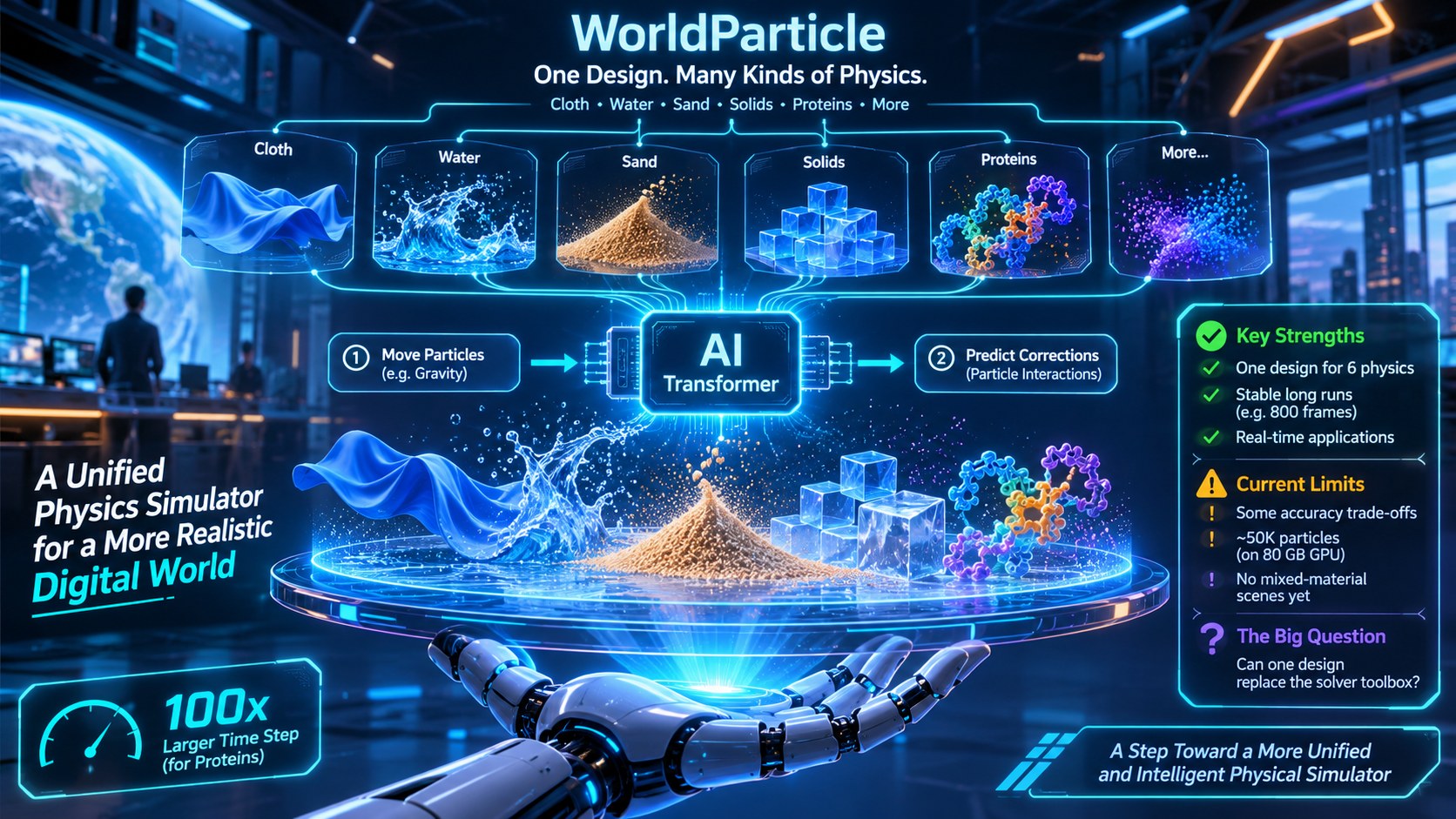
Simulating the real world usually takes a whole toolbox. Cloth, water, sand and molecules each need their own solver, which is a program built for one kind of physics. A paper called WorldParticle tries to use one design for all of them. It comes from researchers at the University of British Columbia, MIT and other schools. It went online as a preprint in May 2026 (arXiv:2605.15305), which means it was shared before peer review. It got fresh attention in November 2026 after a news write-up. This article looks at what the paper shows and what it doesn’t.
One design, six kinds of physics
WorldParticle treats every material as a cloud of tiny particles. At each step, it first moves the particles using known outside forces, like gravity. Then a transformer, the same kind of AI model behind chatbots, predicts the corrections caused by particles pushing on each other. Peter Yichen Chen compares it to ChatGPT, except it predicts how particles move instead of the next word.
The same design handles cloth, elastic solids, thick and thin fluids, sand and proteins. But the team trained a separate network for each of the six types. So it is one design, not one model.
What the “100x” number means
You may see a “100x speedup” for proteins. The paper says something narrower. WorldParticle jumps forward 50 femtoseconds at a time, while classic protein simulations use 0.5 femtosecond steps. That is a step 100 times bigger. A femtosecond is a millionth of a billionth of a second. The paper reports its own speed, but I found no timing comparison with the classic simulator, OpenMM. It also tested only two proteins, in a vacuum, for 100 frames each. Bigger steps are useful, but they are not the same as running 100 times faster.
Does it stay stable?
Neural simulators often drift as small errors pile up. In a fluid test, WorldParticle kept an 800-frame run stable on a scene it had not seen before. In a cloth-twisting test, it was trained on 200 frames and stayed stable for 250 frames, with forces it had not seen. The authors say it beats other neural simulators, like GNS and DeepLagrangian, on accuracy and long-run stability.
What it can’t do yet
The authors admit that one design costs some accuracy compared with specialized solvers like FEM and SPH. Those solvers also made the training data, so WorldParticle learns from them, not instead of them.
Memory is another limit. The model handles about 50,000 particles on one 80 GB A100 GPU. The paper also does not show different materials interacting in one scene, like a robot gripper in sand. That is only an idea.
What it is used for
The paper shows three uses. One is pushing a soft object with a user’s force in real time. Another is finding the friction value that makes a sliding duck stop at a target. The third is predicting the motion of real rope, cloth and a toy from 3D point data, and the predictions match the real motion only by eye. It does not test robot training.
I also could not confirm that the authors released their code and model weights. The one GitHub repo I found is by a third party. So outsiders can’t easily check the claims yet.
WorldParticle is a strong sign that one design can learn many kinds of physics. Whether it can replace the solver toolbox is a question the paper leaves open.