Inpatient hospital medical coding has long remained one of the most stubborn manual bottlenecks in healthcare finance. On October 2, 2026, revenue-cycle software provider AKASA announced an autonomous platform for inpatient medical coding and clinical documentation integrity. The company claims the system works encounters from start to finish without human intervention. Cleveland Clinic and Nebraska Methodist Health System are named launch customers.
The move marks an aggressive operational transition. Instead of acting as an assistive copilot that highlights suggested billing codes for human review, the software operates as an autonomous mid-cycle billing layer.
How AKASA’s Autonomous System Works
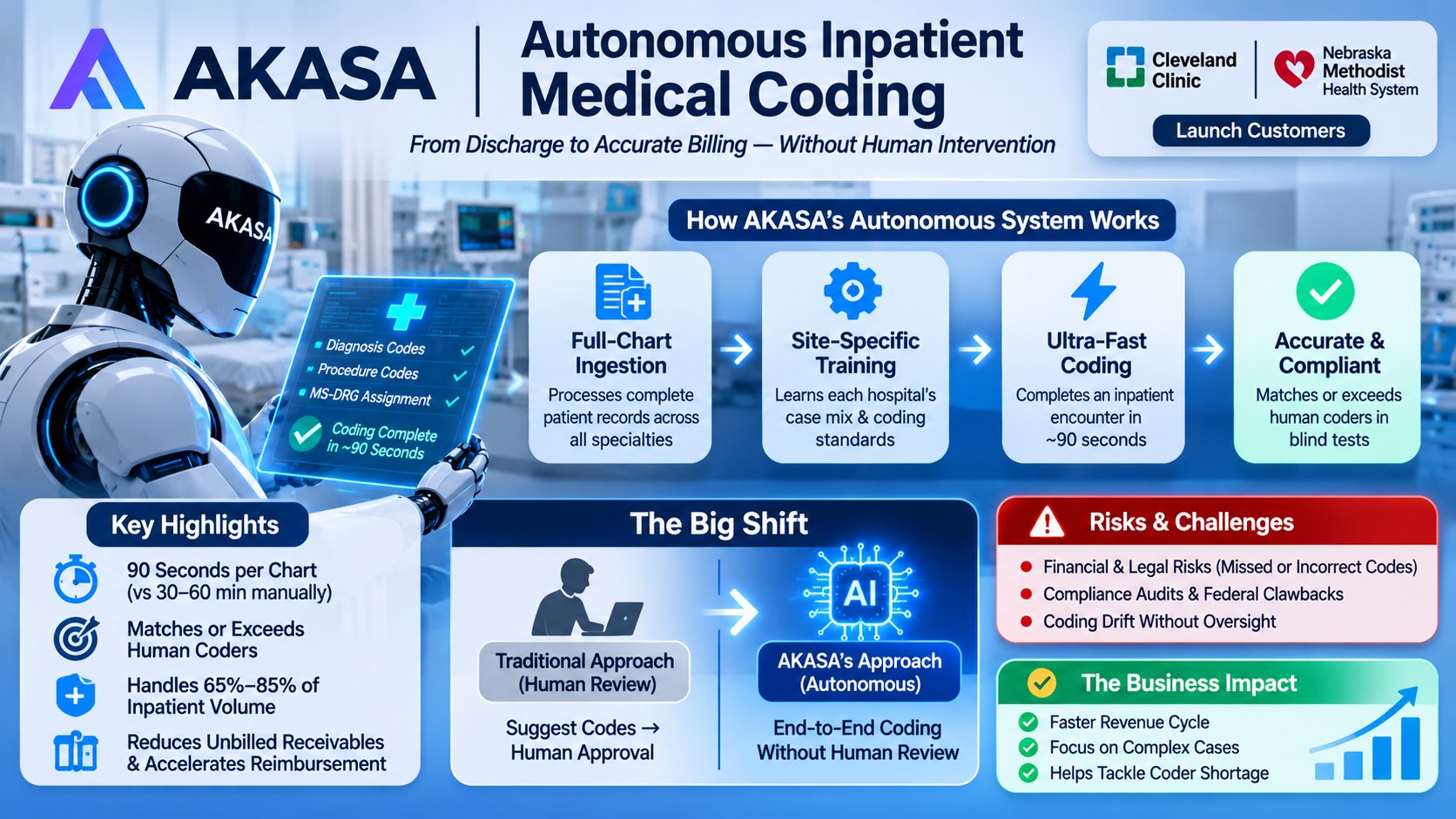
Inpatient charts often span hundreds of pages across intensive care notes, surgical reports, lab panels, imaging files, and discharge summaries. AKASA’s engine ingests the complete patient record to assign diagnostic and procedure codes directly.
The platform relies on custom models fine-tuned to each hospital network:
-
Site-Specific Training: AKASA adapts its models to each individual health system’s historical case mix, documentation patterns, and local coding standards.
-
Full-Chart Ingestion: Rather than skimming isolated summaries, the engine parses unstructured narrative records across multiple medical specialties.
-
Speed and Processing: AKASA states that the system finishes coding an inpatient encounter in roughly 90 seconds after discharge. By comparison, manual medical coding typically requires 30 to 60 minutes per chart.
In blinded evaluations, AKASA reported that its autonomous system matched or exceeded human coders across measures such as principal diagnosis and MS-DRG assignment. The tests evaluated cases covering 65% to 85% of total inpatient volume at partner health systems.
Industry Conflict and the Shift Away From Human Review
AKASA’s decision to remove human review directly challenges prevailing industry consensus. Most hospital billing artificial intelligence platforms maintain a strict human-in-the-loop posture. Assistive systems suggest billing codes, but a certified medical coder signs off on the final submission.
Bypassing human validation carries serious financial and legal risks. If an automated model misses a valid secondary diagnosis, the hospital understates illness severity and loses legitimate reimbursement. Conversely, if an autonomous model assigns an unsupported billing code, it exposes the hospital to compliance audits, federal clawbacks, and billing fraud allegations. Errors compound quickly in high-volume hospital environments.
AKASA contends that severe staffing shortages make full autonomy an operational necessity. Coders remain difficult to hire, and unbilled discharges can sit in backlogs for days.
Production Economics and Operational Reality
Compressing chart turnaround to 90 seconds allows hospitals to reduce unbilled receivables and accelerate reimbursement cycles. Instead of managing routine cases, experienced coding staff can focus exclusively on anomalous outliers and disputed claims.
Yet significant production hurdles remain. Enterprise revenue managers must verify how these models perform when clinical documentation is incomplete or contradictory. Without ongoing oversight, subtle shifts in physician note-taking can introduce systematic coding drift.
Handing complex inpatient billing directly to autonomous software represents a major shift in healthcare technology. Whether health systems adopt end-to-end autonomy will depend on whether automated billing codes can withstand regulatory audits without continuous human verification.