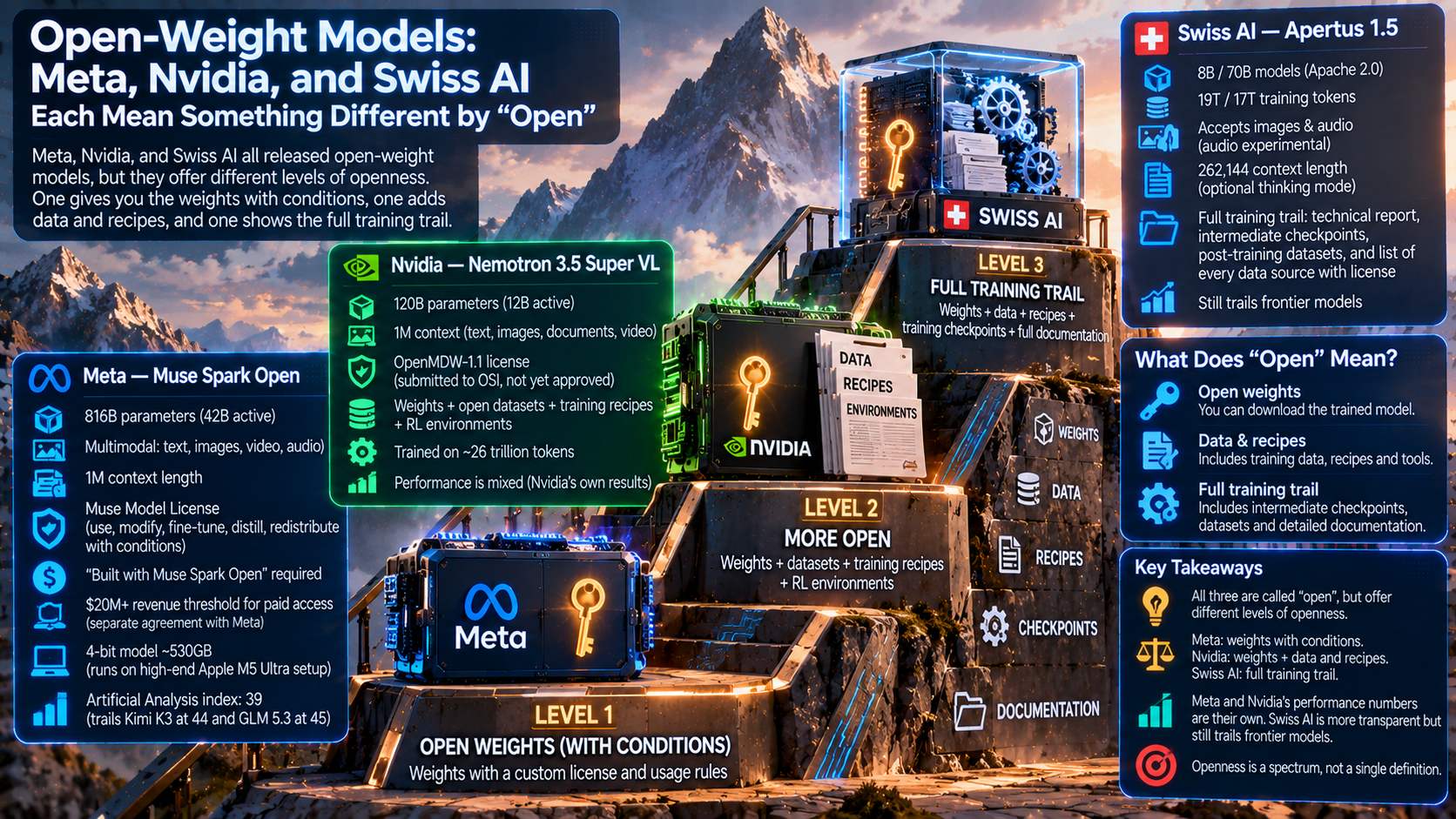
On October 15, 2026, Meta and Nvidia released new open-weight models, and Swiss AI published the full report and training checkpoints for Apertus 1.5. All three are called open. They are not the same thing. Open-weight models let you download the trained model. Beyond that, the three differ in the license, the training data, and the recipes. According to Swiss AI's release notes on Hugging Face, Apertus 1.5's weights came out earlier, on July 24, so October 15 was its documentation day.
Rung One: Meta’s Muse Spark Open
Muse Spark Open has 816 billion parameters, with 42 billion active for each token. It reads text, images, video, and audio, and handles a one-million-token context. Meta calls it the open-weights version of Muse Spark and the most capable US open-weight model to date. Meta's October 15 developer blog says the 4-bit NVFP4 version can run on two Apple Mac Studios with M5 Ultra chips and 512GB each, or on four with 256GB each, using Apple's MLX software. That version is about 530GB, so "desktop" means a very high-end desktop.
The Muse Model License lets you use, modify, fine-tune, distill, and redistribute the model, with conditions. You must display “Built with Muse Spark Open.” Any model trained on its outputs counts as a derivative. If you sell access to models and your group’s revenue passes $20 million in a year, you need a separate agreement with Meta. A usage policy bans some uses. Meta describes its training data only in general terms.
Meta's benchmark results are its own, and one report notes they have not been checked independently. Meta's model card lists a score of 39 for Spark Open on the Artificial Analysis Intelligence Index. Artificial Analysis's own pages put Kimi K3 at 44 and GLM-5.3 at 45. No Artificial Analysis page for Spark Open was found, so the 39 is as reported by Meta. That makes "most capable US model" a narrower claim than it sounds.
On August 10, Meta released Muse Glimmer, a 30-billion-parameter model, and promised an open version of Muse Spark 1.2 “soon.” Meta’s pages for Spark Open do not say which version it matches.
Rung Two: Nvidia’s Nemotron 3.5 Super VL
Super VL has 120 billion parameters, with 12 billion active. It mixes Mamba, mixture-of-experts, and attention layers, and handles one million tokens of text, images, documents, and video. Nvidia ships the weights, open datasets, training recipes, and reinforcement learning environments. It trained on about 26 trillion tokens.
The license is OpenMDW-1.1, written by the Linux Foundation to cover models, data, code, and documents under one permissive grant. It has been submitted to the Open Source Initiative, which has not yet approved it. A smaller Bolt 74B-A9B model is out too, and Bolt E4B is due October 23.
The performance numbers are Nvidia’s. It says Super VL is up to five times faster than comparable open models, and its chart marks the gap against one rival, Inkling Small. Its scores are mixed. It posts 89.9 on GPQA Diamond but 17.78 on a banking agent test, and it trails Alibaba’s Qwen3.5-122B on some coding and instruction tests. Nvidia also says customers post-trained Super VL for narrow jobs, such as credit analysis. Those results describe the customized models, not the released checkpoint. Nvidia sells the hardware the model is tuned for.
Rung Three: Swiss AI’s Apertus 1.5
Apertus 1.5 comes in 8B and 70B sizes under Apache 2.0. The 8B model was trained on 4 trillion more tokens, for 19 trillion in total, and the 70B on 2 trillion more, for 17 trillion. It accepts images and audio, though audio is experimental, and it answers in text. It has an optional thinking mode and a 262,144-token context.
What sets it apart is the trail. On October 15, Swiss AI published release notes that point to a technical report posted to arXiv on October 11. It also published intermediate checkpoints for the base model and the supervised, reinforcement-learning, and preference-tuned stages, plus the post-training datasets and a list of every data source with its license. Researchers can see how each stage changed the model.
The cost is capability. Swiss AI says Apertus 1.5 still trails frontier open-weight models. Its model cards also ask users to accept an acceptable-use policy. Swiss AI’s roadmap for Apertus 2.0 is a sparse model of about 600 billion parameters.
What “Open” Does and Does Not Tell You
A TechTarget survey reports that RedMonk’s Stephen O’Grady reviewed 68 models in May 2026 and found none of the 40 non-closed ones qualified as Open Source AI. In practice, open mostly means you can download the weights. Choose by what you need. To run a model locally, any of the three works. To audit how it was built, Apertus offers the most. To avoid license conditions, Meta’s terms deserve a careful read.
In the near term, expect independent tests of Spark Open and Super VL. The long-term picture is speculation. If standards like OpenMDW win approval, “open” may get a clearer legal meaning.


