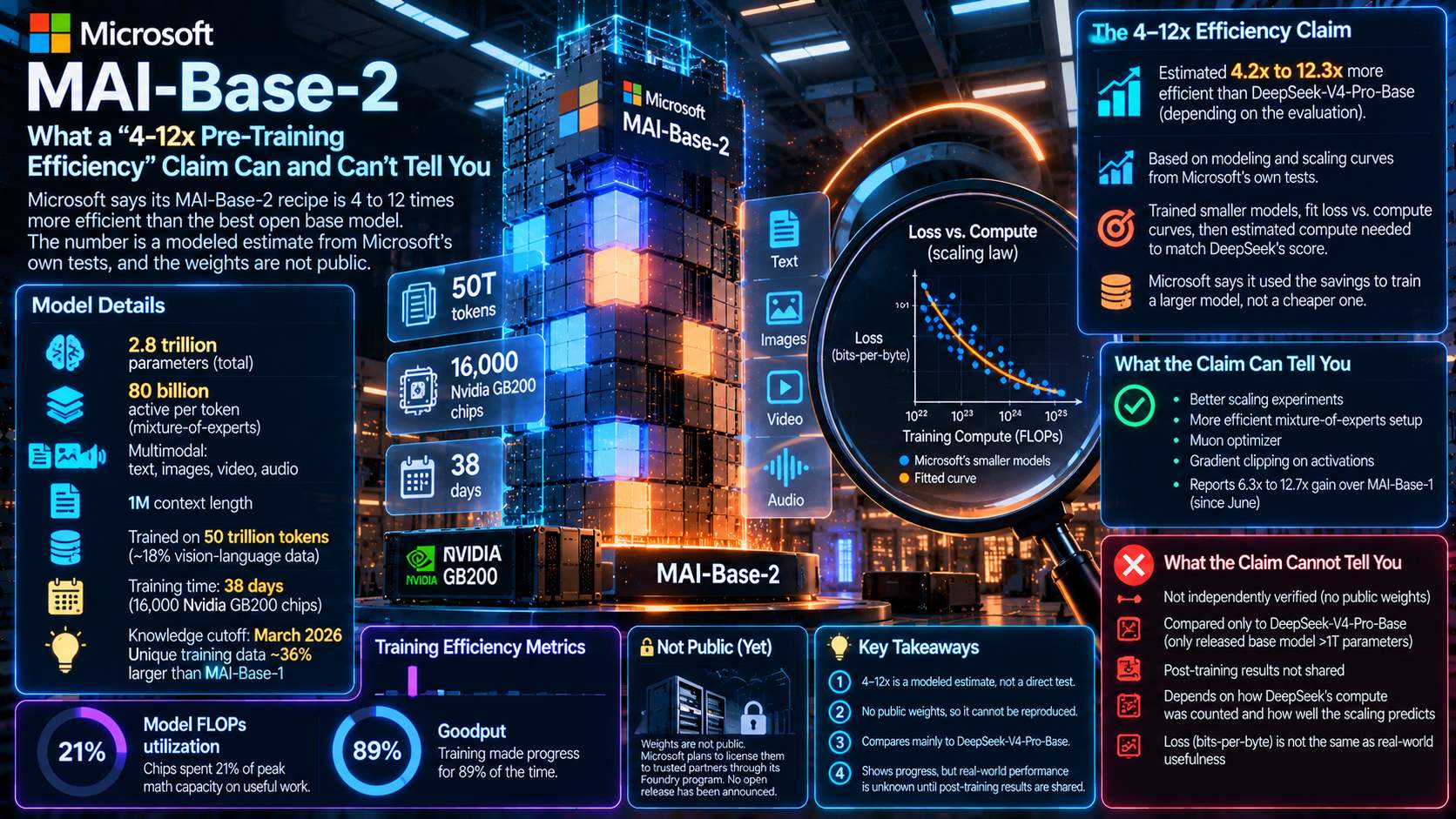
Microsoft’s AI lab says it has finished pre-training MAI-Base-2, a very large model, and that its training recipe is 4 to 12 times more efficient than the strongest open alternative. Microsoft published a detailed technical note on October 15. The efficiency claim is also a headline number that nobody outside Microsoft can reproduce, because the weights are not public. This article explains how the number was built, and what it can and cannot tell you.
What Microsoft Disclosed
MAI-Base-2 is a mixture-of-experts model with 2.8 trillion parameters in total and 80 billion active for each token. Microsoft says it trained the model on 16,000 Nvidia GB200 chips over 38 days in August and September, on a mixture of 50 trillion tokens. About 18% of that mixture was vision-language data, so the model learned to read images from the start. Its unique training data grew about 36% from MAI-Base-1, and its knowledge cutoff is March 2026.
Microsoft also gave efficiency figures for the run. Average model FLOPs utilization was 21%, meaning the chips spent that share of their peak math capacity on useful work. Goodput was 89%, meaning training made progress for that share of the time. Microsoft says all data was organic, with no distillation from other models. That is a company statement that outsiders cannot audit.
This is a base model, which is the model before it is tuned to chat or reason. It is still in post-training. Microsoft plans to license the weights to trusted partners through its Foundry program. No open release has been announced.
How the 4-12x Number Was Built
Pre-training FLOPs are the total computing a model uses to learn. Comparing two finished models is unfair, because they differ in size and compute. So Microsoft used a modeling approach instead.
It trained a ladder of smaller models with a fixed recipe. For each of four held-out evaluations, it fit a curve of loss against training compute. Loss here is bits-per-byte, which measures how well a model predicts held-out text regardless of its tokenizer, and lower is better. It then estimated how much compute its recipe would need to match DeepSeek-V4-Pro-Base’s score, and compared that with DeepSeek’s training compute. The answer ranged from 4.2 to 12.3 times, depending on the evaluation. Microsoft says it put that saving into training a larger model, so MAI-Base-2 is bigger, not cheaper.
Microsoft says MAI-Base-2’s own result was included in the fits, so the matching point falls inside the range it measured, not beyond it. Put simply, this is not a test where Microsoft trained the same model with one quarter of the compute. It is an estimate from curve fitting on Microsoft’s own tests.
What the Claim Can and Cannot Tell You
It can tell you that Microsoft credits specific changes: better scaling experiments, a more efficient mixture-of-experts setup, the Muon optimizer and a technique that clips gradients on activations. Microsoft also reports a 6.3 to 12.7 times efficiency gain over MAI-Base-1 since June. These are the company’s own figures.
It cannot tell you several things.
First, it is not independently checked. There are no public weights, and the tests are Microsoft’s. For code, it used its own codebase. Science, math and question-answering tests were commissioned from outside vendors to reduce contamination, and Microsoft says it removed overlaps with its training data. That reduces one risk, but it is not outside replication.
Second, the efficiency comparison rests on one reference. DeepSeek-V4-Pro-Base is the only released base model above one trillion parameters. Microsoft also compared three other open models, Kimi K3, Qwen3.8 and MiMo-V2.6-Pro, but only post-trained versions exist, and Microsoft warns that post-training may affect those results.
Third, the post does not say how DeepSeek’s training compute was counted, and the estimate depends on how well Microsoft’s own scaling ladder predicts results. Fourth, loss on held-out text is not the same as being useful. Post-training results have not been shared.
What Comes Next
In the near term, watch for post-training results, any independent benchmark runs once partners get access, and details of the Foundry licensing. Microsoft says preparations for MAI-Base-3 are already underway. The long-term question is whether such efficiency gains hold at larger scales. That is a forecast, not a finding. For now, the claim is best read as a promising, detailed, but unverified estimate.


