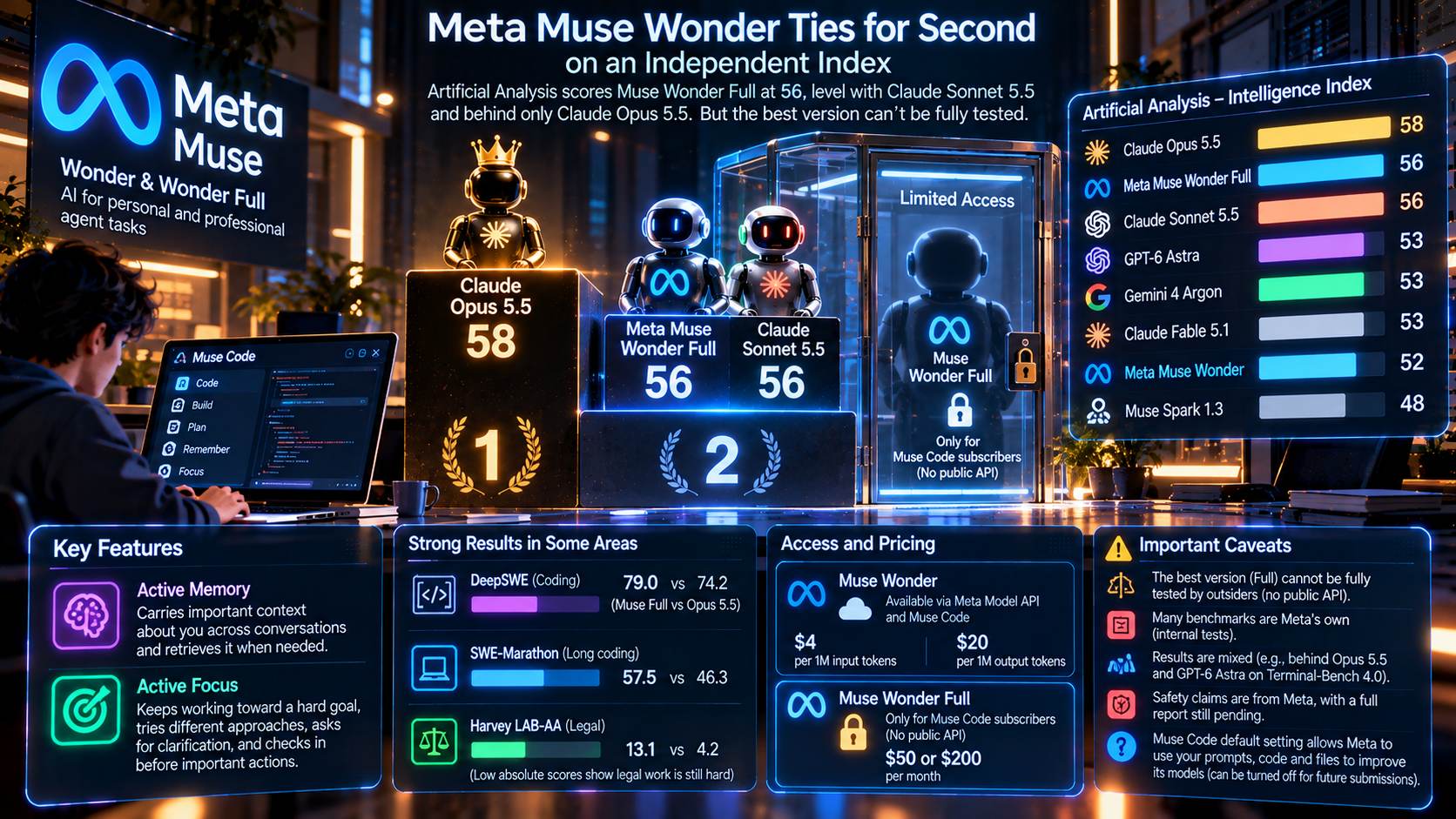
On October 12, 2026, Meta released two AI models, Muse Wonder and Muse Wonder Full. Meta says they lead on personal and professional agent tasks. Artificial Analysis, an independent testing firm, scored Full at 56 and Wonder at 52 on its Intelligence Index. That ties Full with Claude Sonnet 5.5 and puts it behind only Claude Opus 5.5 at 58. It is a real result. But the best version is hard for outsiders to test, and many of Meta’s claims rest on its own benchmarks.
What Meta Announced
Both models come from Meta Superintelligence Labs, led by Alexandr Wang. Meta says it trained them at Prometheus, its gigawatt-scale data center. They take text, images, audio, and video, produce text, and handle about one million tokens of context. The weights are not public.
Meta’s two headline features are Active Memory and Active Focus. Active Memory carries important context about you across conversations and pulls it back when a task needs it. Active Focus keeps the model working toward a hard goal. It tries other approaches, works through blockers, asks for clarification, and checks in before important actions.
Wonder is available through the Meta Model API and in Muse Code, Meta’s coding assistant. The API price is $4 per million input tokens and $20 per million output tokens. Full is only for Muse Code subscribers, at $50 or $200 a month.
What Outside Tests Show
Artificial Analysis gives Opus 5.5 a 58 and Sonnet 5.5 a 56. GPT-6 Astra, Gemini 4 Argon, and Claude Fable 5.1 each score 53. Meta’s earlier Muse Spark 1.3 scored 48, according to coverage of the firm’s results.
Several third-party results favor Full. On DeepSWE, run by Datacurve, it scores 79.0 against 74.2 for Opus 5.5. On SWE-Marathon, a long-coding test run by Abundant AI, it scores 57.5 against 46.3. On Harvey LAB-AA, a legal test run by Artificial Analysis, it scores 13.1 against 4.2. That low absolute number shows how hard legal work still is for agents.
It does not win everywhere. Opus 5.5 and GPT-6 Astra both beat it on Terminal-Bench 4.0, and Opus 5.5 leads on HealthBench Pro. Full also wrote 140 million tokens during the index, against a median of 88 million. And the standard Wonder costs $4.52 per index task, per Artificial Analysis. That is below Opus 5.5 at $5.98 but above GPT-6 Astra at $3.26, even though Wonder’s per-token price matches Opus’s.
What Rests on Meta’s Own Word
Meta says Wonder reaches state-of-the-art results on agents, memory, and coding. But several of its benchmarks are internal: FocusBench, MemoryBench, and its Personal Superintelligence Index. Outsiders cannot run them. I found no independent test of Active Memory.
Meta’s model card also explains how it picks scores. Where a third-party result exists, it uses it. Otherwise it uses the highest of its own run, a self-reported score, or an official leaderboard score. It calls its runs of rival models best-effort. On SWE-Marathon, rivals used their own coding tools while Full ran at extra-high effort, so the row is not a controlled comparison. Meta also compared against only three rivals, not Sonnet 5.5 or Gemini 4 Argon.
Safety claims are Meta’s too. It calls Wonder its most aligned model, and says a full safety report is coming soon. Its model card says that, without safeguards, it cannot rule out the model reaching Meta’s high-risk level in chemical and biological areas. Meta says it applied safeguards.
The Access Catch
Artificial Analysis’s page for Full says there is no public API. It can show an intelligence score, but speed and cost per task are listed as unavailable. The firm does not say how it got access to run the tests. The same page ranks Full fourth among 689 entries, which suggests ties and variants sit above it. That is my inference. Most coverage calls it joint second among the main flagship models.
There is a privacy catch too. VentureBeat reports that Muse Code subscriptions default to a mode that lets Meta use prompts, code, and files to improve its models. Users can switch it off, but only for future submissions. The pay-as-you-go API does not train on submitted content. So the most capable model comes with the less private default.
What Could Come Next
In the near term, watch for two things. One is Meta’s promised safety report. The other is any API for Full, which would let Artificial Analysis and others measure its speed and cost. VentureBeat says Meta has not announced a price for one.
The long-term picture is speculation. If Active Memory proves reliable, users will want clear control over what an AI remembers about them. Whether it does is not yet measured by anyone outside Meta.


