Big companies rely on many software tools to manage daily business operations. A typical recruiting business might use Microsoft Copilot for emails, Anthropic's Claude to write code, and Salesforce databases to store candidate records.
This setup creates a major technical challenge for corporate IT leaders. When an automated AI assistant tries to access candidate profiles, update resume data, or launch background checks, how does the system ensure the AI processes data securely without breaking access permissions?
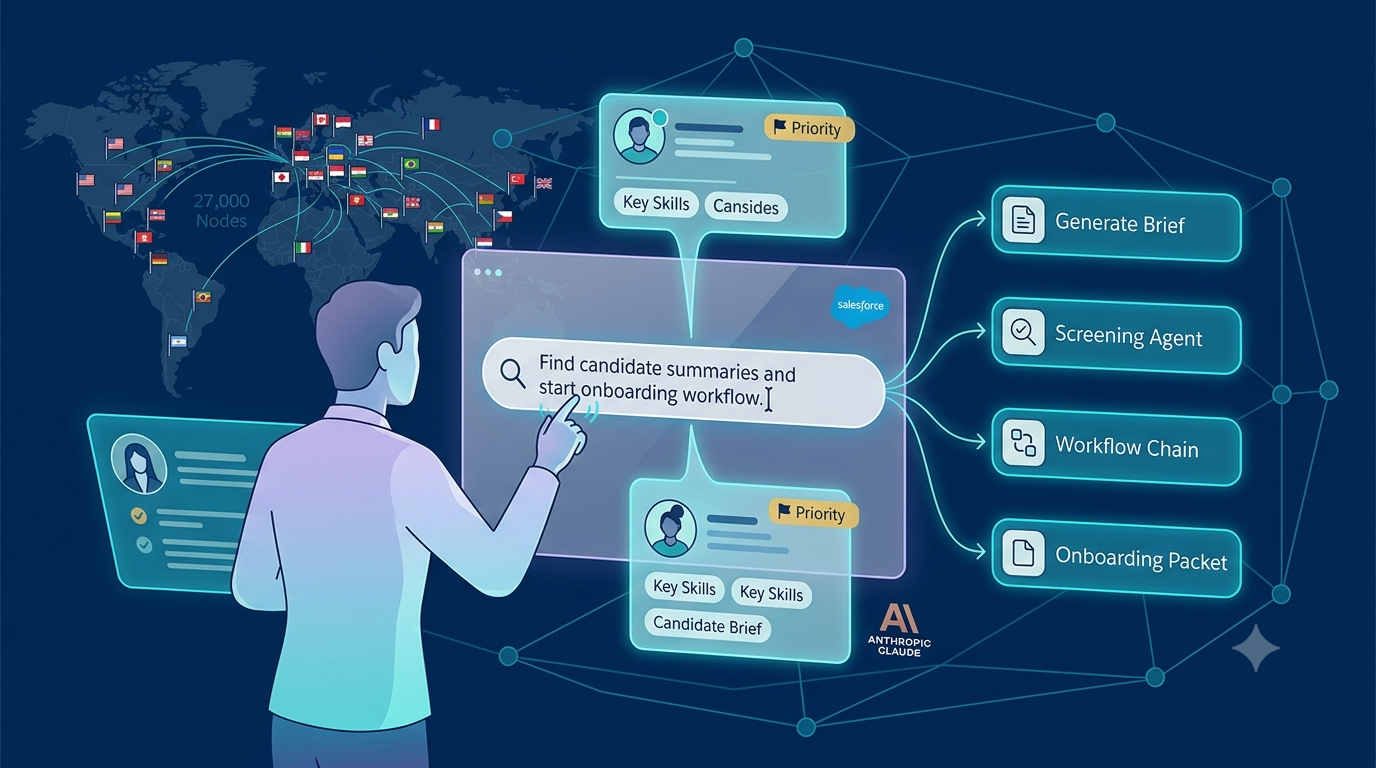
To solve this challenge, global staffing enterprise Adecco Group announced a massive deployment of Salesforce Agentforce Coworker across more than 40 countries. The rollout connects 27,000 recruiters and sales staff to an internal AI teammate integrated directly into their workspace.
How the System Operates
Following initial pilot testing in the United Kingdom and France, the system lets employees query corporate records using natural language directly inside the software search bar.
Underneath the user interface, the tool is powered by Anthropic's Claude reasoning engine to process complex, multi-step tasks. Instead of requiring users to click through multiple software menus, the assistant retrieves client records, generates candidate summaries, and enriches database profiles using live CRM data.
Adecco uses a two-part strategy for enterprise automation. First, candidate-facing agents handle initial pre-screening, send automated messages, and guide new hires through onboarding across ten major global markets. Second, internal tools like Agentforce Coworker help recruiters analyze data and run workflows faster.
Built-in Security Protocols and Access Controls
Enterprise security is a core requirement when deploying workplace AI tools across thousands of corporate users. Rather than operating with unrestricted database privileges, the software enforces corporate security policies.
The AI assistant is designed to inherit each employee's exact user access profile. When a recruiter inputs a prompt, the system verifies access rights before returning data. If a recruiter lacks authorization to view sensitive client billing details or executive salaries, the platform prevents that information from appearing in the output.
Because the system connects directly to enterprise software workflows, recruiters can launch complex task sequences—such as executing candidate pre-screening routines or generating onboarding packets—without leaving their main dashboard screen.
Real Operational Challenges to Remember
While large enterprise software deployments demonstrate fast adoption, companies face clear practical constraints when rolling out workplace AI.
First, reasoning models depend heavily on data quality. If recruiters input incomplete phone numbers, missing work histories, or unstructured notes into the CRM, the system ingests flawed data and generates inaccurate candidate summaries.
Second, tracking real return on investment requires verified performance metrics. While Adecco reported fast initial user adoption across international offices, long-term success depends on measuring actual time saved per candidate placement, overall software licensing costs, and recruiter placement volume.
Software platforms make it easier to automate routine office tasks, but human recruiters must still verify candidate details, build real relationships, and make final hiring decisions.