For decades, assistive educational technology was fundamentally rigid, brittle, and prosthetic
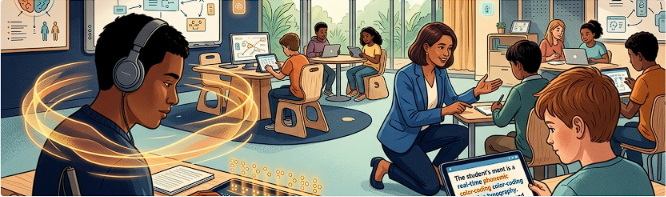
Modern multimodal models move beyond rigid mechanical transcription to deliver real-time semantic interpretation. These systems do not just convert text to audio. Instead, they interpret visual spatial hierarchies, translate diagrams into spatial soundscapes, and dynamically adapt syntax to match each learner's unique neuro-perceptual needs.
Dyslexia: Phonemic Decoding and Working Memory
In developmental cognitive neuroscience, as established by Shaywitz (
Modern artificial intelligence systems operationalize the Orton-Gillingham multisensory approach by simultaneously engaging visual, auditory, and kinesthetic-tactile pathways
Cognitive Scaffolding for ADHD and Neurodiversity
Generative artificial intelligence transforms reading and academic execution from an insurmountable barrier into an accessible multi-sensory experience
-
Dynamic Phonemic Color-Coding: Highlighting phoneme clusters, silent letters, and irregular digraphs to reduce visual crowding and phonological decoding latency
-
Decodable Syntactic Restructuring: Rewriting university-level texts into high-concept, low-lexical-friction prose without dumbing down the underlying scientific rigor
-
Executive Function Offloading for ADHD: Decomposing vague, multi-week assignments into structured 15-minute micro-tasks with interactive checklists and dopamine-aligned progress milestones
-
Dyscalculia Visual-Spatial Anchoring: Providing dynamic spatial dot arrays, color-coded magnitude representations, and step-by-step conceptual anchoring for students who struggle with mental number lines
When assistive artificial intelligence removes the extraneous cognitive load of phonemic decoding, neurodivergent students are finally free to deploy their superior spatial, creative, and associative reasoning capabilities
Vision Impairments and Semantic Scene Description
For blind and low-vision learners, visual assets such as charts, scatter plots, molecular geometries, and geometric proofs have historically constituted an insurmountable accessibility wall
Algorithmic Ableism and Hallucination Hazards
Automated accessibility systems carry acute technical hazards
What AI Cannot Do: The Human Core of Special Education
While artificial intelligence can effortlessly transform sensory formats, the emotional, social, and moral architecture of special education remains categorically beyond algorithmic reach
-
Affective Attunement and Sensory Overload: An artificial intelligence cannot perceive tactile defensiveness, sensory dysregulation, or pre-meltdown autonomic agitation in an autistic child, whereas experienced human educators read subtle physical cues to adjust ambient sensory inputs before behavioral crises occur
-
Relational Trust and Shame Dissolution: Neurodivergent learners frequently carry deep emotional trauma from institutional schooling, and overcoming learned helplessness requires unconditional positive regard and relational trust that only human empathy can foster
-
Vygotsky's Social Mediation: As Lev Vygotsky established (Vygotsky, 1978), higher mental functions are socially mediated before they are internalized; a machine provides information, but a human mentor provides emotional scaffolding within the Zone of Proximal Development[cite: 29, 30, 33].
-
IEP Advocacy and Systemic Navigation: Designing and defending an Individualized Education Program requires navigating complex family dynamics, socio-economic factors, and school district politics
Universal Design for Learning frameworks, pioneered by Rose and Meyer (