Greenjoules Raises ₹150 Crore to Turn Farm Waste Into Fuel
What Happened
A company from Pune called Greenjoules just raised ₹150 crore in its Series B round. They make fuel out of farm waste, like the dry stalks and husks that are left after a harvest. Business Standard reported it on 11 November 2026, and DealStreetAsia said it’s nearly $16 million. Two Amazon funds, the Smbhav Venture Fund and the Climate Pledge Fund, led the round.
Who Invested: The Investors
Business Standard says Rainmatter, which is Zerodha’s investment arm, and Singularity’s Strategic Autonomy Fund also joined in. Blue Ashva Capital led the 2021 Series A, and it’s still the biggest shareholder.
Who Invested: The Government Loan
The company also got a ₹100 crore loan from the Technology Development Board, which is part of the Government of India. DealStreetAsia says that makes the total ₹250 crore.
How Farm Waste Becomes Fuel: The Process
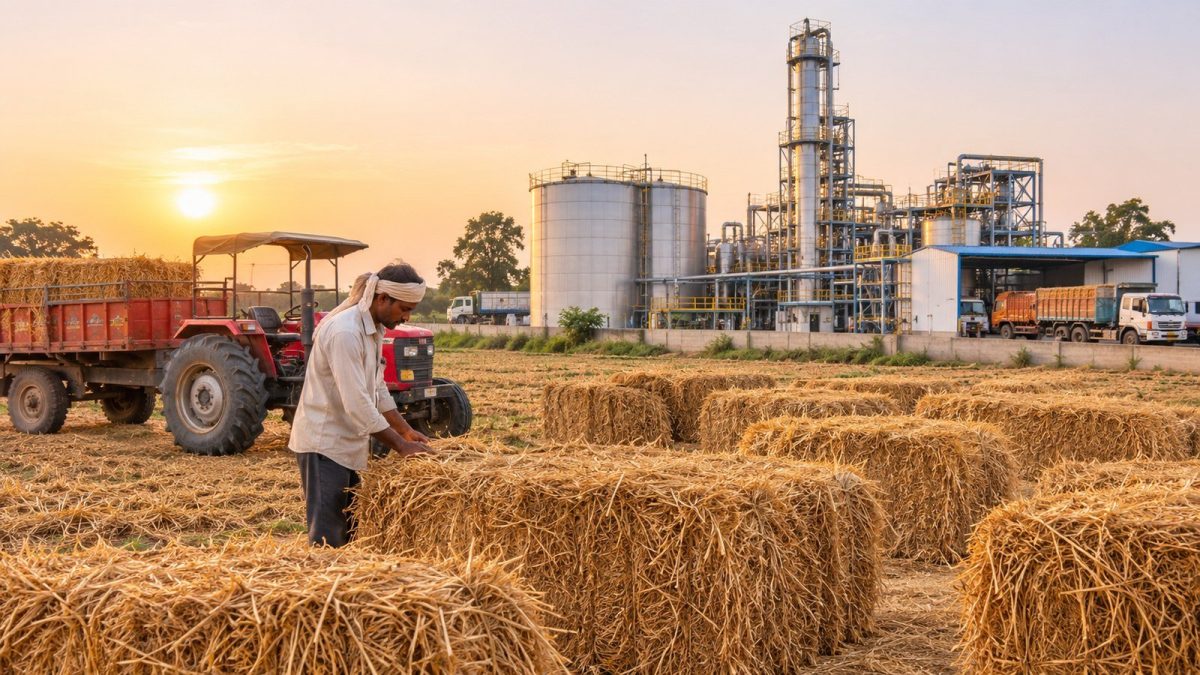
According to Business Standard, the technology changes crop waste into biocrude, and then that gets refined into renewable diesel. Biocrude is a raw oil, a bit like crude oil, which also has to be refined. The Technology Development Board lists the steps as thermal cracking, catalytic upgrading, and refining. In simple words, heat breaks the waste apart, and a catalyst (a helper material) makes the change happen faster.
How Farm Waste Becomes Fuel: What’s Still Unconfirmed
Devdiscourse says the company has made fuel from nearly 40 kinds of plant waste, but I couldn’t find anyone else checking that number. Business Standard also calls it a “drop-in” fuel, so existing vehicles and fuel systems can use it without any changes.
Why It Matters: Oil Imports
India imports about 88 per cent of the crude oil it uses. That number comes from the government’s PPAC, as reported by ThePrint for April to September 2026. Business Standard also says farms make millions of tonnes of crop waste every year. So Greenjoules wants to turn some of that waste into fuel made here in India.
Why It Matters: Farmers and Emissions
Business Standard says that buying crop waste from farmers could give them extra income and help cut down on crop burning. Those are only possible benefits, though, not proven results. Amazon’s Abhinav Singh said that cutting transport emissions needs railways, alternative fuels, and electric vehicles all working together. He connected the investment to Amazon’s net-zero goal for 2040.
The Challenges: The Plant
The new plant isn’t built yet. Business Standard says work will start in phases in 2027. So far, the process has only been developed and tested at the company’s Chakan plant near Pune. Both Business Standard and DealStreetAsia say the new plant is supposed to make 200,000 litres of biocrude a day, but that’s just a goal. I think the hardest part will be going from a working plant to a much bigger one.
The Challenges: The Price
None of the reports I found say how much this fuel will cost compared to regular diesel. That’s a big deal, because buyers care a lot about price.
What Comes Next
Business Standard says the Khed City plant could be the biggest of its kind in India when it’s finished. DealStreetAsia says the company also wants to use its technology for sustainable aviation fuel, green hydrogen, and other materials. Right now, those are only plans and not products anyone can buy.
So Greenjoules has new money and a plant that works. Now it has to prove it can work at a much larger size. Until it does, the biggest claims are still just plans.