Remedy Robotics Raises $62 Million for Remote Stroke Robots
When a stroke blocks a blood vessel in the brain, doctors are racing against time. The best treatment is to remove the clot with a thin tube, but only about 1 in 10 eligible patients gets it. On 16 November 2026, Remedy Robotics announced $62 million to build robots that let a doctor treat strokes from far away. The idea sounds promising, but it’s still unproven.
What did Remedy announce?
Remedy is a startup in San Francisco. The company says DCVC led the $62 million Series B round, and UC Investments, Skip Capital and Hostplus joined. IEEE Spectrum also covered it. It says part of the money came from the University of California system.
CEO David Bell told IEEE Spectrum that University of California hospitals will host the trials within a year. They’ll start with planned surgeries where the doctor is in the room, not remote ones. Remote surgeries, in Australia or inside the University of California system, could come near the end of 2027, Bell said.
How does the N1 robot work?
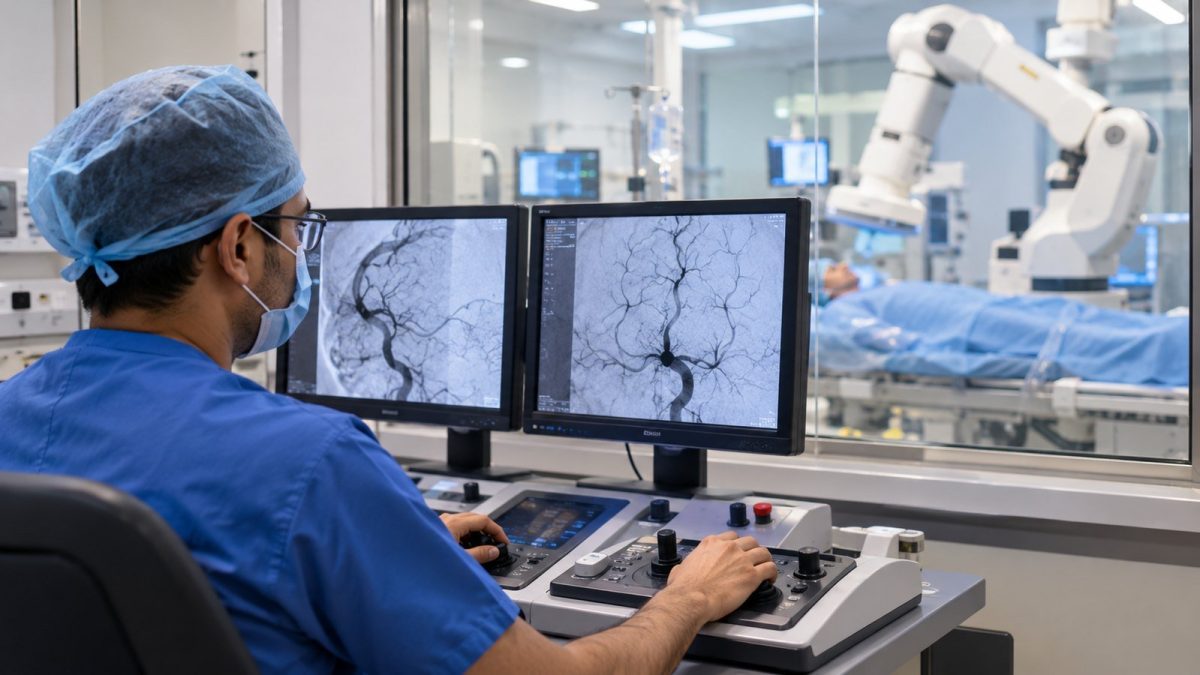
A doctor controls a thin tube called a catheter with a handheld controller. The robot pushes it through blood vessels toward the clot. IEEE Spectrum’s writer tried a practice version on a plastic model, using an Xbox controller.
Software makes a map of the patient’s blood vessels from a CT scan and puts it over the live X-ray. Small marks on the catheter help a computer track how it twists, so the doctor’s moves turn into the right action.
What has really been tested?
In 2025, Remedy tested N1 on 10 patients in Toronto. A neurosurgeon did brain angiograms, which are X-ray pictures of blood vessels. Some patients were in a different hospital across town. Remedy says the procedures finished nearly twice as fast as the usual method. That is only the company’s claim. It wasn’t a clot removal, and only 10 patients took part.
Who else is in the race?
XCath, a Houston company, says it removed a clot from a stroke patient remotely in March 2026. The company says the surgeon was more than 120 miles away, in Panama. India-based SS Innovations says its robot has done more than 150 remote surgeries, including heart procedures.
Brad Nelson, a robotics researcher at ETH Zurich who isn’t linked to Remedy, says emergencies like stroke are a good place to start. If the internet link drops, a blood-vessel procedure can just pause.
What challenges are left?
Internet delay is a big one. Remedy aims for a round-trip delay of no more than 150 milliseconds, which is 0.15 seconds, and its system pauses if the lag goes higher. But Mike Teodorescu, a researcher at the University of Washington, says many rural areas, and even most countries, struggle to meet a 100-millisecond limit.
Remedy also needs approval. IEEE Spectrum notes that no robotics company has won full approval for telesurgery, and no patient has been operated on remotely in the United States.