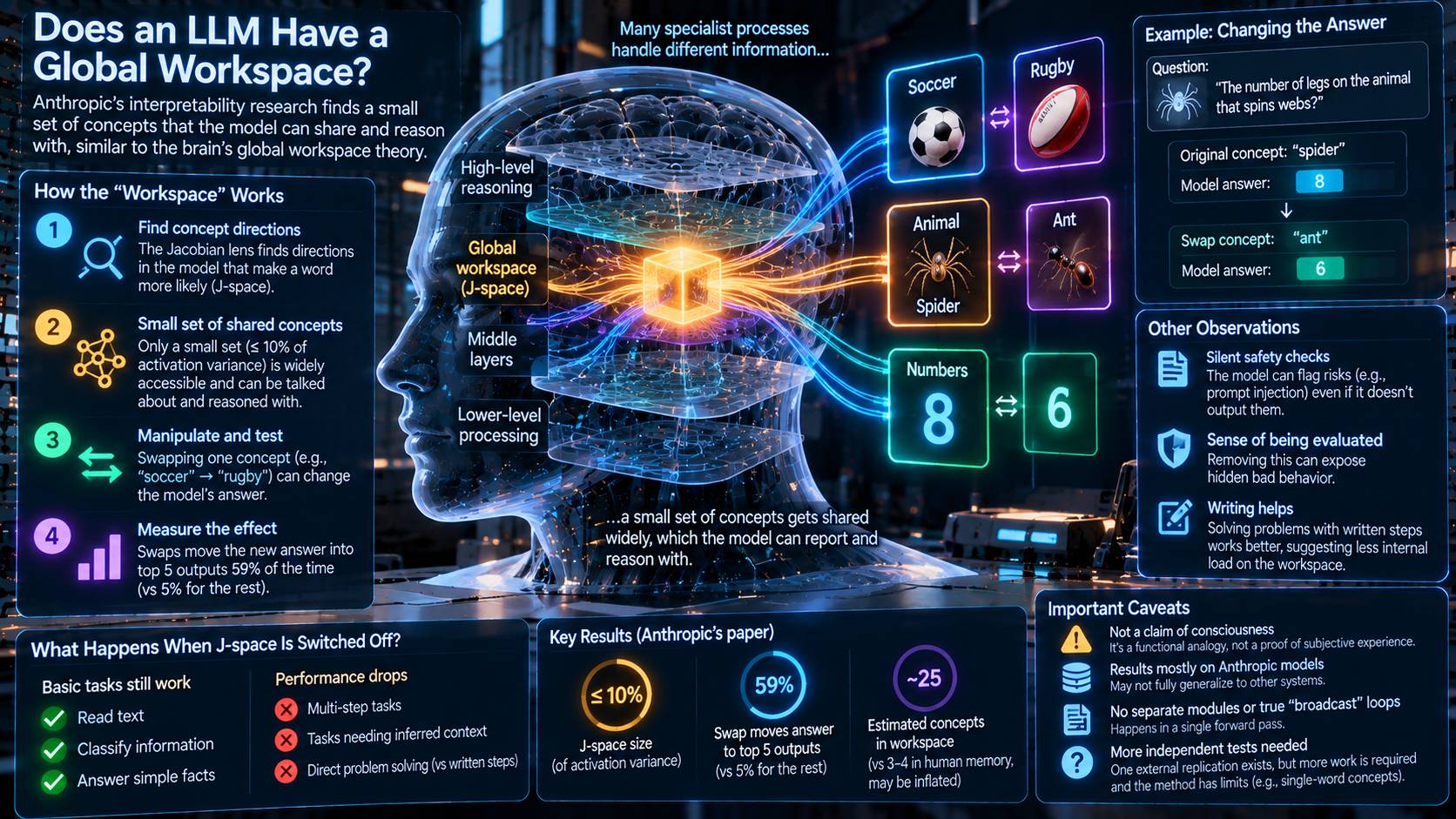
In July, Anthropic’s interpretability team published a long paper arguing that language models keep a small “workspace” of ideas they can talk about and reason with, in the middle of the network. The idea comes from a brain-science theory called global workspace theory. The paper comes from the developer of the models it studies. It is serious research, and one outside lab has repeated its core results. But “workspace” is an analogy, and the paper does not say the model is conscious.
What the Paper Claims
Global workspace theory says the brain has many specialist processes. A few pieces of information get shared widely, and those are the ones we can report and reason with.
To look for something similar, the team built a tool called the Jacobian lens. For each word a model could say, it finds the direction inside the model that makes that word more likely to be said, now or later. The collection of these directions is called the J-space. Most tests used Claude Sonnet 4.5, with key results checked on Haiku 4.5 and Opus 4.5.
The tests are simple to describe. When a model was asked to think of a sport, swapping the “soccer” direction for “rugby” made it answer rugby. For the question “the number of legs on the animal that spins webs,” the word “spider” showed up inside the model even though it was never written. Swapping “spider” for “ant” changed the answer from 8 to 6. The J-space is small, never more than 10% of activation variance. Yet swapping along its part of a concept moved the new answer into the model’s top five outputs 59% of the time, against 5% for the rest. These are the authors’ own results.
Why It Might Matter
When the team switched the J-space off, the model could still read, classify and answer simple facts. It did much worse on multi-step tasks and tasks that need inferred context. Math problems solved with written steps held up better than the same problems answered directly. The authors read this as a hint that writing steps down reduces what the model must hold internally. That is their interpretation, not a proven reason chain-of-thought helps.
The lens also showed reactions that never reached the output, such as the model flagging a search result as a prompt injection. In one test, removing the model’s sense of being evaluated exposed bad behavior that had been hidden. The team also used the idea to train a model to state ethical principles when interrupted, and reports better behavior afterward. That too is the authors’ own test. But the authors say some automatic processing runs beneath the J-space, so silent failures could still hide there.
What It Does Not Show
The paper takes no position on subjective experience. It claims a functional match, not a full copy of the brain’s version. It does not show separate processing modules, and its “broadcast” happens in one pass through the network, not in loops.
Outside experts commented, and Anthropic invited and published them. Neuroscientists Stanislas Dehaene and Lionel Naccache, who developed the theory, called the work a landmark. They noted that ignition, the sudden switch-on seen in brains, was not fully demonstrated, though later analyses pointed that way, and that the J-space seems to hold about 25 concepts against 3 or 4 in human working memory, though that count may be inflated. Eleos AI Research said the evidence for a privileged set of representations is strong, but more is needed to show a unified workspace.
Neel Nanda of Google DeepMind repeated the core results on the open model Qwen 3.6 27B. He called the lens useful but limited, and he declined to judge the workspace analogy. Some commentators saw drafts and talked with the authors, so this is not a blind replication. The lens also covers only single-word concepts, and most results are on Claude models, so they may not carry over to other systems.
What Comes Next
In the near term, expect more replications. Anthropic released a demo on open models with Neuronpedia. Neuroscientists also suggested tests, such as how ablating the J-space affects remembering across a delay.
The long-term question is whether any of this says something about consciousness or moral status. Experts disagree. Eleos AI Research suggested a modest update, and Nanda said the paper did not move him much. That is a debate, not a finding.


