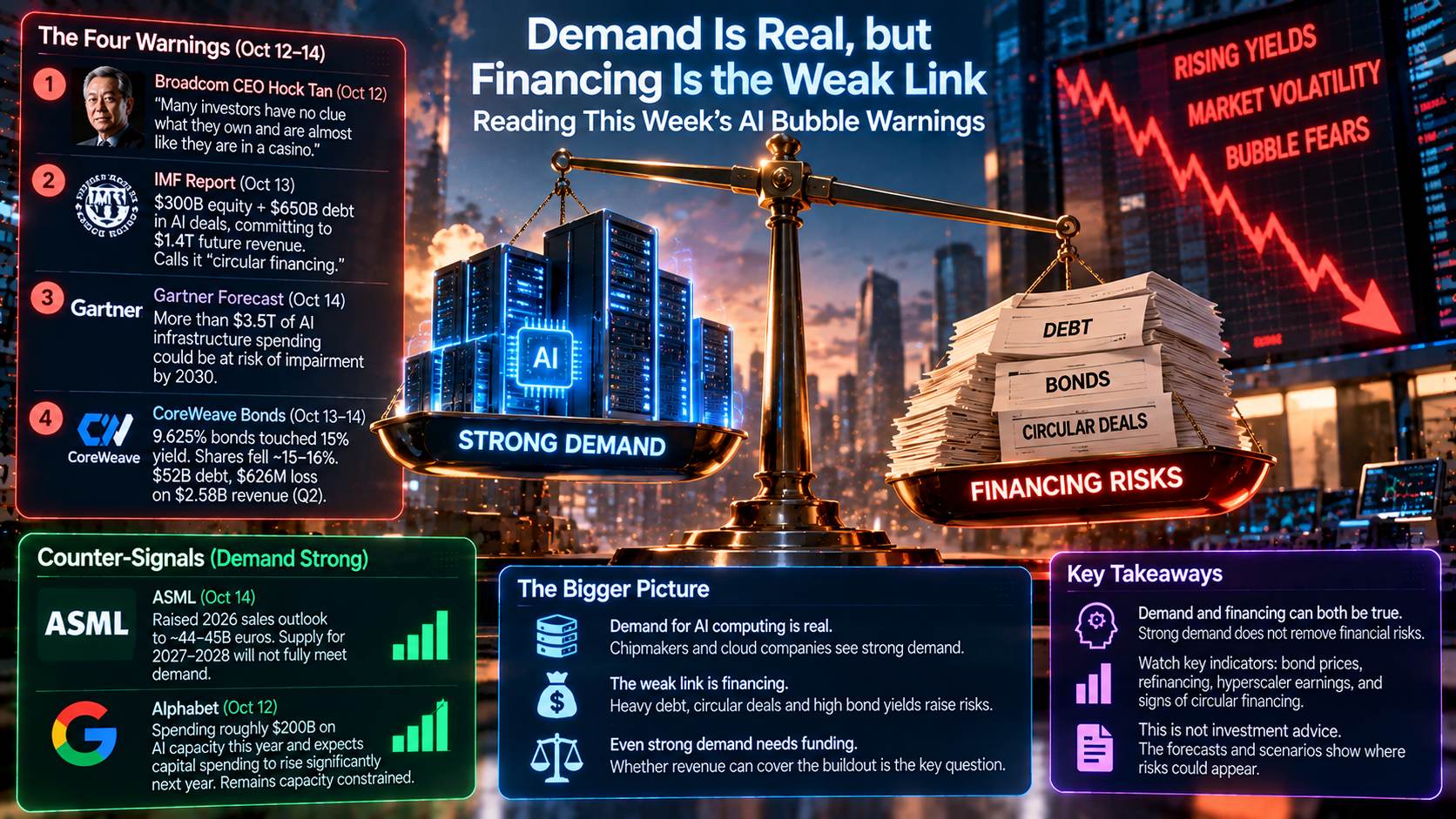
From October 12 to 14, four voices raised doubts about the AI buildout: a chip CEO, the IMF, an analyst firm and the bond market. None of them said people have stopped wanting AI computing. ASML and Alphabet said the opposite. The sharper question is how the buildout is being paid for, and whether future revenue will cover the debt. It is not investment advice.
The Four Warnings
A chip CEO and a sentiment sell-off
Broadcom CEO Hock Tan spoke in Singapore on October 12. Bloomberg reported that he said investors set extreme expectations, then find it is “almost like they are in a casino.” On October 13, Samsung Electronics and SK Hynix, together about half of Korea’s Kospi, fell as much as 8.8% and 9.4% in Seoul before recovering to about 4.5% lower each. Chinese memory-chip news and higher bond yields also weighed. Financial Times analysts, including Société Générale’s Manish Kabra, blamed sentiment, not demand. Caution: Tan’s remark is known only from two reported lines.
The IMF and circular financing
The IMF’s Global Financial Stability Report, released October 13, named an AI-related correction as one of three near-term risks, alongside rising government bond yields and a major cyber incident. It counted 14 publicly disclosed deals since 2023 in which hyperscaler-led investors put about $300 billion of equity and $650 billion of debt into financially weaker AI firms. Those firms committed about $1.4 trillion in future revenue, through services or chip orders. The IMF called this circular financing: an investor funds a customer, and the customer spends the money back with the investor.
Gartner and the revenue gap
Gartner said on October 14 that more than $3.5 trillion of AI infrastructure spending could be exposed to impairment, a write-down in asset value, by the end of 2030 if the current pace continues. AI data center owners would need $8.5 trillion in cumulative revenue to cover announced spending, financing costs and a 12% return on invested capital, Gartner’s assumed hurdle rate. Gartner forecasts no more than $3.6 trillion. It also expects over 80% of neoclouds, the GPU-rental firms below the hyperscalers, to cease independent operations by 2030. This is a forecast with stated assumptions, not a measurement.
The bond market and CoreWeave
On October 13, the yield on one $1.25 billion CoreWeave bond due in 2032 touched about 15% and closed at a record 14.5%. Shares fell as much as 15% in morning trading the next day. The yield is for that bond, not all its borrowing. Its own numbers show the strain. In the second quarter it lost $626 million on $2.58 billion of revenue, with net interest expense of $640 million. It held about $35 billion in borrowings, plus about $16 billion in lease liabilities. It reports a revenue backlog of about $104 billion, a company figure that depends on delivering capacity on time.
The Counter-Signal
ASML reported record third-quarter sales on October 14 and raised its 2026 outlook to €44 billion to €45 billion, lifting the low end from €43 billion. It said planned chip-tool supply for 2027 and 2028 will not fully meet demand. Some customers are asking about 2029 and 2030, which ASML described as interest, not firm orders. Its shares still fell 1.86%. Alphabet’s president and chief investment officer, Ruth Porat, said on October 12 that Alphabet is spending roughly $200 billion on AI capacity this year, will spend significantly more next year, and remains capacity constrained. Both are company statements, not independent checks.
Where Demand Meets Financing
The two sets of signals do not contradict each other. Even strong demand needs funding, and companies fund it differently. Alphabet’s June filing proposed an $80 billion equity raise and said demand for its AI services exceeded its supply. Its quarterly report shows about $49 billion of common and mandatory convertible preferred stock issued in the second quarter, while long-term debt rose from $46.5 billion at the end of 2025 to $98.2 billion at the end of June. Fortune reports free cash flow of negative $5.9 billion, its first negative quarter as a public company. In the same quarter CoreWeave spent $6.4 billion on equipment against $0.7 billion of operating cash flow, and raised $13.5 billion of debt.
Our analysis, not a reported fact: stress shows first where money is dearest. Alphabet can mix cash flow, stock and bonds. CoreWeave leans on debt, and one of its bonds now yields about 14.5%. Gartner adds that less than half of AI revenue should go to providers that own significant infrastructure, so earnings and spending may land in different companies.
What to Watch
Watch CoreWeave’s bond prices and how it refinances. Watch the hyperscalers’ next earnings, and whether ASML’s 2029 and 2030 interest turns into orders. Whether a correction comes is unknowable. IMF scenarios and Gartner forecasts show what could happen under stated assumptions, not what will. The accurate reading of this week is narrower: demand signals are strong, financing signals are strained, and the link between them is the part to watch.


