DeepSeek is reportedly close to raising about $14 billion at a valuation near $75 billion, partly to build a huge data center on Huawei’s Ascend chips. On October 15, its chatbot and API went down for almost five hours. Together these stories point to compute as the constraint on Chinese AI. But the sources disagree on important details, and DeepSeek has confirmed few of them. This article separates what is reported from what is documented, and asks whether Chinese AI can scale without Nvidia.
What Is Reported About the Round
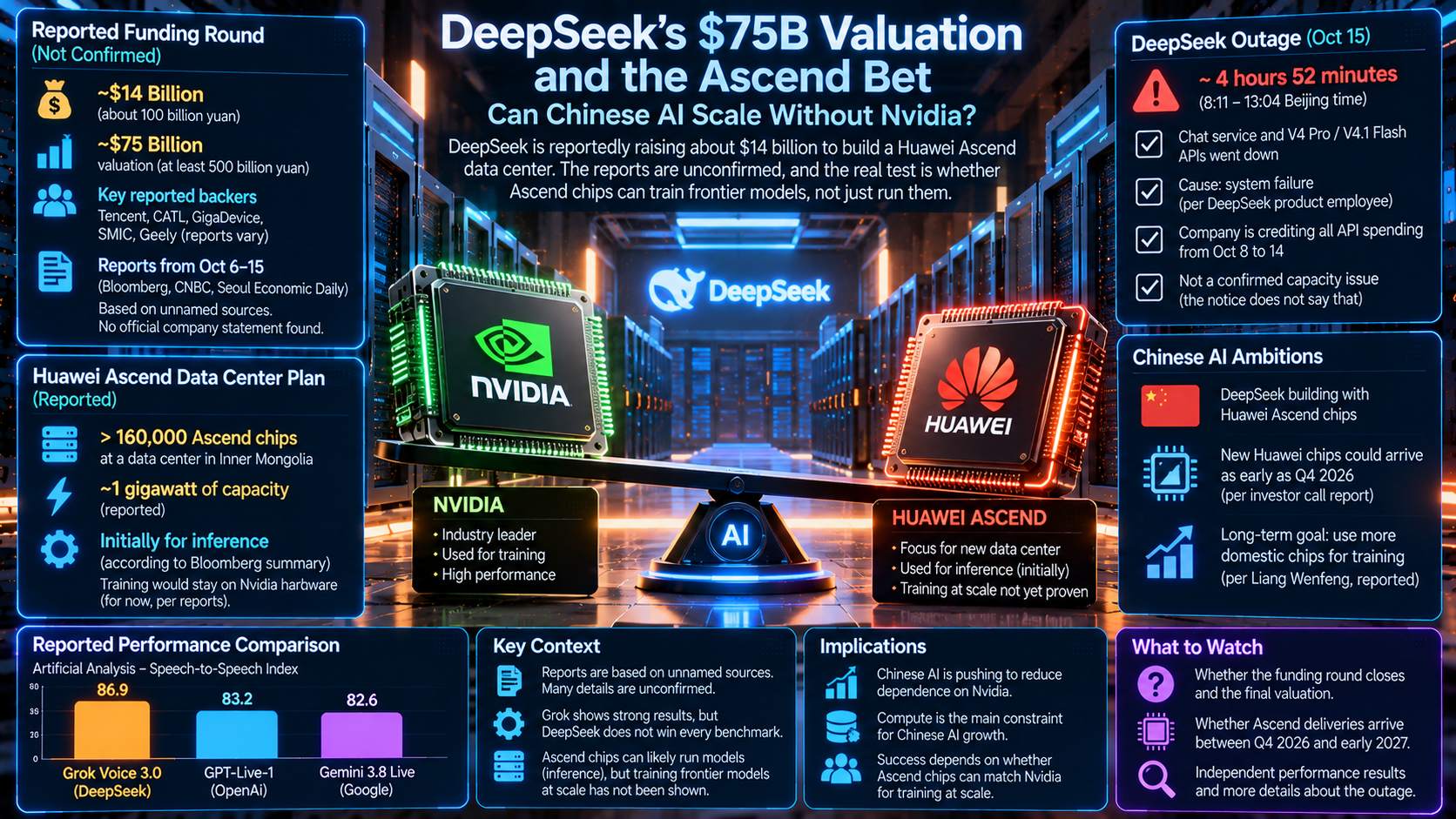
Bloomberg reported on October 6 that DeepSeek was close to raising at least 80 billion yuan ($12 billion) at a valuation of at least 500 billion yuan, about $75 billion. Tencent and battery maker CATL were among the largest backers. The original target was 50 billion yuan. CNBC reported that the round could double to 100 billion yuan, and that DeepSeek was limiting investors mostly to government and corporate funds. On October 15, Seoul Economic Daily, citing Chinese outlet Caijing, said the round was nearing 100 billion yuan, with new backers including chip designer GigaDevice, chipmaker SMIC and carmaker Geely.
Treat this as reporting, not confirmation. The sources are unnamed people, and no company statement was found in this research. One report says the 500 billion yuan figure is the value before the new money.
The listing plans follow the same pattern. Reuters reported that DeepSeek hired CITIC Securities to prepare a possible listing on Shanghai’s STAR Market and planned to hire Yan Wentao as its first CFO. BigGo reported plans to file by the end of the year and list in 2027.
The Huawei Ascend Bet
Bloomberg reported that DeepSeek plans to deploy more than 160,000 Huawei Ascend chips at a data center being built in Inner Mongolia. The South China Morning Post, citing Bloomberg, said the site would add about one gigawatt of capacity. One detail matters: a summary of Bloomberg’s report says the chips would initially be used for inference, which means running models for users. Training, the costlier step of building models, would stay on Nvidia hardware.
DeepSeek’s founder, Liang Wenfeng, has said more. According to The Information, he told investors DeepSeek plans to use more domestic chips for training, and new Huawei chips could arrive as early as the fourth quarter. A transcript of a July investor call has him estimating that four Huawei chips equal one Nvidia GB300 chip, and that Huawei is about two years behind. In the same call, he reportedly said DeepSeek’s compute equaled about 20,000 Nvidia H100 chips.
On September 30, DeepSeek and Huawei released open-source tools that mirror ones built for Nvidia chips, so developers can target the Ascend 950 more easily. They also built a 128-chip cluster. BigGo noted the announcement did not say DeepSeek’s V4 model had finished full-scale training on Ascend. The Financial Times reported in 2025 that an earlier training attempt on Ascend failed. Performance figures for Ascend chips come from Huawei and the companies involved. No independent audit was found.
The Outage Is Not a Capacity Confession
On October 15, DeepSeek’s chat service and its V4 Pro and V4.1 Flash APIs went down from 8:11 to 13:04 Beijing time, about 4 hours and 52 minutes, according to its status page. A DeepSeek product employee posted that the cause was a system failure, and that the team would remove single points of failure. The company is crediting users with all API spending from October 8 to 14.
Some summaries say DeepSeek blamed capacity. The notice does not say that. BigGo counted at least 10 major outages this year from DeepSeek’s status page. One analyst argued that giving away a week of free usage suggests the company was not short of compute at that moment. That is an opinion.
What Comes Next
In the near term, watch whether the round closes and what valuation is confirmed. Watch whether Ascend deliveries arrive between the fourth quarter of 2026 and early 2027, and whether DeepSeek explains the outage. The long-term question is bigger. Running models on Huawei chips looks plausible. Training frontier models on them at scale has not been shown. That makes “can Chinese AI scale without Nvidia?” a question with a split answer: partly yes for running models, not yet demonstrated for building them.