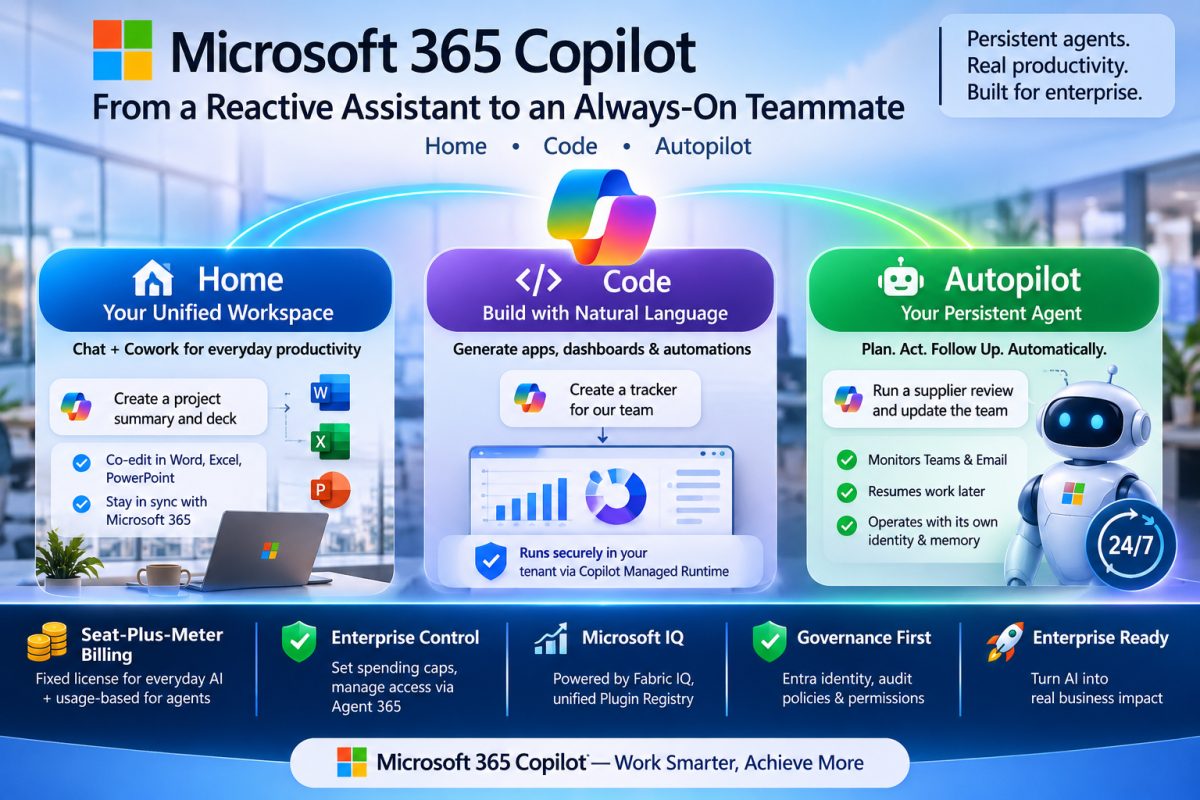
Most people don't finish big, multi-step projects in one chat session, and Microsoft is trying to fix that. On September 25, 2026, it redesigned the Microsoft 365 Copilot app around three parts: Home, Code, and Autopilot. The idea is to turn Copilot from something that only answers prompts into a workspace where agents keep working even after their human coworkers log off. Jared Spataro, Microsoft's Chief Marketing Officer for AI at Work, introduced the update.
How Home, Code, and Autopilot Work
According to Microsoft's September 25 blog post, the new Copilot has three areas.
Home is the main starting point. It combines regular Chat with bigger tasks you hand off, called Cowork. With Office in Copilot, people can create and edit live Word documents, Excel workbooks, and PowerPoint decks next to the assistant, and the files stay synced with the regular Office apps. Home is rolling out slowly through Microsoft's Frontier early-access program.
Code runs on the same technology as GitHub Copilot. It lets people who aren't developers build trackers, dashboards, and internal automations just by describing them. What they build runs in a sandbox inside the company's own tenant through Microsoft Copilot Managed Runtime.
Autopilot used to be called Scout. It's a cloud-based agent that works on its own, and it enters private preview at the end of September 2026. Users give it a name, a role, and a goal, like running a regular supplier review. It watches Teams channels, follows up on email threads, and picks projects back up days later without being asked. Each agent has its own directory identity, memory, and workspace, and it's controlled by Microsoft Entra and Agent 365 audit policies.
Seat Plus Meter Billing
For finance teams, the biggest change is the billing. Everyday AI, like Chat, Office app features, and Auto model routing, is covered by the per-user license. But Cowork, Code, Autopilot, long-running agent workflows, and top models like Astra and Fable are billed by usage.
To stop surprise bills, Microsoft expanded Agent 365 cost management to cover Code and Copilot Managed Runtime, with Copilot Studio agents planned for October 2026. Admins can set spending rules through an API, send credit requests through approval workflows, and limit which model families certain groups can use.
What I Think About It
To me, mixing a fixed seat license with metered agent work gives companies a steady base cost, but finance teams could get hit with spikes once agents are working overnight. VentureBeat's analysis said Microsoft showed good examples of Autopilot, like tracking Black Friday shipments across Teams, email, and Dynamics 365. But it didn't explain how admins can approve each action when an agent contacts people outside the company.
IT leaders should handle two things before turning this on. First, set spending caps. IT and FinOps teams need limits for each group and lists of allowed model families in Agent 365 before giving lots of people access. Second, clean up permissions. If files in SharePoint, OneDrive, or Teams are already shared with too many people, an agent could spread that problem around automatically while employees are offline.
What Happens Next
By putting live Office editing, plain-language app building, and always-on background agents together under Entra identity controls, Microsoft wants Copilot to be the base layer for everyday knowledge work. Companies that set strict credit limits and clean up permissions early can get the benefit of night-shift automation without losing control of their money or data.