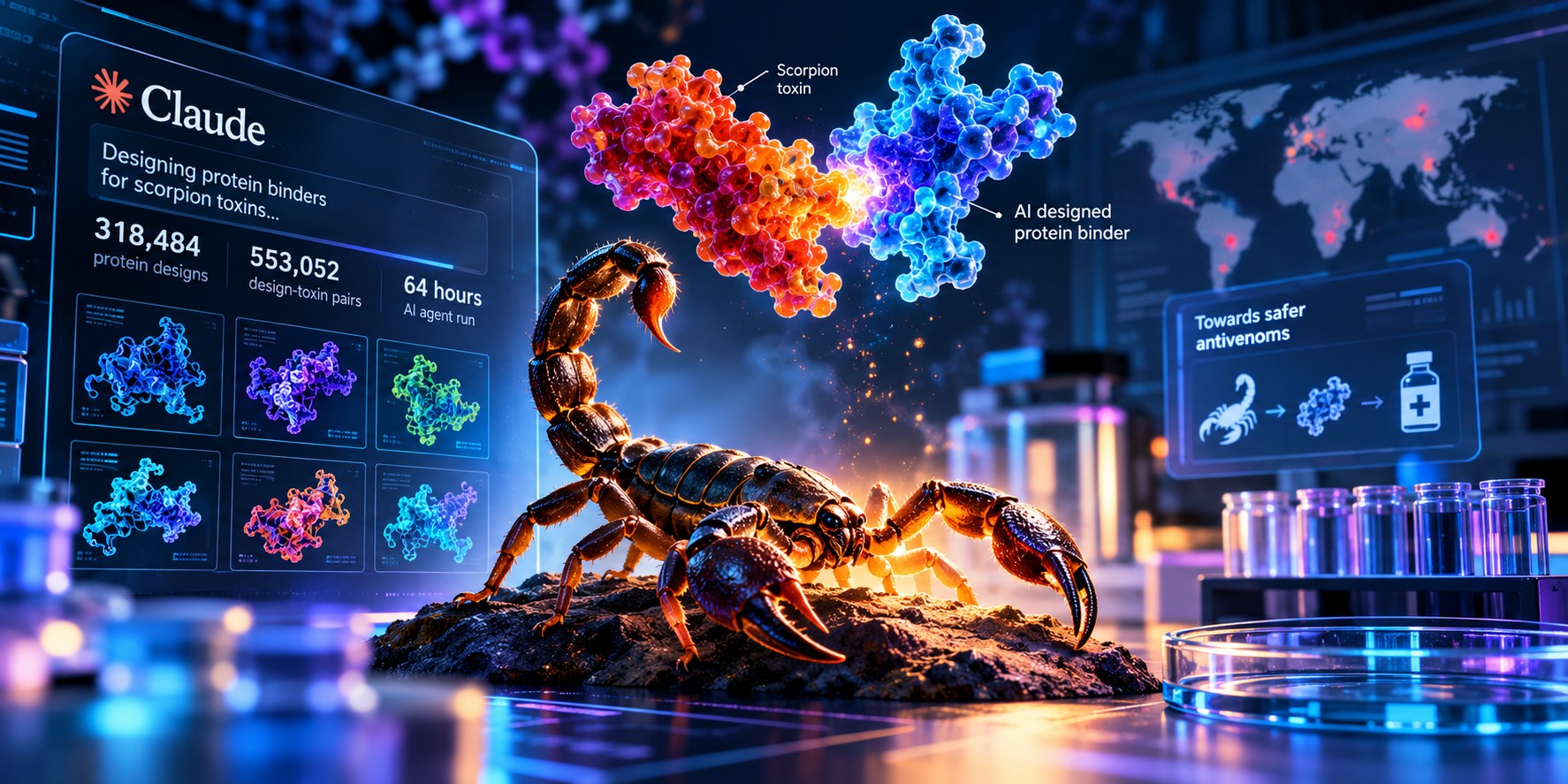
On October 20, 2026, Anthropic published a Claude protein design result that is easy to oversell. An internal Claude model ran a 64-hour campaign against scorpion toxins. It generated 318,484 designs and screened 553,052 design-toxin pairs. Of 211 designs tested in labs, 17 bound a toxin. But binding is not a cure, and no design was tested for neutralizing venom.
What Claude Did
Anthropic worked with Citrini Research, an investment research firm with no biology background. Claude got one starting prompt and four follow-ups. It picked where to aim on each toxin, used 12 design tools, set its own scoring cutoffs, and removed designs that looked like a toxin or a known protein. After 64 hours it had a list of 180 designs. The team added 31 more with Claude's help.
According to Anthropic's technical report, the run used on the order of 10,000 GPU hours, far more than most researchers have. Anthropic adds that a simplified setup, with one agent on one GPU over 24 hours, reached comparable computer-predicted scores. That is a computed score, not a lab result.
The five target toxins come from scorpions in Mexico, Brazil, North Africa and the Middle East.
What the Labs Found
Two outside labs, Adaptyv Bio and Twist Bioscience, tested 211 designs. A design counted as a binder only if every lab that tested it saw binding, the binding was tight, and it did not stick to an unrelated human protein. One toxin, LqhIII, was tested at only one lab. Seventeen passed: seven against Cn2 (Mexico), four each against AaH I and AaH II (North Africa), and two against LqhIII (Middle East). None passed for the Brazilian toxin, Ts1.
The two best Cn2 binders reached single-digit nanomolar affinity, where a lower number means tighter binding. According to the technical report, as summarized by Kingy AI, Cn2-B1 measured about 3.1 nM at Adaptyv Bio and 1.7 nM at Twist Bioscience. Cn2-B2 measured about 5.6 nM and 3.4 nM. The report treats these as upper limits, not exact values. It also notes that two qualifying binders, including Cn2-B1, bound ovalbumin, an unrelated protein, in an extra test, so specificity needs more checking.
The two Cn2 binders also competed with an antibody known to neutralize Cn2 in mice, which hints at where they attach. Anthropic calls that a hypothesis, not a result.
The Hit Rate, Explained
The simple math is 17 of 211, about 8%. But that mixes two kinds of designs. Sixty aimed at one toxin, and 11 of those worked, about 18%, which Anthropic calls typical for protein design. The other 151 aimed at several toxins at once. None bound more than one toxin, though six of the 17 hits came from that group, each binding a single toxin.
What Was Not Shown
No design was tested for stopping venom in cells or animals. Only lab-made toxins were used, not toxin purified from real venom. Anthropic says the next steps are tests on venom-purified toxin, then nerve-channel recordings, then mice.
What Outside Experts Say
Experts told The Verge the work gave promising starting points, not a drug. Andreas Hougaard Laustsen-Kiel of the Technical University of Denmark said finding a good binder against scorpion and snake toxins is "easy-ish." The hard part is turning it into a medicine. Andreas Bender of Khalifa University said standard screening can often find many hits at manageable cost without AI. Two experts quoted on Anthropic's own page called the work a promising first step, but Anthropic chose those quotes.
The Verge also reported that Anthropic paid a compute and token bill of just under $50,000, and that lab testing cost about $150,000 more.
Why It Matters
Our reading, not a finding: the story of this Claude protein design run is the workflow. One general AI agent ran a multi-tool design pipeline from five prompts, and outside labs checked the output. Anthropic released all 211 designs and the data, so others can check the count. But the hit rate is normal, the multi-toxin goal failed, and neutralization, the step that matters to patients, is still open.
What Comes Next
Watch for tests on venom-purified toxin, neutralization data in cells and mice, and outside groups re-analyzing the released data. Anthropic says scorpion stings cause at least 1.2 million cases and over 3,250 deaths a year, mostly among children in places with limited care. A cheap, stable treatment would matter, but this result does not yet show one.
Disclosure: Claude is made by Anthropic, and this article was drafted with Claude. The results are Anthropic's own, so the article leans on outside commentary and on the released data.