Can an AI Tutor Explain the Same Idea in 5 Different Ways?
Inside polymorphic explanation architectures, Bloom's 2 Sigma Problem, the myth of rigid learning styles, and how adaptive AI diagnoses genuine conceptual comprehension.
Published: Oct 12, 2026
6 min read
👁️ 129 Unique Views
In 1984, educational psychologist Benjamin Bloom identified one of the most famous challenges in cognitive science: Bloom's 2 Sigma Problem. Bloom demonstrated that students tutored one-on-one using mastery learning techniques performed an astonishing two standard deviations higher than students in conventional 30-person classrooms, effectively elevating an average 50th-percentile student to the 98th percentile. For over four decades, society lacked the economic and labor capacity to provide every human learner with a dedicated master tutor.
Modern large language models represent the first computational substrate capable of delivering on-demand, one-on-one cognitive scaffolding at a global scale. At the heart of this capability is polymorphic explanation: the capacity of neural architectures to deconstruct a single, abstract scientific or mathematical concept and re-synthesize it across radically different cognitive modalities. Rather than forcing a struggling student through rigid, repetitive textbook recitations, an intelligent AI tutor can dynamically project an idea through five distinct pedagogical lenses.
The Five Pedagogical Lenses: Deconstructing a Single Concept
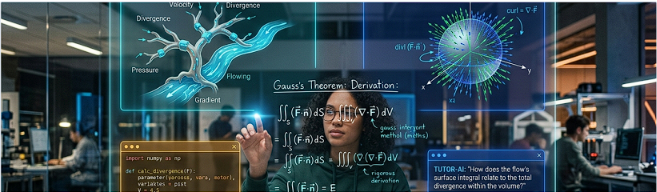
Consider a notoriously challenging undergraduate concept such as Gauss's Divergence Theorem or an equivalent topic in computer science, economics, or biology. An advanced AI tutoring framework can fluidly navigate five distinct representational planes to help students understand and explain core principles:
-
The Grounded Real-World Analogy: Translating mathematical abstraction into physical intuition by modeling divergence as water flowing through a porous sponge or air escaping an inflating balloon, establishing baseline sensory intuition before formalizing symbols.
-
The Spatial and Geometric Vector Diagram: Leveraging Paivio's Dual Coding Theory to generate an interactive vector field enclosed by a three-dimensional bounding mesh, visually displaying positive sources, negative sinks, and surface flux.
-
The Rigorous Formal Derivation: Presenting the axiomatic mathematical proof, linking the surface integral of a vector field directly to the volume integral of its divergence.
-
The Concrete Executable Code: Transforming continuous calculus into discrete algorithmic logic, such as NumPy or Python array differentials, allowing engineering students to inspect and execute the numerical mechanics.
-
The Socratic Dialectic: Guiding the student through scaffolded inquiry within Vygotsky's Zone of Proximal Development, prompting the learner to deduce the theorem's core conservation law independently.
Debunking the Learning Styles Myth: The Science of Representational Fluency
When educators hear that an AI tutor can present five different explanations, many assume the objective is to match a student's innate learning style, such as Fleming's VARK model covering visual, auditory, reading, or kinesthetic preferences. However, rigorous cognitive science has thoroughly dismantled this premise. In their landmark review, Pashler et al. found virtually zero empirical evidence supporting the meshing hypothesis, proving that pigeonholing a student as an exclusively visual or auditory learner does not improve learning outcomes.
The genuine cognitive power of offering multiple explanations is not catering to a static personality trait, but cultivating Representational Fluency. Deep comprehension occurs when a learner can mentally translate between multiple representations of the same phenomenon, connecting an intuitive analogy to an algebraic formula and cross-verifying both through an algorithmic simulation. By rotating through multiple angles, the AI tutor helps students break cognitive fixation and construct robust, multi-dimensional mental schemas.
The Illusion of Explanatory Depth and Socratic Guardrails
The greatest danger of generative artificial intelligence in education is the Illusion of Explanatory Depth. When an AI generates a beautifully eloquent, polished explanation, a student reads it, experiences immediate cognitive fluency, and mistakenly assumes they have mastered the material. In reality, passive reading creates an illusion of competence that vanishes the moment the student faces a blank examination sheet.
Furthermore, presenting all five explanations simultaneously induces catastrophic cognitive overload based on Sweller's Cognitive Load Theory. State-of-the-art educational artificial intelligence architectures, such as Stanford's MathDial framework developed by Macina et al. and Khan Academy's Khanmigo, implement strict Socratic Guardrails. Rather than lecturing, the artificial intelligence delivers a targeted explanatory fragment and immediately checks understanding with a diagnostic probe, asking how changes to system density impact outward flow across surface boundaries.
Metacognitive Scaffolding: Teaching Students How They Learn
The ultimate value of an adaptive artificial intelligence tutor is helping students develop Metacognitive Awareness, which is the ability to reflect on and regulate their own cognitive processes. Most learners naturally gravitate toward explanations that feel effortless, falling into the trap of superficial fluency rather than engaging in the desirable difficulties required for long-term retention.
By logging which representation successfully resolved a conceptual bottleneck, an AI tutor acts as a metacognitive mirror. It prompts the student to analyze why a particular vector diagram or code loop unlocked their understanding. Over time, students learn to identify their own cognitive barriers, transforming from dependent consumers of technology into autonomous, self-directed learners.