Consider an engineering undergraduate at 1:00 AM wrestling with linear algebra. The textbook defines an eigenvector with uncompromising mathematical austerity. An eigenvector of a linear transformation is a non-zero vector such that the matrix transformation equals a scalar multiple of that vector. The student reads this sentence five times. It is formally complete, peer-reviewed, and mathematically irrefutable, yet conceptually impenetrable to a tired novice.
Desperate, the student types into an artificial intelligence tutor: "Explain eigenvalues like I am looking at a physical object." Within three seconds, the artificial intelligence responds: "Imagine you are stretching a circle of pizza dough in all directions. Most points move along crazy diagonal curves. But along two specific axes, the dough only stretches straight outward without rotating at all. Those unchanging axes are the eigenvectors, and the factor by which they stretch is the eigenvalue."
Instantly, the geometric fog lifts. The student experiences an immediate, palpable "aha!" moment. This vignette captures the transformative appeal of artificial intelligence tutors. But it also exposes a profound question: Did the artificial intelligence explain the concept better than the textbook, or did it merely provide an alluring metaphor that masks rigorous technical mechanics?
Bloom's Two-Sigma Phenomenon: The Power of Scaffolding
In 1984, educational psychologist Benjamin Bloom documented a historic benchmark known as Bloom's Two Sigma Problem: students taught via one-on-one human tutoring performed two standard deviations above students taught in conventional classrooms, moving the fiftieth-percentile student into the ninety-eighth percentile (
Generative artificial intelligence tutors represent the first scalable technology capable of approximating one-on-one Socratic dialogue at zero marginal cost. By diagnosing specific misconceptions and operating inside Lev Vygotsky's Zone of Proximal Development, artificial intelligence agents dynamically adjust cognitive scaffolding, meeting the learner at their exact edge of competence (
The Cognitive Anatomy of an Explanation: Static Versus Dynamic
Comparing an artificial intelligence tutor to a technical textbook reveals a stark dichotomy between two distinct cognitive architectures:
-
The Textbook as Authoritative Canon: Textbooks are monolithic, peer-reviewed, and epistemically stable. Authors spend years refining proofs, designing precise vector schematics, and aligning chapters with curricular standards. A textbook guarantees that every formula, constant, and boundary condition is mathematically sound. However, its transmission is strictly one-to-many and non-interactive.
-
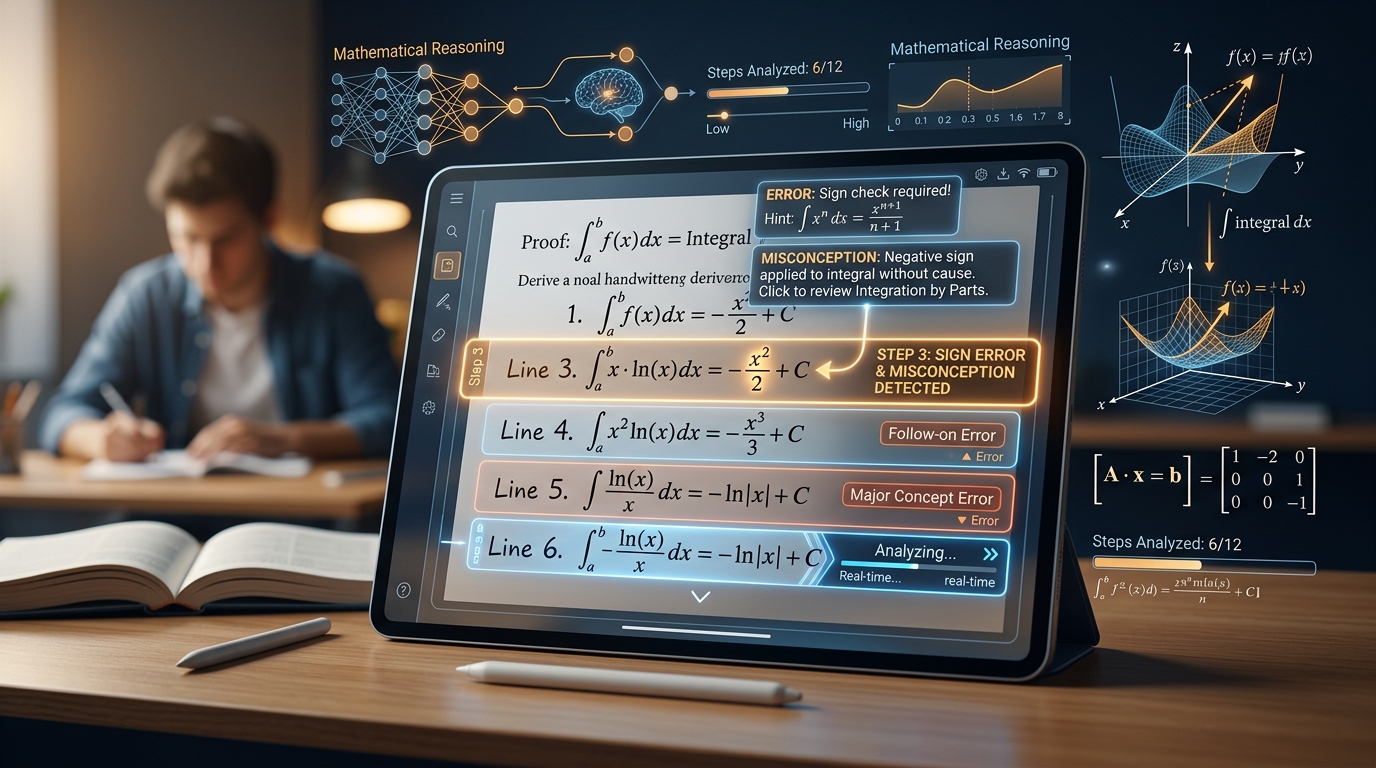
The Artificial Intelligence Tutor as Bidirectional Sparring Partner: An artificial intelligence tutor offers real-time adaptive conversational feedback. It can translate abstract algebraic concepts into physical analogies, generate infinite customized practice problems, and trace a student's buggy code line-by-line to pinpoint an unhandled null pointer or a wrong sign in an integration-by-parts substitution.
While an artificial intelligence tutor provides unmatched cognitive ease, it lacks an internal model of ground truth. It predicts the most statistically probable next token, making it susceptible to plausible yet catastrophic mathematical errors.
The Hallucination Hazard and the Loss of Epistemic Authority
The primary danger of relying exclusively on an artificial intelligence tutor is the Epistemic Reliability Gap. Standard engineering textbooks undergo rigorous peer review, editorial scrutiny, and classroom field-testing over decades. Errata are tracked and corrected. When a textbook prints an empirical equation or material property table, an engineer can trust it with human lives.
Generative large language model tutors have no commitment to ground truth. When prompted with advanced boundary-value problems or multi-variable control loops, they frequently produce hallucinated proofs—equations that look syntactically elegant and mathematically persuasive, but are completely unphysical. A novice learner cannot distinguish a brilliant shortcut from a fabricated identity.
The Fluency Trap: Friendly Metaphors Versus Real Mastery
Educational psychologists define the Fluency Illusion as the dangerous cognitive trap where understanding a simplified analogy is mistaken for mastering the underlying mathematical physics (
The pizza dough analogy for eigenvalues is memorable, but it will not help an aerospace engineer calculate the flutter resonance frequencies of a supersonic carbon-composite wing. To prevent structural failure, the engineer must compute the characteristic polynomial, prove matrix diagonalizability, and account for damping matrices—rigorous mathematical heavy lifting that conversational artificial intelligence tends to dilute or bypass.
The Dual-Core Epistemic Protocol: Four Rules for STEM Mastery
The question is not whether an artificial intelligence tutor is better than a textbook, but how they synthesize into a superior intellectual workflow:
-
The Textbook as the Constitution (Epistemic Bedrock): Always begin with the authoritative textbook. Read the formal chapter definitions, inspect the verified schematics, and wrestle with the notation. The textbook establishes the non-negotiable ground truth.
-
Targeted Socratic De-Bottlenecking: When you hit a cognitive wall on a specific derivation step, do not abandon the book. Copy the exact confusing equation into the artificial intelligence tutor and prompt it to provide a hint rather than the final answer.
-
The Reverse-Verification Audit: After an artificial intelligence tutor explains an abstract concept via a colorful metaphor, immediately verify its claims against the textbook to ensure essential boundary conditions were not simplified away.
-
Closed-Book Whiteboard Re-Derivation: Close both the textbook and the artificial intelligence chat. Re-derive the entire mathematical proof or circuit topology from memory on a blank whiteboard. Active unassisted retrieval is the only proof of biological understanding.