Global data centers currently consume over 460 terawatt-hours of electricity per year—a figure projected to double by 2028 driven by the rapid growth of generative artificial intelligence training and cloud services
The Thermal Complexity Problem: Why Human Operators Hit a Wall
To understand why data center cooling is so inefficient, consider the sheer complexity of a hyperscale facility
Deep Reinforcement Learning: DeepMind's Autonomous Cooling Breakthrough
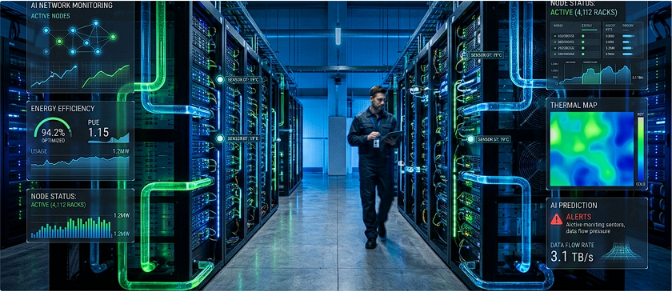
To address this challenge, researchers at Google DeepMind and Google Infrastructure Engineering deployed Deep Reinforcement Learning across live commercial data centers. Their landmark study detailed an autonomous artificial intelligence agent that ingests thousands of sensor readings—including temperature, pressure, power consumption, and local weather forecasts—every five minutes
The neural network predicts how changing cooling setpoints will impact future temperatures 60 minutes ahead. Operating under strict safety constraints, the reinforcement learning agent automatically adjusts chiller valve speeds and fan rates
Carbon-Aware Workload Scheduling: Temporal and Spatial Shifting
Beyond cooling pumps, computer scientists at Google Research, MIT CSAIL, and Meta developed carbon-intelligent computing platforms. Instead of running non-urgent compute tasks immediately, artificial intelligence scheduling engines evaluate regional electrical grid carbon intensity in real time
The scheduler uses two primary strategies:
-
Temporal Shifting: Delaying time-flexible batch workloads, such as artificial intelligence model pre-training or data backups, until local solar or wind energy generation peaks.
-
Spatial Shifting: Automatically routing computational workloads over high-speed optical fiber to geographically distributed data centers where local renewable energy is abundant and cheap.
Hardware-Level Voltage Scaling and GPU Power Capping
At the silicon level, researchers at Stanford and Meta AI introduced dynamic co-optimization frameworks for large-scale graphics processing unit inference. By applying Dynamic Voltage and Frequency Scaling and machine learning-guided power capping, algorithms identify phases where chips are bottlenecked by memory transfer rather than compute
Lowering chip clock speeds during these microsecond memory stalls saved up to 18 percent of chip-level energy without causing measurable latency degradation. Coordinated cooling and compute models further streamline thermal dissipation across dense server racks.
Architectural Trade-Offs and Enterprise Infrastructure Bottlenecks
While artificial intelligence optimization yields major energy savings, implementing these technologies introduces distinct architectural trade-offs
Furthermore, facilities must deploy thousands of extra Internet of Things telemetry sensors to provide reinforcement learning models with sufficient state visibility
Engineering Limits and the Jevons Paradox
Despite these successes, energy-aware computing encounters a broader economic phenomenon known as the Jevons Paradox
Additionally, regional electrical grids often lack the flexible transmission capacity required to absorb sudden spatial workload transfers, limiting how aggressively enterprises can shift compute toward green power sources in real time
Why Energy-Aware Computing Is Essential for the Future of AI
As artificial intelligence scales globally, energy efficiency is no longer just an operational detail—it is the central bottleneck governing technology growth