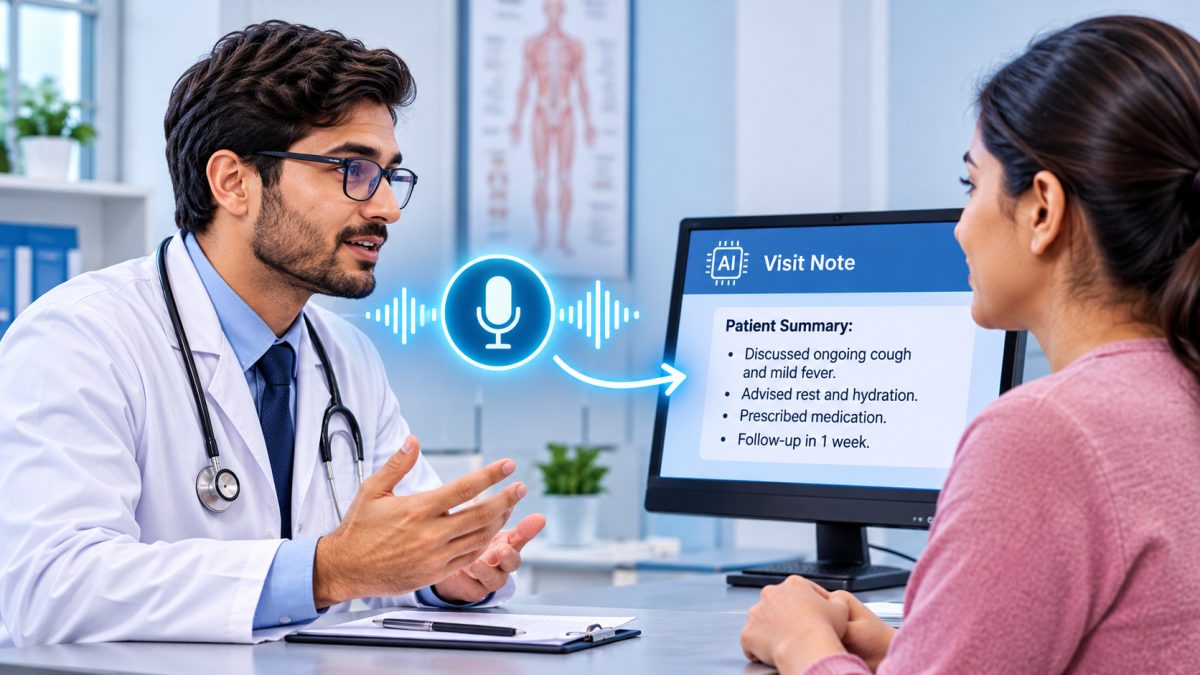
AI scribes are supposed to save doctors time on typing notes. A big new study from Beth Israel Lahey Health, a group of 14 hospitals near Boston, checked how well that works. It covered 902 clinicians, meaning doctors and other care providers, and more than 1.6 million clinic visits. It was published on October 27 in Annals of Internal Medicine.
What Happens Inside the Scribe
An AI scribe does three jobs. It records the talk between the doctor and the patient. It turns the sound into written words. Then a large language model, an AI trained on huge amounts of text, writes a draft of the visit note. The doctor reads the draft, fixes it and signs it.
The study used a tool called Heidi. Its engineers say it uses note templates and large language models. That comes from a write-up of their AWS re:Invent 2025 talk. We could not find the model names or sizes.
What the Study Found
The researchers looked back at records from July 2024 to January 2026. It was not a randomized trial. All 902 clinicians had signed up for Heidi. Of them, 605 used it and 297 never did.
They measured how long a note stayed open on the clinician’s screen. Before signing up, the usual time was 21.0 minutes per visit. Afterward it was 18.6. After adjusting for things like patient age and how complex the visit was, the study found an immediate drop of 1.2 minutes per visit, according to the journal’s news summary. No confidence interval was given, so we cannot say how certain that number is.
Heavy users, who used Heidi in about 55% of their visits, saved around 2.5 minutes. Light users, at about 3% of visits, saw almost no change. Those two percentages come from news coverage, not the paper.
Why the Saved Minutes Did Not Add Up
Clinicians did not see more patients, and their productivity scores stayed the same. They did not close notes sooner, and they did not write fewer notes after hours. The notes did get longer.
The study does not say why. Also, the study did not count the time clinicians spent fixing drafts inside the scribe tool.
Is a Longer Note a Better Note?
We do not know. The study did not check how good the notes were. A long note can bury the key facts or hide a mistake the doctor misses. Reading a draft carefully takes time too, which may use up some of the minutes saved.
Things to Keep in Mind
This was one health system and one product. A former employee told TechTarget that Heidi was linked to the Epic record system only about six months after launch. That could change the savings, and we could not tell if the study accounted for it.
The paper’s summary says Heidi Health had no role in the data analysis or the decision to publish. A trade report says one co-author is affiliated with Heidi. We could not confirm that part.
Hospitals thinking about AI scribes should expect small time savings. They should also check how good the notes are, not just how fast they get written.