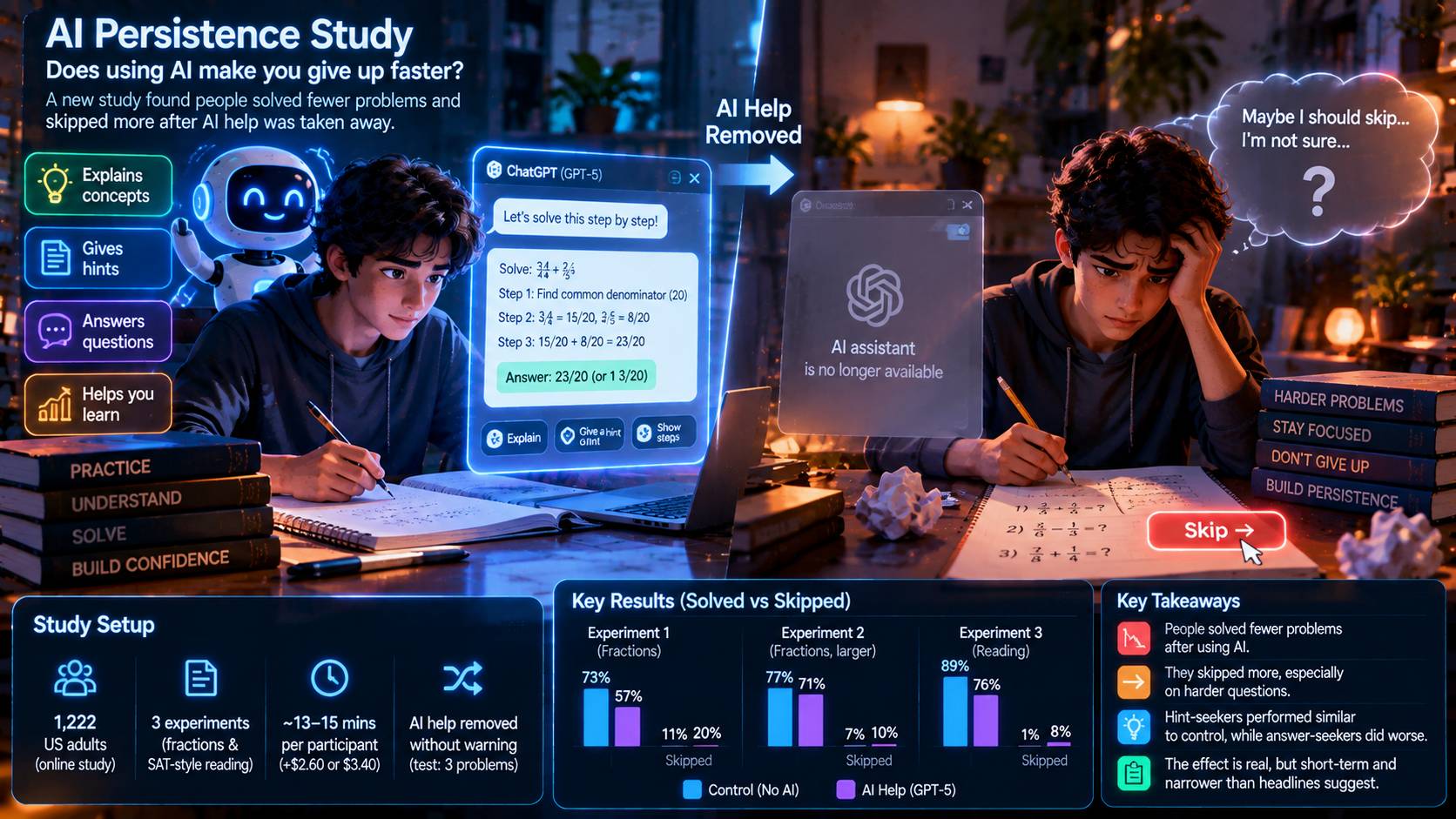
“Using AI for just 10 minutes erodes your ability to persist at hard things.” That was the headline from UC Berkeley on October 9, 2026, about a study presented at the Conference on Language Modeling. The AI persistence study is real and carefully built. But the headline says more than the experiments measured. Here is what they found, and what they did not.
What the Researchers Did
The paper was led by Grace Liu of Carnegie Mellon University. Brian Christian, a research fellow at Berkeley’s Center for Human-Compatible AI and listed at Oxford on the paper, is a co-author, along with researchers from MIT and UCLA.
They ran three randomized experiments with 1,222 US adults recruited online. Experiments 1 and 2 used fraction problems. Experiment 3 used SAT-style reading questions. Half the people were randomly given an AI assistant for the practice problems. The paper’s methods sections name the model as GPT-5, though participants were told it was ChatGPT. The other half had no AI. Then the AI was removed without warning, and everyone did three test problems.
Persistence was measured by a skip button. There was no penalty for wrong answers, and payment did not depend on getting problems right. So a skip meant a person chose not to try. Participants were paid $2.60 or $3.40 for about 13 to 15 minutes of work.
What They Found
In Experiment 1, the AI group solved 57% of the test problems, against 73% for the control group. They skipped 20%, against 11%. In Experiment 2, the larger replication, the AI group solved 71% against 77%, and skipped 10% against 7%. That skip gap was not statistically significant. In Experiment 3, the AI group solved 76% against 89%, and skipped 8% against 1%.
Effect sizes tell you how big a gap is. The solve-rate gaps measured about 0.4, 0.2, and 0.4 on a common scale where 0.2 is small and 0.5 is medium. So the drop in accuracy was small to moderate. The skip gaps were small in raw terms, and the biggest experiment did not confirm one.
Another detail: 1,222 people took part, but after exclusions the analyses used 1,060, by my arithmetic. Experiment 1 also had a flaw. Its exclusion rule may have kept weaker people in the AI group. The authors fixed this in Experiment 2, where the accuracy gap was smaller. Experiment 2 also gave control participants a sidebar, so both groups saw the same screen change when help was removed.
How You Use AI Seems to Matter
In Experiment 2, people in the AI group reported how they used it. About 61% mostly asked for answers, 27% asked for hints, and 12% did not use it. Answer-seekers scored 65% on the test, against 77% for the control group. Hint-seekers scored 76%, about the same as the control group. Answer-seekers also skipped more, 13% against 7%.
But people chose how to use the AI. Those groups were not randomized, so the authors say this is not necessarily causal.
What the Study Cannot Tell You
The sessions lasted about 13 to 15 minutes, and the tests came right after. Nobody was followed over weeks. The paper itself says long-term effects need further study.
The AI was also set up to give answers. The paper’s method section for Experiment 1 (Section 2.1) says it was preloaded with each problem and its solution, so users could get a correct answer with little effort, for example by typing “answer?” Experiment 2 used the same setup. In Experiment 3, the AI saw the passage, question, and answer choices. The tasks were basic fractions and short reading questions, done for small pay with no stakes, by US participants. Real homework, work, and learning differ.
The authors suggest AI makes people expect instant answers and removes productive struggle. That is a hypothesis. The experiments did not test it. And “erodes your ability” overstates a drop measured minutes later.
One more caution. The version I could read was marked as a preprint under review. Berkeley’s October 9 news release says an updated, peer-reviewed version was presented at the Conference on Language Modeling. I could not confirm that from the conference program, so check the final paper for any changes to the numbers.
Why It Matters and What Could Come Next
In the near term, the practical lesson is about design and habits. Christian says AI could default to teaching, like a tutor, instead of handing over answers. The hint-versus-answer result, though not causal, suggests trying first and asking for hints.
The long-term picture is speculation. If short-term effects add up over months of daily use, schools and workplaces may need rules for how AI is used. The study does not show that. It shows a short-term cost under one design, and that is worth taking seriously without calling it proof that AI makes us lazy.


