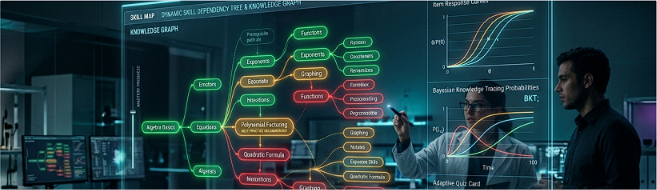
For over a century, educational assessment has operated on static uniformity: every student in a classroom receives the identical 20-question quiz, ordered in the same linear sequence, regardless of their background knowledge, misconceptions, or learning speed. This legacy paradigm suffers from severe inefficiencies, as advanced learners waste time answering questions far below their ability level, while struggling students face demoralizing failure on advanced questions before mastering foundational prerequisites.
Modern artificial intelligence has radically upended this paradigm through Computerized Adaptive Testing and dynamic practice engines deployed in platforms like Duolingo, Khan Academy, and standardized testing environments. Rather than scoring a student only after a completed exam, an adaptive quiz treats every interaction—whether a correct answer, an error, a hint request, or response latency—as an immediate Bayesian update to a live mathematical model of the student's latent knowledge. The central challenge of these engines is algorithmic recommendation: out of thousands of possible concepts and questions, how do adaptive systems decide what a learner should practise next?
Item Response Theory and Fisher Information Maximization
The psychometric engine underlying adaptive quizzing is Item Response Theory, pioneered by Lord in 1980. Classical test theory evaluates students on raw percentages while completely ignoring question difficulty. Item Response Theory, by contrast, models the student's latent ability as an unobservable parameter and calibrates each question along three fundamental psychometric parameters via the 3-Parameter Logistic Model.
Within this model, question difficulty represents the proficiency threshold where a student has a fifty percent probability of answering correctly, discrimination represents how sharply the question separates high from low ability, and a guessing parameter accounts for random chance. After each answer, the system updates its estimate of the student's ability. To select the next question, the engine maximizes the Fisher Information Function, choosing an item whose difficulty closely matches the student's estimated ability. This guarantees that every question delivers the maximum possible statistical information, reducing test length by over 50 percent while increasing measurement precision.
Knowledge Tracing: Tracking Mastery from Bayesian HMMs to Deep Recurrent Networks
While standard Item Response Theory models assume a student's ability remains static throughout an evaluation, an adaptive tutoring system must account for the reality that practice actively produces learning. To model mastery dynamically over time, adaptive systems implement Knowledge Tracing algorithms.
Bayesian Knowledge Tracing, developed by Corbett and Anderson in 1994, models each discrete skill as a Hidden Markov Model. The system tracks the probability that a skill is in a learned state, updating it after each response using parameters for transition probability, guessing, and slipping. In a landmark Stanford study by Piech et al. published at NeurIPS 2015, researchers replaced manual Bayesian models with Recurrent Neural Networks, specifically utilizing Long Short-Term Memory networks. Deep Knowledge Tracing predicts student performance on future problems without requiring human-authored skill labels, successfully capturing complex, non-linear dependencies across hundreds of concepts simultaneously.
Prerequisite DAGs and Root-Cause Diagnosis: Why Did the Student Stumble?
When a student answers an advanced algebra problem incorrectly, such as solving a quadratic equation via the quadratic formula, a naive system might simply serve another identical quadratic formula problem. An intelligent adaptive engine, however, consults a Knowledge Component Directed Acyclic Graph to diagnose root causes.
The knowledge graph connects advanced skills to their structural prerequisites, spanning quadratic equations, factoring polynomials, distributive properties, and signed arithmetic. By analyzing the student's specific error pattern—especially through generative large language models that analyze intermediate calculation steps or select targeted multiple-choice distractors—the system traces backward along graph edges. If the engine detects that the error stemmed from distributing negative signs rather than applying the formula, it routes the student to a remedial micro-quiz targeting negative sign operations.
The Multi-Armed Bandit in the Zone of Proximal Development
Curriculum sequencing is formalized as a Multi-Armed Bandit reinforcement learning problem that balances two competing objectives:
-
Exploitation within the Zone of Proximal Development: Keeping the student in Vygotsky's Zone of Proximal Development, where the predicted probability of success is calibrated to an optimal sweet spot between 70 percent and 80 percent. Tasks above 90 percent success induce boredom, while tasks below 50 percent trigger frustration.
-
Exploration and Spaced Repetition: Integrating mathematical models of memory decay, such as Duolingo's Half-Life Regression and Ebbinghaus forgetting curves developed by Settles and Meeder in 2016, to re-introduce older, mastered skills just as memory retention drops near the 85 percent recall threshold.


