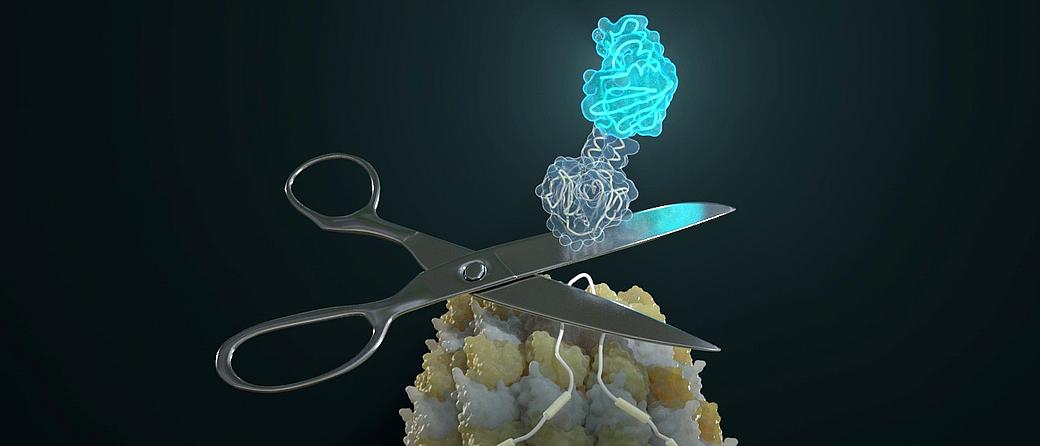
Think of a protein as a long string of beads. To use it, or to get rid of it, your body has to cut that string, and it has to cut in exactly the right place. The tools that do this are called proteases. Your cells use them for everything from digesting lunch to clotting blood when you get a cut.
Scientists have wanted to build their own for a long time. Now a team at the University of Washington says it has done it with AI. Two papers in Nature, published on October 14, 2026, describe brand-new proteases that never existed in nature.
Why It Is So Hard
Cutting a string sounds easy, but it is not. The bonds in a protein are very stable, and in water they break extremely slowly. A protease speeds that up a lot, and only at the spot it was made for. That needs a pocket of exactly the right shape, lined with the right chemical parts. Scientists have built enzymes from scratch before, but mostly for easier reactions. This was a much steeper climb.
How the Team Did It
The team used AI tools from David Baker’s lab, including one called RFdiffusion. Instead of copying nature, the AI drew new protein shapes, each with a pocket meant for cutting. Some designs used a zinc atom to do the cutting. Others used a part of the protein called cysteine. Then the researchers made the proteins in the lab to see which ones worked.
What Worked
Not every design worked, and that is normal. In the cysteine paper, 13 of 69 designs worked, which is about one in five. In the zinc paper, 36 percent of 135 designs cut the right spot, according to Phys.org. For brand-new enzymes those are good odds, since a tiny mistake in shape can ruin one.
The best zinc design cut more than 100 million times faster than it would with no enzyme at all. After four small changes, one cysteine design reached about half the speed of TEV protease, a natural enzyme that many labs use, says the Baker lab.
Why Doctors Might Care
An enzyme that cuts one chosen protein could one day do useful jobs. In test tubes, the team’s proteases cut proteins linked to Alzheimer’s disease and ALS. They also built signaling proteins that stay off until the designed scissors cut them open. That is a clever trick. But for medicine it is still just an idea, not a treatment.
What Nobody Knows Yet
Everything here happened in the lab. The papers describe no tests in animals or people. The first targets were short pieces of protein, not whole folded proteins, says Chemistry World. The new enzymes are also slower than the best natural ones, partly because of small flaws in their shapes. And no one knows yet whether they would be safe, or even work, inside a living body. A designed enzyme is a long way from a medicine.