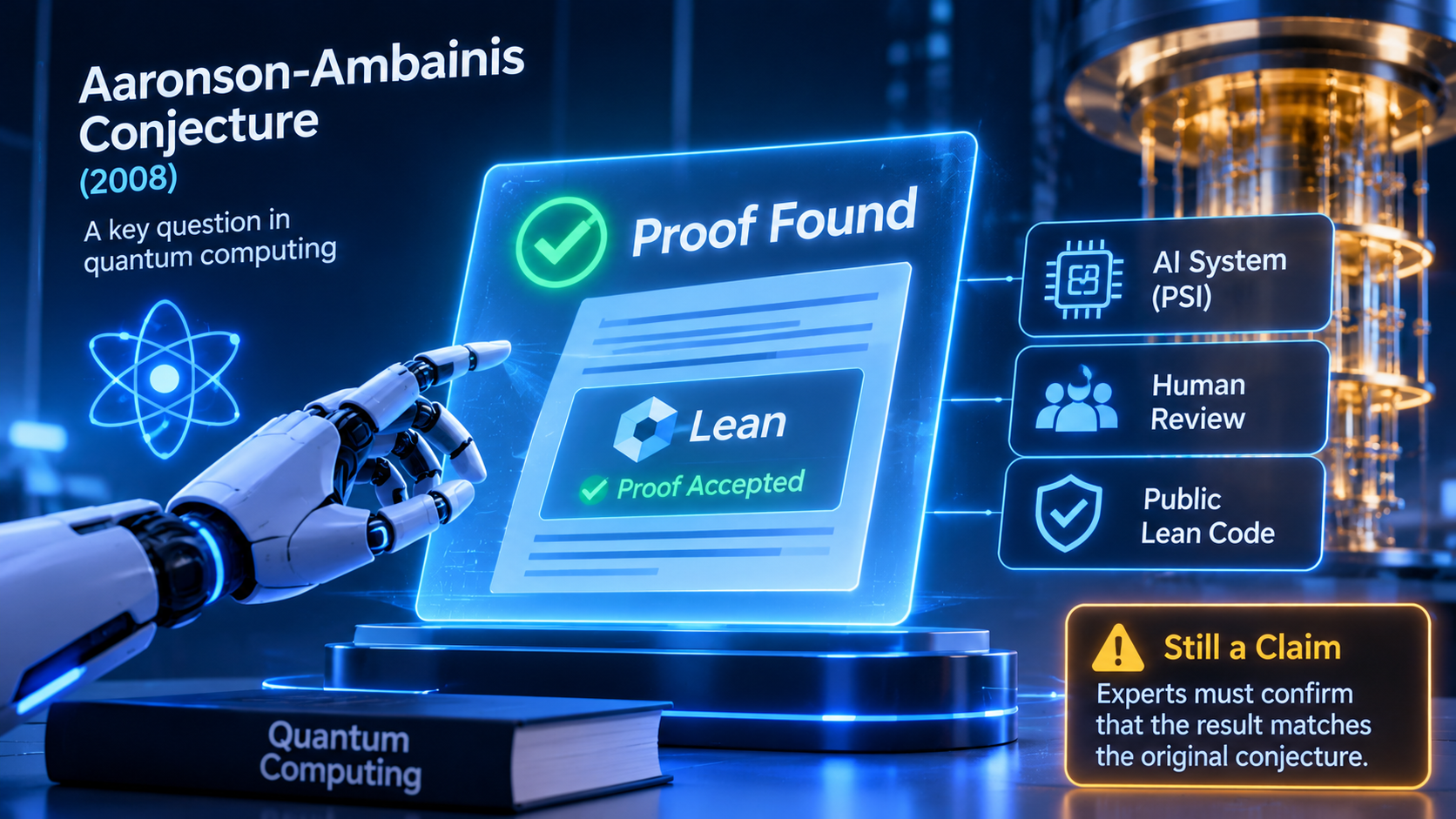
Claims that AI is changing science are often hard to check. This one is different, because part of it can be checked by anyone. On November 6, 2026, a startup called Physical Superintelligence (PSI) said its research system, which runs a non-public Anthropic model, found a proof of the Aaronson-Ambainis conjecture. A conjecture is a math claim that people believe is true but have not proved. This one has been open since 2008, and it is about quantum computing.
What the result says
The result is about yes-or-no questions on random inputs. It says a quantum computer’s advantage in how many input values it must read is at most polynomial. That holds for most inputs, up to a small error. Polynomial growth is slow compared with exponential growth. So a big quantum speedup needs inputs that have some pattern or structure.
What the system did
PSI says the system produced a complete proof on the third day of a run on its own computers. Lean accepted it. Lean is a proof assistant, a program that checks every logical step. PSI then gave the system related open problems. It improved the result twice before Lean accepted the final version. The paper and the Lean code are public. An audit of the code found no gaps in the proof and no extra assumptions added. The code was also replayed in an independent checker called lean4lean.
What Lean cannot check
Lean confirms that the proof follows from the statement written in Lean. It cannot confirm that this statement matches the original conjecture. Humans have to check that. The paper is also a preprint, which means outside experts have not reviewed it yet. So the final answer has to wait for quantum complexity experts.
What we still can’t see
PSI only launched publicly in September. The Anthropic model is not public, so outsiders can’t test it. They can read the final Lean code, but not the process that made it. The reports I found don’t say how much computing power the run used or how many copies of the model ran.
Humans in the loop
David Turturean of PSI built the system, picked the problem and ran it. He asked the model to write a first draft of the paper, then reviewed it, and he says he is responsible for its correctness. Adviser Jim Halverson audited the proof, and adviser Phiala Shanahan commented on the Lean version. PSI says AI models wrote the math statements, the first draft and the Lean code.
This is better than most AI-for-science claims, because anyone can run the Lean code instead of trusting the model. But a checked proof of the wrong statement would still be the wrong result. Until experts agree that the statement matches the conjecture, this is a strong claim, not a settled one.