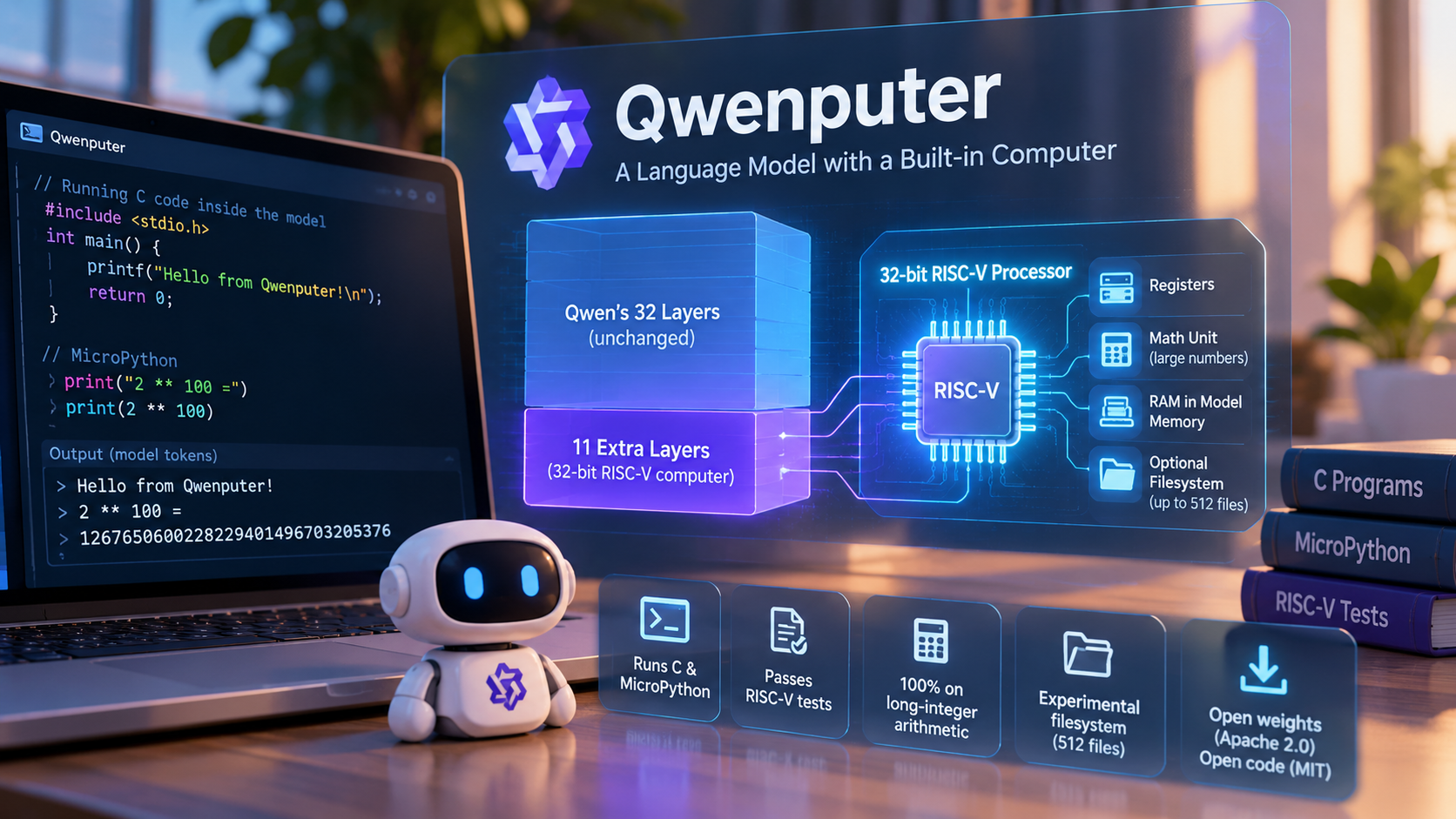
Qwenputer is an experimental model by developer Divyansh Agrawal. It takes Qwen3.5-4B and adds a small computer inside its weights. The computer is a 32-bit RISC-V processor with a maths unit for very large numbers, and it sits in 11 extra layers in front of Qwen’s own 32. The weights are Apache 2.0 and the code is MIT, so anyone can download both.
How It Works
Qwen3.5 uses a layer type called Gated DeltaNet in three of every four layers, and each one keeps a running memory. Agrawal set two controls so nothing in that memory fades and each write replaces exactly one row. That turns the memory into exact RAM, where the processor keeps its registers and program. No training was needed. A compiler sets every weight directly, and Qwen’s original weights stay unchanged. Each processor step appears as a few extra generated tokens, which work as a log of what the processor did.
What It Can Do
The model runs C and MicroPython inside its own forward pass, with no outside tool or runtime. Agrawal reports that it passes the official RISC-V tests and ran about 18 million instructions without an error. On long-integer arithmetic it scores 100%, against 48.6% for base Qwen. On five arithmetic tests it matched or beat base Qwen with a Python tool on four, and trailed by one problem on the fifth. A variant adds an experimental filesystem that keeps up to 512 files, about 53,000 tokens of text, between chats.
What Is Verified and What Is Not
Every number above comes from Agrawal. The code and weights are public, and the model runs on one 24 GB GPU, so others can test it. No independent test had been reported as of October 30, and news coverage mostly repeats his figures. Each test has only 40 problems, so one miss costs 2.5 points. Some coverage says it beat the Python tool on all five tests, which is not quite right.
What It Costs
The checkpoint is 18.8 GB, about double base Qwen, though Agrawal says most of the extra is zeros. It cannot be loaded like an ordinary model, because a small driver called RvChat must start the processor first. It is also slow. Each instruction costs a few generated tokens, so work a normal chip does in milliseconds takes seconds. Agrawal’s batched runner manages about 3,200 processor tokens a second on one L4 GPU.


