DeepMind’s AI “Proved” Signal Is Secure, But Here’s What That Really Means
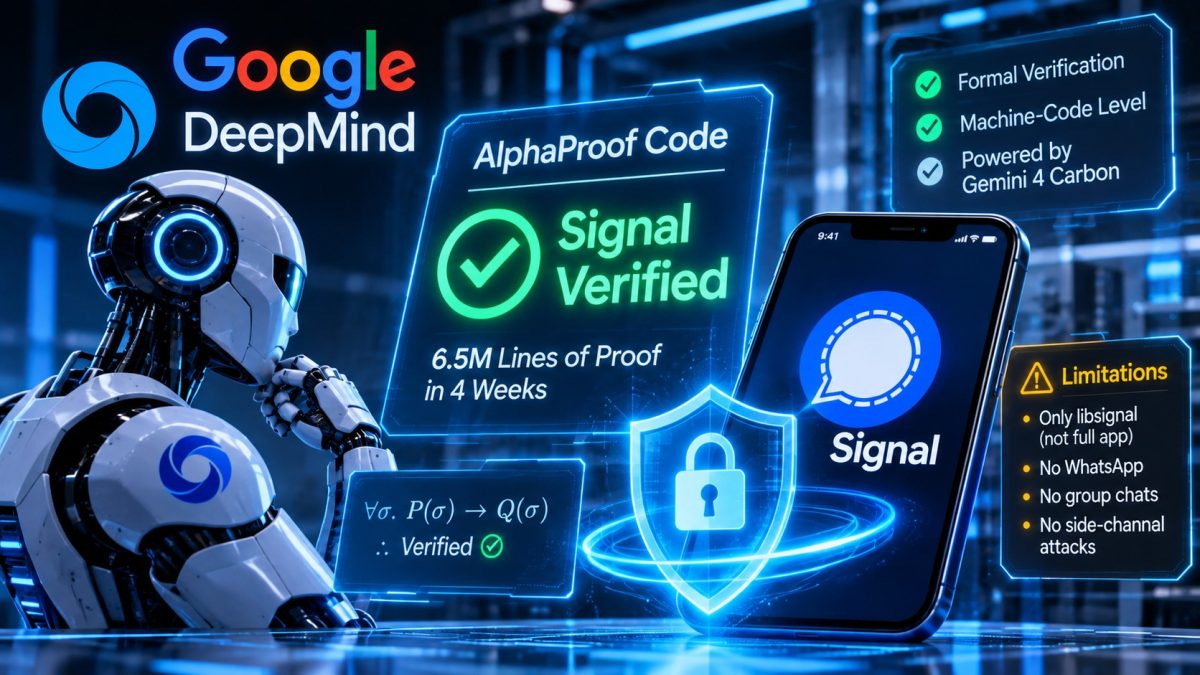
On November 10, 2026, Google DeepMind said its AlphaProof Code system had formally verified the Signal protocol, the encryption that keeps messages private. DeepMind says it’s the first time AI has been used to formally verify a widely used cryptographic protocol this deeply. It also says it’s the first time the actual implementation of a protocol like this has been verified by any method. But “verified” doesn’t mean “zero bugs.” It’s a math proof that a piece of code follows a specific rulebook that humans wrote.
How big was it?
Pretty huge. A team of just five people at DeepMind used AI agents powered by Gemini 4 Carbon, and in four weeks the agents wrote about 6.5 million lines of math proofs in a language called Lean. They checked key security promises at the machine-code level, which is the actual compiled code that runs on a device. Lean works like a super strict teacher. It rejects any step that isn’t logically correct, so the AI can’t just make up a fake success. For comparison, verifying the seL4 microkernel took twenty person-years.
What it didn’t cover
There are some big limits. The proof covers libsignal, the main code library behind Signal, run through a command-line tool. It does not cover the whole Signal phone app. It also doesn’t cover WhatsApp, even though WhatsApp uses the same protocol. Group chats, side-channel attacks (where someone learns secrets from things like timing), and key generation were also left out. The proof also assumes the basic encryption math works perfectly.
The human part
The AI wrote around 6.5 million lines of proof, but humans guided and approved the rulebook, which is called the specification. This is the weak spot of the whole method. Lean only checks if the code matches the spec. If someone writes a bad or incomplete spec, a perfect proof just confirms the wrong thing.
The sanity check
To test it, the researchers put two old, already-fixed bugs back into a copy of the code. The AI agents then produced proofs showing those buggy versions were insecure. The system found no new flaws in the parts it covered, but catching known bugs shows it can spot broken code.
Why it matters
Verifying big systems used to take forever. If AI can do the hard proof-writing, then checking other important software could become affordable. DeepMind also put the specs and Lean proofs online so anyone can check them. So AI can’t magically get rid of every bug, but it can make the best kind of security checking a lot faster.


