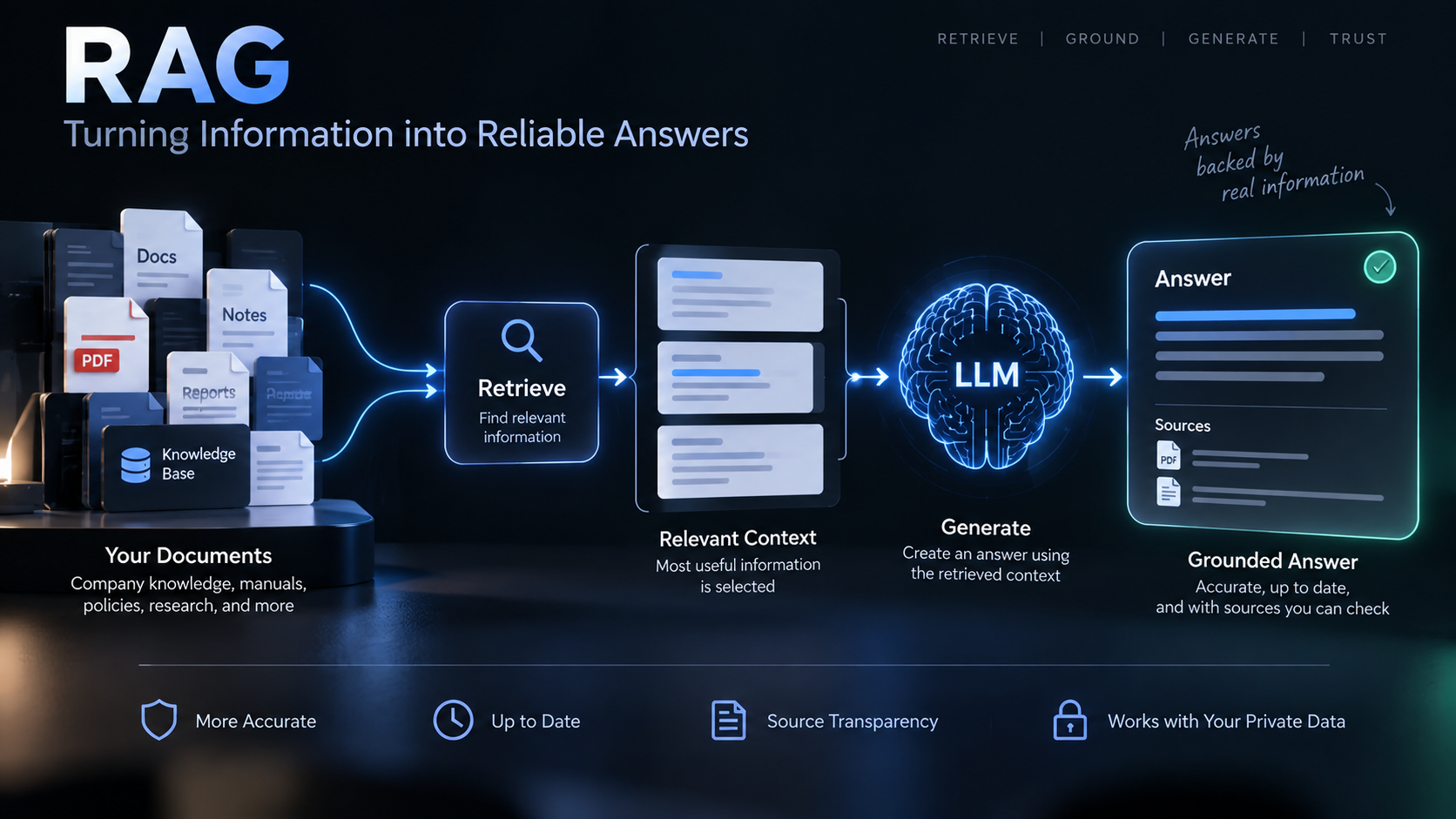
Ask a normal chatbot, "What's our company's remote-work policy?" It will answer anyway. But it's just using what it learned about remote work in general, from the internet, months or years ago. It has no idea your company even exists, let alone what your policy says. It's not really lying. It's just guessing with confidence, like a new employee would if you never gave them the handbook.
RAG fixes this problem. The idea behind it is simple: before answering, go look it up first.
So what does RAG actually mean?
RAG stands for retrieval-augmented generation. That sounds complicated, but it just means two things. Retrieve means search for the right information first. Generate means write the answer using what you found. Instead of relying only on what it memorized during training, the AI searches through real documents. These could be your company's policies, product manuals, or research papers. It finds the useful parts, then writes its answer based on that.
Researchers at Meta first came up with this idea in 2020. They were trying to solve two problems at once.
AI models are good at writing smooth, natural language, but not always good at knowing specific facts. And there was no way to check where an answer actually came from. Adding a search step before the AI answers solved both problems.
How is this different from just asking a chatbot?
A normal chatbot answers from memory. It only knows what it learned during training, and that training has a cutoff date. It knows nothing private about your company. Ask it about last week's meeting notes or your company's pricing sheet, and it simply doesn't know. Sometimes it will admit that. Other times, it makes something up that sounds convincing.
A RAG system works differently. When you ask a question, it first searches a specific set of documents for anything relevant. It doesn't just match keywords — it looks for meaning. Then it hands the AI model the actual matching text along with your question. Basically, it says: "Answer this, using this information." The model still writes the answer in natural language. It just isn't guessing anymore. Good RAG systems also show which document the answer came from, so you can check it yourself.
Why this makes answers more trustworthy
Sometimes AI states something false with full confidence. People in the industry call this hallucination. It happens because the model is built to sound fluent and convincing, not to know when it's actually unsure. Grounding its answer in a real document doesn't remove this risk completely. But it gives the model something real to work with, instead of just guessing from memory. And it gives you a source you can check.
RAG also solves a more practical problem: keeping AI up to date. Retraining a large AI model takes time and money, and you'd have to redo it every time something changes. With RAG, you just update the documents it searches. Change the policy document, and the AI's next answer will reflect that. No retraining needed.
Why companies use this for internal knowledge
This is exactly why RAG has become the standard way companies build internal AI assistants. These are the tools that answer employee questions using company handbooks, product manuals, or compliance rules. One industry survey found that RAG-style adoption among large companies passed 50% by 2024. That's a sharp rise from the year before, and it's kept growing since.
RAG also solves a privacy problem companies actually care about. A well-built RAG system only searches documents an employee is already allowed to see, using the company's existing permission system. If someone asks about a colleague's HR file they don't have access to, the system simply won't retrieve it. The AI can't leak information it was never allowed to look at in the first place.
It's not magic, and it's not the whole answer
RAG isn't perfect. If the documents it searches are outdated, messy, or just wrong, the AI will confidently repeat those mistakes too. It's only as good as the information it's allowed to find. This is the same lesson that applies to AI and data in general. And for tasks that need multiple steps of reasoning across many connected facts, simple document search can fall short. That's why newer versions now combine RAG with structured knowledge maps.
Still, the basic idea holds up. An AI that looks something up before answering will always be more trustworthy than one that's just guessing from memory. That's not a high bar, but RAG clears it easily. That's exactly why it has become the default way serious companies build AI systems today.