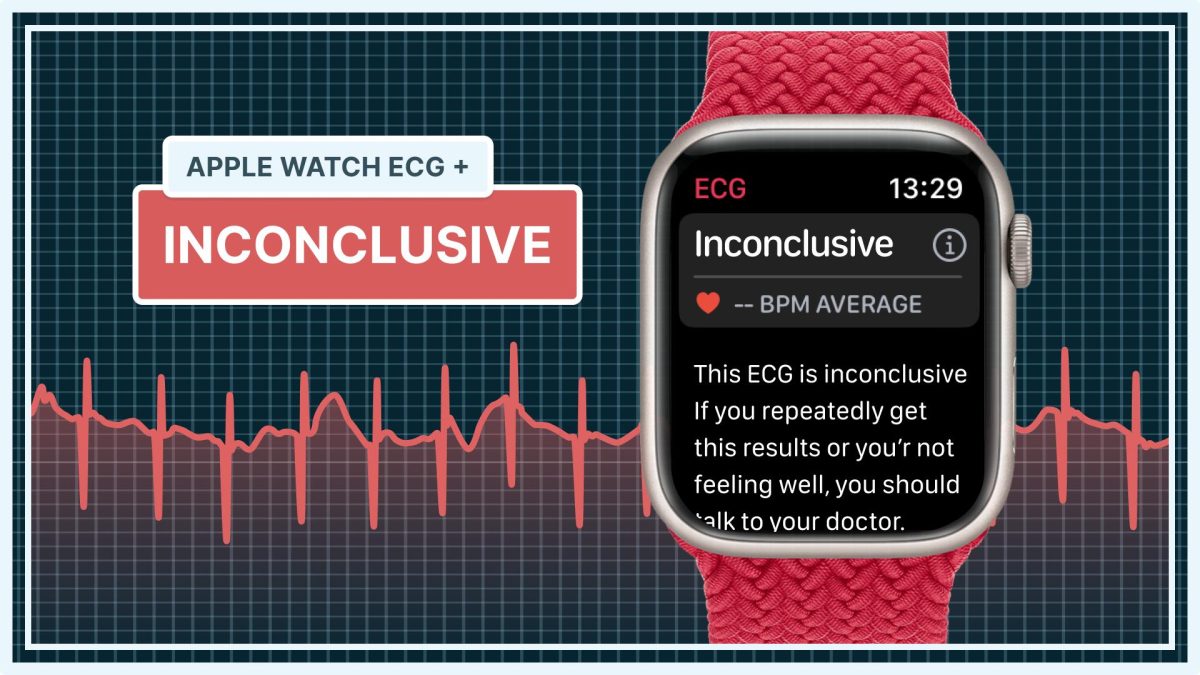
Here is how the Apple Watch ECG looks in one study. Ignore the results it could not read, and it spots 96.1% of people with atrial fibrillation, a common irregular heartbeat. Count those unreadable results as misses, and it spots only 78.1%. On November 5, a Belfast company called PulseAI announced FDA 510(k) clearance for AI that reads smartwatch ECGs.
The Problem With “Inconclusive”
A smartwatch can record an ECG, which is a line that shows your heartbeat. Then the watch gives one of three answers: atrial fibrillation, normal, or inconclusive. Inconclusive means it could not tell.
Most studies leave out the inconclusive results. They also give each person only one try. That makes the watch look better than it is.
Researchers at Ulster University and PulseAI tested this in a study in Heart Rhythm. They used Apple Watch recordings from 296 people at a hospital in Ireland. They counted the results three ways: leave out the inconclusive ones, count them as wrong, or allow up to three tries.
How often the watch caught atrial fibrillation: 96.1%, then 78.1%, then 92.2%. How often it correctly cleared healthy people: 97.9%, then 81.0%, then 91.0%.
How the AI Works
PulseAI’s tool is a neural network. That is software that learns by studying many example ECGs. In atrial fibrillation, the beats come at uneven times, and the P wave is missing. The P wave is a small bump that normally comes before each main spike. The AI can learn to spot these signs, even in messy recordings.
It read the same recordings as the watch. Inconclusive results fell from 17.6% to 1.4%, a 92% drop. Those two numbers come from news coverage, not the study’s summary. When inconclusive results were counted as wrong, the AI caught 98.4% of cases and correctly cleared 96.1% of healthy people. It was also more steady. When it read the same person again, it gave the same answer more often than the watch did. The score was 0.96 against 0.77, where 1 means always the same.
PulseAI says only that it trained the AI on “large-scale ECG datasets.” It has not shared how the AI is built or what data it used. The full study was not public until November 7, 2026, so I could not read it.
Why It Matters
Every inconclusive result means another recording, more staff time and more follow-up. A test can look great on paper and still be hard to use. Counting these results shows the real picture.
What We Still Don’t Know
The company has not shared the FDA 510(k) number, a launch date or which devices will work with it. FDA clearance means the tool can be sold. It does not prove that patients get better care.
The study was small: one hospital and 296 people. PulseAI paid for it, and its CEO is one of the authors. The summary also does not say what the AI’s results were checked against.