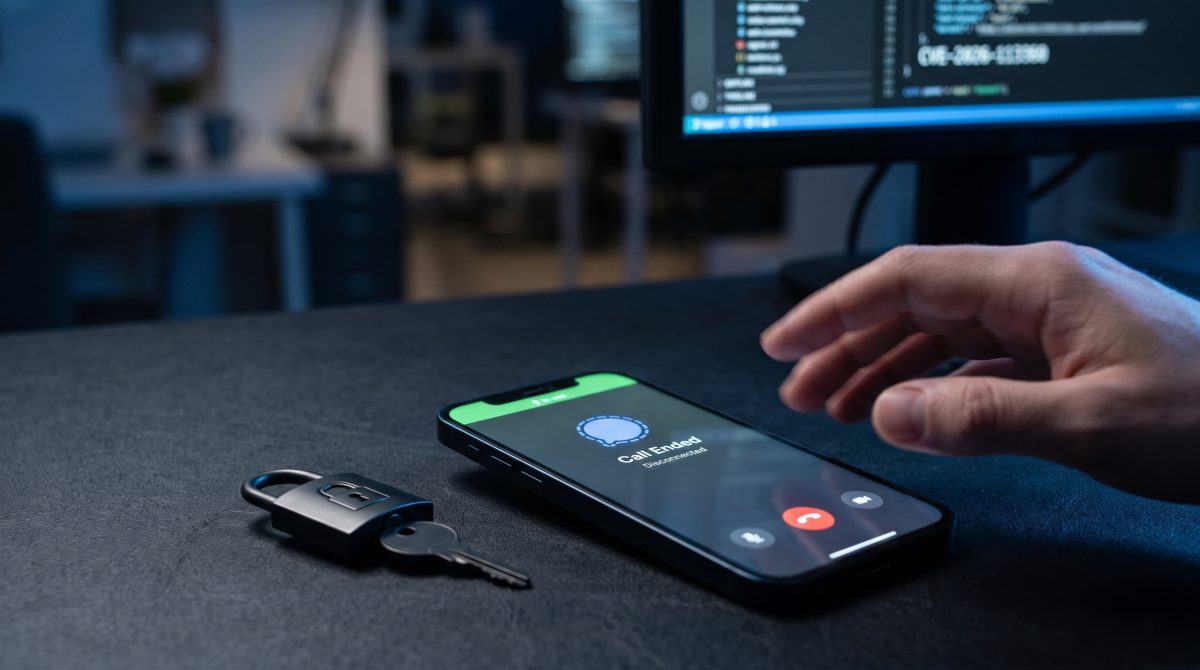
On 20 October 2026, a public record appeared for a critical Signal vulnerability that affects how the app ends calls. It is tracked as CVE-2026-113380 (CVE stands for Common Vulnerabilities and Exposures, a public list of security flaws) and sits in RingRTC, the open source library behind Signal’s voice and video calls. The record says a person on the other end of a call can interfere with a hang-up, so audio, and possibly video, may keep flowing.
What the Flaw Does
SecurityWeek reports that RingRTC runs each call as a finite state machine, a program model that moves a call through fixed stages, with events waiting in a queue. A hang-up was one more event in that queue. The other caller could flood it with junk, so the hang-up waited behind the noise and the call never ended. Researcher Imahian called it “no rate limit on peer-originated events and no priority lane for hang-up,” Help Net Security reports.
How Serious Is It
The CVE record, assigned by the organisation MITRE, gives the flaw a severity score of 9.3 out of 10, labelled critical. The score measures technical severity, not how many people are affected. RingRTC versions before 2.72.0 are listed as affected. Help Net Security reports that the attacker must place an ordinary call, the proof of concept is only conceptual, and no attacks in the wild are known. Malwarebytes says message encryption is not affected.
What Signal and Others Have Said
We found no public statement from Signal. SecurityWeek says the fix shipped in RingRTC 2.72.0, released on 4 September, with details published on 20 October. The US Cybersecurity and Infrastructure Security Agency (CISA) added assessment data to the record, listing exploitation as none. The Register reports that Signal Desktop’s release history shows RingRTC 2.72.0 arrived in September, but rollout dates for Android and iOS are unclear.
Our Analysis
This is not the first time a calling feature has failed users at a moment of trust. In January 2019, a Group FaceTime bug let callers hear an iPhone before it was answered. CBS News reported that Apple issued a statement, promised a fix and made the group feature unavailable. In October 2019, SecurityWeek reported that Signal patched an Android bug, found by Google Project Zero researcher Natalie Silvanovich, that let a caller force a ringing call to be answered.
Encryption protects what travels between phones, but these bugs sit in call control, which decides when audio starts and stops. So strong encryption alone does not settle whether a call is safe. What is missing here is a dated list of fixed Android and iOS versions. Without it, users cannot tell whether the 46 days between the 4 September library release and the 20 October disclosure left their phone exposed. Apple told users what was happening in 2019; Signal has not yet said which apps carry the fix.
What Users Should Do
Help Net Security advises keeping Signal updated on every device used for calls. SecurityWeek adds that users should check the call indicator after hanging up to confirm the call ended. Because Android and iOS rollout dates are unclear, updating every phone and computer is the safest step.