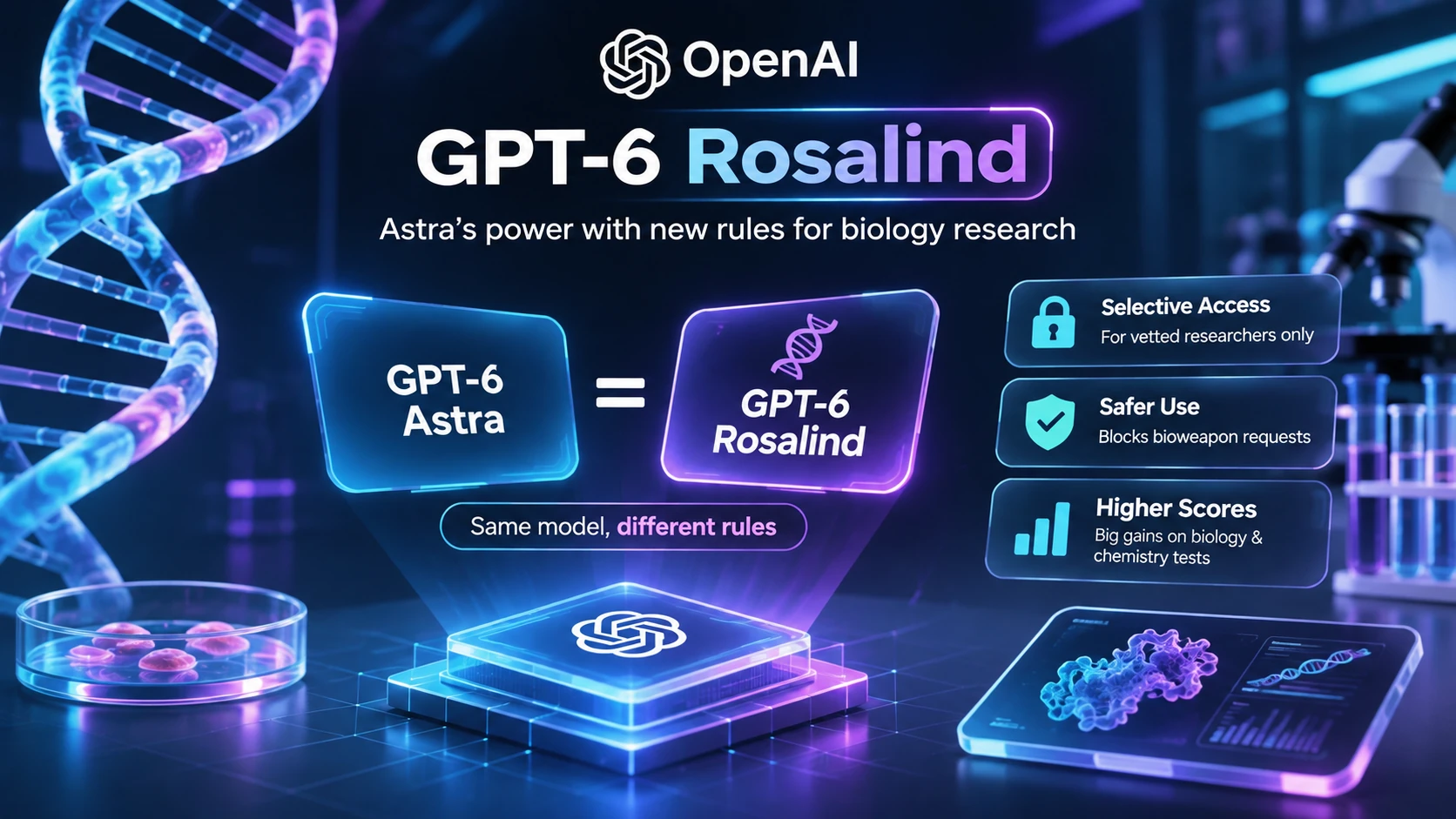
OpenAI did not build a new AI model for biology. When it released GPT-6 Rosalind on October 30, 2026, its own system card said the model uses the exact same weights as GPT-6 Astra, its main model. Weights are the numbers that store what an AI has learned, so both models share the same learned knowledge. OpenAI added no new training data, so the real difference lies in the rules wrapped around it.
Same Model, Different Rules
Two changes matter here, and the first is what the model will answer. Rosalind refuses fewer dual-use biology questions, meaning questions that could be used for good or bad. A general model may block them even though researchers need answers, yet OpenAI says it still refuses requests that would help someone build a biological weapon.
The second change is access, since only approved customers can use the model. OpenAI checks each applicant's mission, use case and security, and customers must limit use to approved staff. A qualified person must also review outputs before they guide experiments.
What the Test Scores Show
OpenAI reports big gains over its older model, GPT-Rosalind-5.5. On MedChemBench, a chemistry test, the score rose from 28.9% to 49.6%. On GeneBench Pro, a data-analysis test, success rose from 16.7% to 37.7%, and on LifeSciBench Gold the score rose from 44.0% to 61.3%.
OpenAI ran every one of these tests itself, and I found no outside check. The older model was retested on the same problems, so its scores differ from the numbers published at its launch. Since no new training was added, the gains most likely come from the stronger Astra base rather than biology tuning, though that is my reading, not OpenAI's claim.
How Risky Is It?
OpenAI rates the model High for biology and chemistry risk, one step below its top tier, Critical. None of its four Critical-level biology tests crossed the warning line, though the model keeps Astra's Critical rating for cybersecurity.
One number stands out: on a biorisk knowledge test, Rosalind-6 refused 9.4% of questions. That compares with 29.2% for Astra and 1.8% for the older Rosalind-5.5, so the new model is more open than Astra but stricter than the one it follows.
Who Checks the Gatekeeper?
Gating moves part of the safety job from the model to the people using it. OpenAI says it red-teamed its monitoring on Rosalind-5.5, meaning testers tried to break it, and it is repeating that test for GPT-6 Rosalind without sharing details publicly. Outsiders can only check what they can reach, so a gated model is harder to audit, which is my view, not OpenAI's.
When OpenAI launched the first GPT-Rosalind in April, it named Amgen, Moderna, Thermo Fisher Scientific and the Allen Institute as partners, but the new card names none. Its GPT-5.5-Cyber model, released to vetted security teams on May 7, follows the same pattern of one model with several rule sets. For now, the case for that approach rests on OpenAI's own documents.