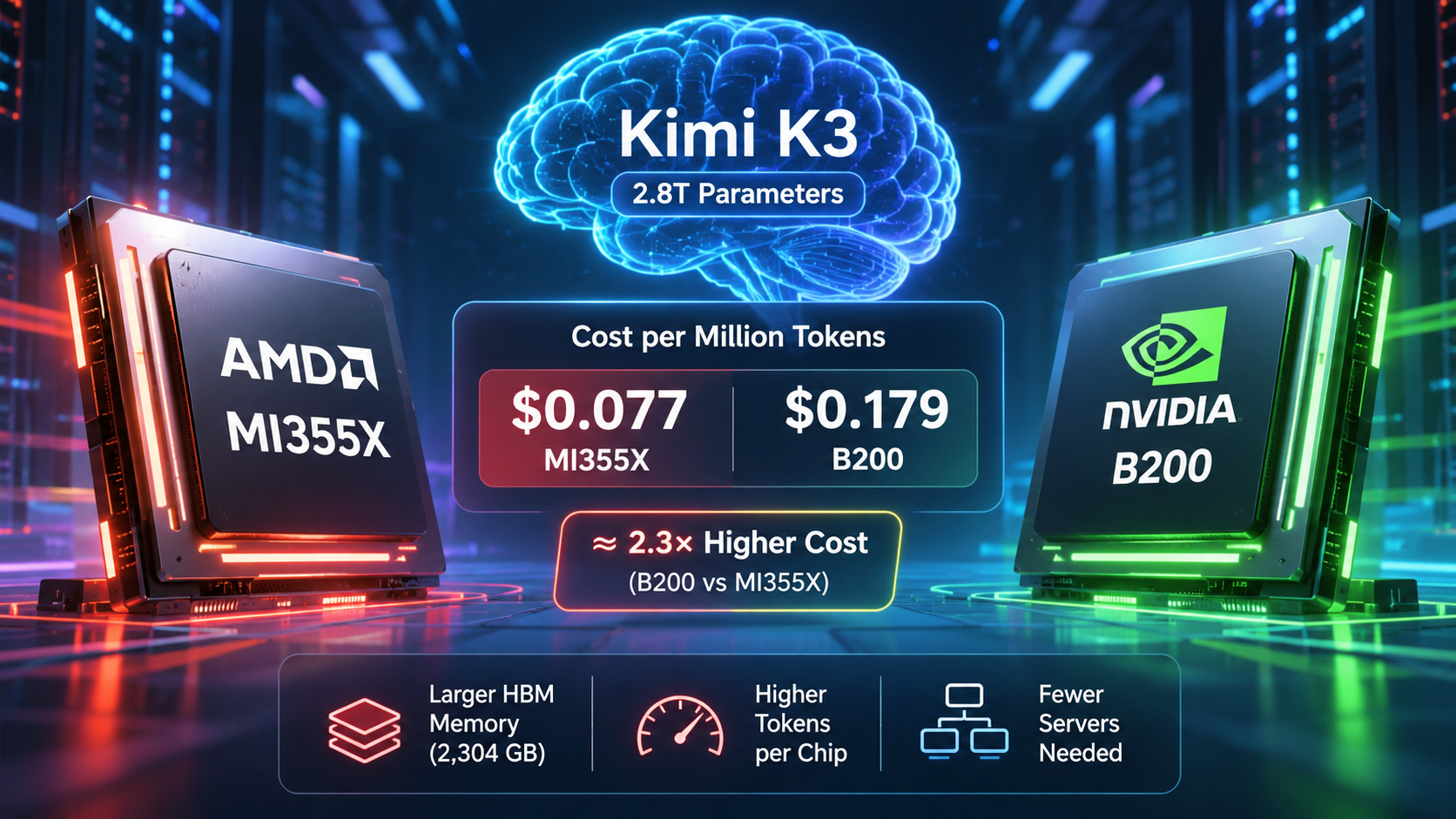
The AMD vs Nvidia race has a new data point. On October 31, 2026, SemiAnalysis said its InferenceX test shows AMD’s MI355X chip running one huge AI model for about half the cost of Nvidia’s B200 chip. The model is Kimi K3 from Moonshot AI, with 2.8 trillion parameters. It is real, but not the full story.
AMD vs Nvidia: What the Numbers Say
AI models handle text in small pieces called tokens. InferenceX copies real coding sessions and prices one million tokens. “Tokens per second per user” means how fast text appears for one person.
At 100 of those, one million tokens cost $0.077 on the MI355X and $0.179 on the B200. So the B200 costs 2.3 times as much. At two other speeds it is about 1.9 times. Faster service costs more: on the B200, $0.089 at 57 tokens per second rises to $0.275 at 144.
Why Memory Drives the Gap
Kimi K3 is a mixture-of-experts model. Only about 104 billion of its parameters work on each token, but all 2.8 trillion must stay in memory. One MI355X server has 2,304 GB of fast memory, called HBM. One B200 server has less than 1,500 GB.
So the B200 needs two servers, and data must cross a slower network between them. By my math, the MI355X handled about twice as many tokens per chip at 100 tokens per second per user. That explains most of the gap.
What It Means for Real Projects
These costs are not real bills. SemiAnalysis’ cost model assumes $1.73 per hour for each B200 chip and $1.50 for each MI355X, for a big company that owns its chips. Renters pay different prices. Wafer assumed rental prices of $2.50 for the MI355X, $4.25 for the B200 and $6 for the B300, and in its own test found the MI355X best per dollar.
In Wafer’s test, a B300 server moved about 1.65 times more tokens per second than an MI355X server, at 2.4 times the assumed price.
There is also developer work. Wafer reported needing two software fixes to run Kimi K3 well on AMD’s software. My takeaway: budget engineering time, not only chip cost.
Read the Comparison Carefully
Another summary says the MI355X is up to 46% cheaper than Nvidia’s GB200 NVL72, a larger rack-style system. That is at the fastest speed. At slower speeds it says 20% to 35%.
That 46% may be the wrong way round. It looks like GB200 costs 46% more, which is not the same as AMD being 46% cheaper. With prices of $0.15 and $0.22, the saving is about 32%. This is my estimate, from rounded prices.
Newer Nvidia chips (B300, GB300 NVL72) look cheaper than the MI355X on some other InferenceX pages. I could not date those, so I left them out.
For very large models, memory in each server can matter as much as chip speed. We do not yet know if that holds for other models and real customers.