Teaching a robot to pick up a cup may look simple, but it takes a lot of practice. Engineers usually have to show the robot the same task many times. To make this easier, Runway released Praxis-1 on November 11, 2026. It is an AI model that helps robots learn movements from videos. Developers can now download it and use it with their own robots.
What Is Runway Praxis-1?
Runway is a company known for its AI video tools. It first introduced Praxis-1 in September 2026 and tested it with companies like Noble Machines, Standard Bots and Ultra.
Now, Runway has made the model and its code available to everyone under the Apache 2.0 licence. This means developers can study, change and even use it for commercial projects.
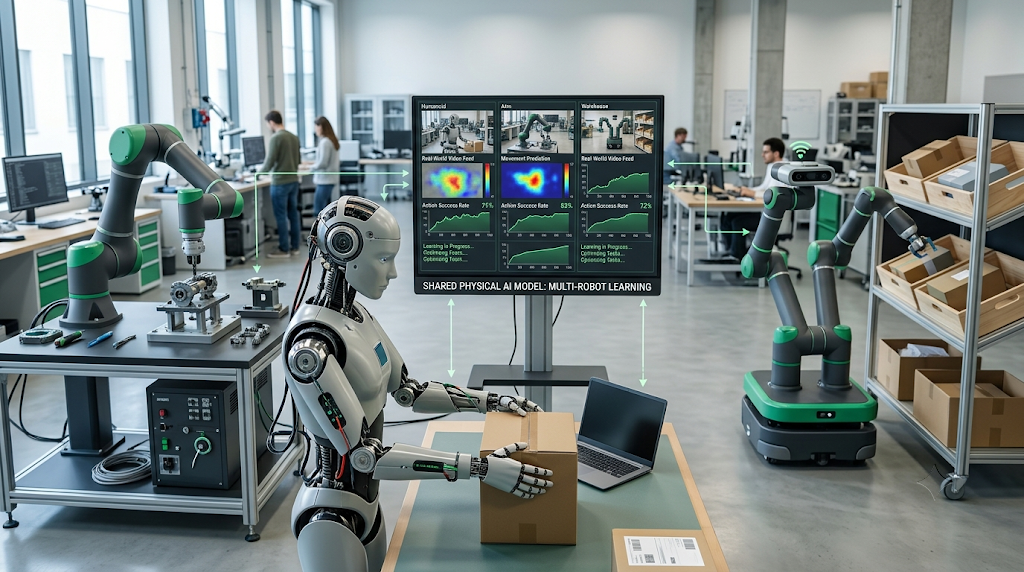
Runway calls Praxis-1 a world action model because it learns from videos and helps robots decide how to move.
How Does Praxis-1 Work?
Praxis-1 has 27 billion parameters. These are like small settings that help an AI model remember what it has learned.
The model looks at camera images, written instructions and the robot's current position. It then predicts what might happen next and how the robot should move.
For example, if a robot needs to pick up a cup, the model can predict how the movement should look before guiding the robot.
Runway says Praxis-1 learns mainly from normal videos. Developers can then give it extra training to work with their own robots.
Why Is This Important?
Training robots usually takes a lot of time and effort. Engineers need to collect many examples before robots can perform tasks properly.
Praxis-1 could make this process easier because it already learns about objects and movement from videos.
Another benefit is that developers can access its code. They can test the model, make changes and try to improve it.
Runway also tested Praxis-1 using RoboLab-120, a computer simulation with 120 tasks. The company reported a 46.2% success rate across 1,200 attempts. This result comes from Runway's own testing.
What Are the Challenges?
Praxis-1 still has some limitations. A 46.2% success rate means that more than half of the tested attempts were unsuccessful.
The tests were also done in simulation, not real factories. So, the results do not prove that the model can work safely in every real-world situation.
Another problem is computing power. Runway recommends a powerful graphics card with at least 80 GB of memory for its standard setup.
Developers still need to check robot safety, compatibility and performance.
What Happens Next?
Researchers can now test Praxis-1 on different robots and see how well it works. They can also study its mistakes and try to improve the model.
Praxis-1 is not a perfect solution yet. However, making it openly available gives more developers a chance to experiment with robot learning and help improve the technology.