Look at a glass of water on a sunny table. Light bends through the glass, casts a bright spot on the wood, and reflects your hand. For decades, video games used fast visual shortcuts to fake those effects. Today, ray tracing and path tracing simulate how real light moves, trading raw frame speed for visual realism.
How Real Light Simulation Changes Digital Scenes
Traditional graphics rely on rasterization, which maps 3D shapes onto a flat 2D screen and paints shadows using pre-drawn textures. It runs quickly, but reflections break whenever an object leaves the camera's view.
Ray tracing fixes this by sending virtual rays from the camera into a scene to check how surfaces interact with light sources. Hardware makers build dedicated ray-tracing cores into modern graphics chips to calculate these intersections in real time Intel Gaming Resources.
Why Path Tracing Uses Hybrid Shortcuts in Games
Standard ray tracing usually handles only specific parts of an image, such as mirror reflections or sharp shadows, while rasterization draws everything else. Full path tracing replaces those shortcuts by tracing rays for every bounce of light across a scene NVIDIA Technical Blog.
Think of a red ball resting on a white floor. Path tracing calculates how red light bounces off the ball and softly tints the floor nearby. While film studios render offline path tracing for hours per frame, PC titles like Cyberpunk 2077 and Alan Wake 2 use low-sample hybrid path tracing paired with heavy denoising Digital Foundry.
Where Accurate Lighting Matters Beyond Games
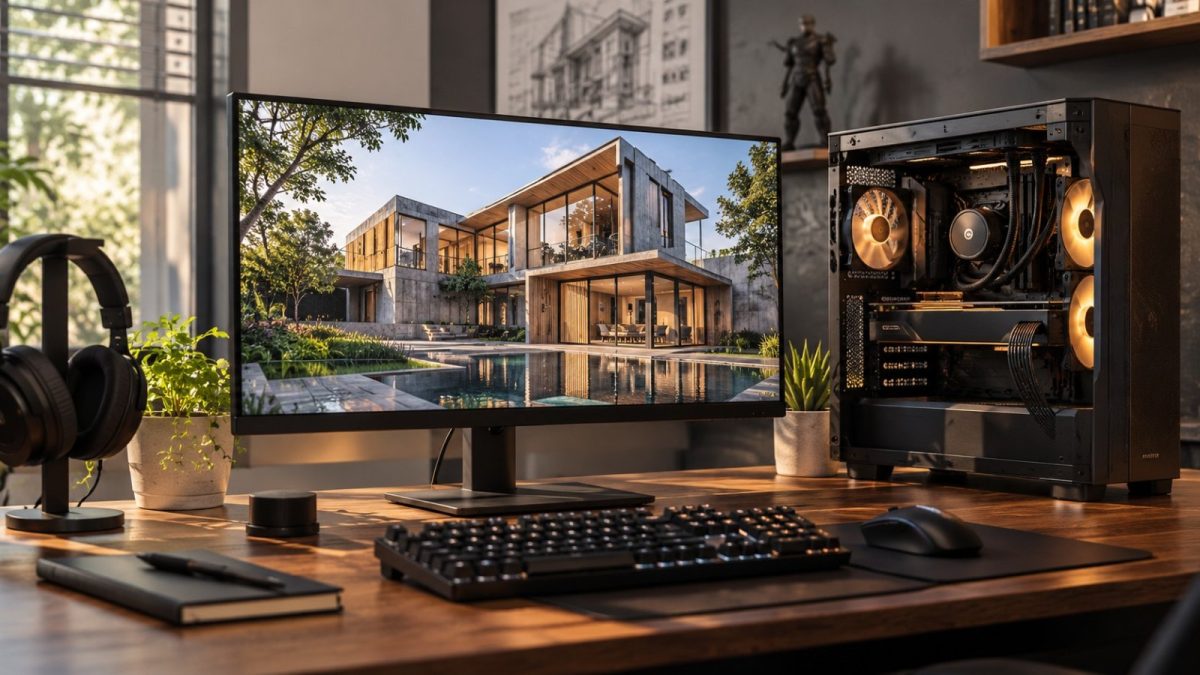
Outside entertainment, architects use physically based light simulation to measure how natural sunlight enters a building across different seasons before construction starts Physically Based Rendering.
Robotics engineers also depend on accurate light transport. In simulation platforms such as NVIDIA Isaac Sim, researchers train camera-based robots on realistic glare, glass reflections, and deep shadows so vision software does not fail when moving from virtual tests to real factories NVIDIA Developer.
The Steep Performance Cost and Visual Trade-Offs
Tracing millions of bouncing light rays demands enormous math throughput. In multi-GPU testing across 32 graphics cards at 1440p and 4K resolutions, enabling ray tracing and path tracing drops frame rates dramatically compared to standard rasterization, depending on the game engine TechSpot.
Even flagship graphics cards cannot render complex path-traced scenes natively at 4K at smooth speeds. Instead, engines trace very few rays per pixel and rely on AI denoisers and upscalers, which can sometimes introduce subtle motion blur or shimmering artifacts on fine textures Eurogamer.Q
What Comes Next for Real-Time Rendering
Graphics engineers are focused on reducing the math needed per pixel rather than simply adding larger chips. New neural rendering and ray-reconstruction algorithms clean up noisy, low-ray images faster than older hand-tuned filters.
As these efficiency methods mature, hybrid path tracing will gradually become practical on mid-range hardware, shifting realistic lighting from a demanding showcase setting to a standard design tool.