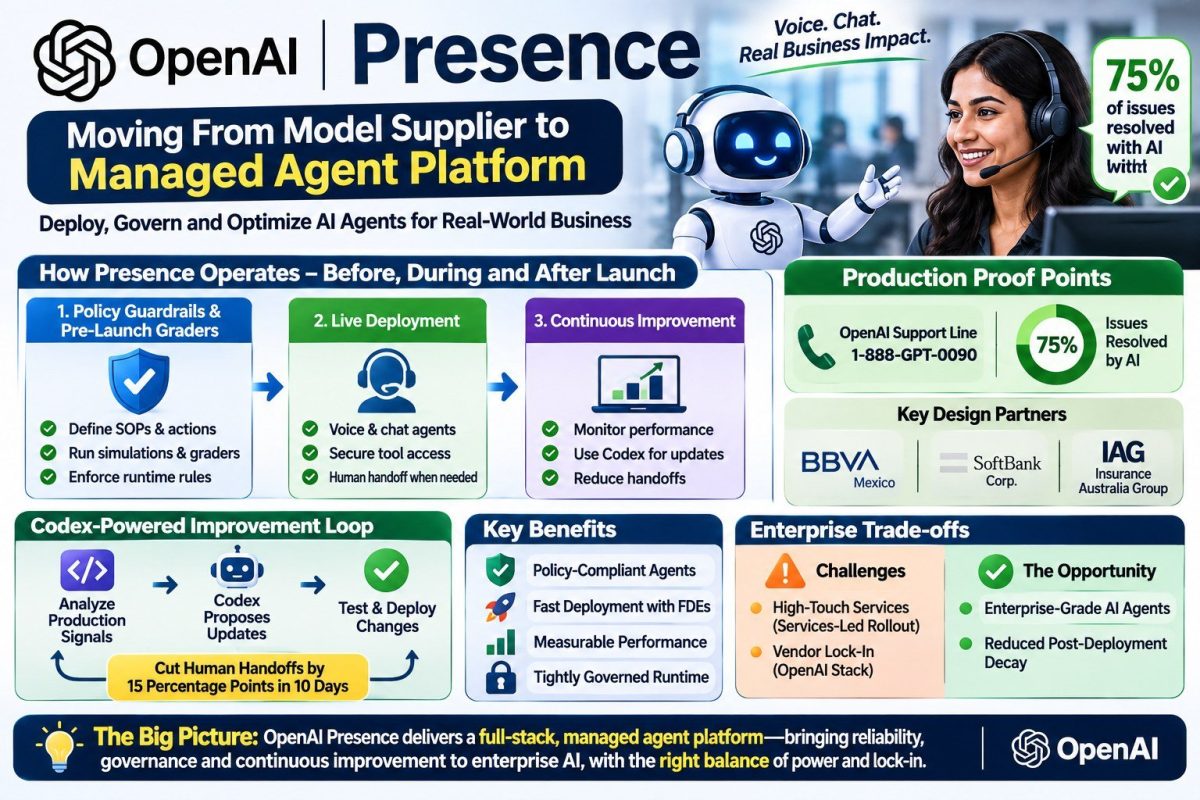
Companies that buy enterprise AI software don't usually fail because the models aren't smart enough. They get stuck when they have to connect everything, enforce policies, and keep tuning things after launch. In its official announcement for OpenAI Presence, OpenAI described a platform for building voice and chat AI agents for customer support, outbound sales, and internal work. It isn't a do-it-yourself toolkit, though. Presence is a limited general availability program run by OpenAI's Forward Deployed Engineers (FDEs) and a few select global systems integrators.
Every project starts with one tightly defined job, like answering billing questions, guiding insurance claims, or handling employee IT requests. The agent only gets the knowledge bases and system permissions it needs for that one job.
How Presence works before, during, and after launch
According to OpenAI's product documentation, Presence combines foundation models with a full lifecycle setup that covers policy controls, testing before launch, and improvement afterward.
Policy rules and pre-launch graders. Company teams set their standard operating procedures, which backend actions are allowed, guardrails while the agent runs, and when to hand off to a human. Before an agent talks to real customers, Presence runs automated simulations and graders on common requests, weird edge cases, and high-risk situations. These checks make sure the agent follows policy, uses its tools correctly, and passes the case to a person when it should.
Narrow jobs and design partners. Instead of letting open-ended chatbots roam around a whole company, Presence keeps each agent focused on one customer-facing or internal task. Early design partners testing it on voice and busy workflows include BBVA in Mexico for everyday banking support, SoftBank Corp. for Japanese-language customer service, and Insurance Australia Group (IAG) for surges of claims during severe weather.
Codex improvement loop. Once it's live, Presence watches real sessions, escalations, and quality numbers to find where policies or edge cases are failing. Using a special Presence plugin, OpenAI's Codex coding agent looks into those signals and suggests changes to the setup or workflow. Human teams test each change against the live baseline before approving a controlled rollout.
Things to think about
I think bundling Forward Deployed Engineers with a Codex tuner that keeps improving things is OpenAI's biggest step yet from just selling an API to selling a full enterprise product. Selling senior-led setup shows that raw model APIs aren't enough on their own for regulated customer service. But it also pushes companies toward running workflows managed by the vendor instead of owning their own orchestration stack.
Still, CIOs should think about two trade-offs before signing up for a limited-availability Presence project.
It's hands-on, so it can be slow. Presence isn't self-serve yet, so how fast you get started depends on whether OpenAI's FDEs and approved integrators have time, not just how fast your own engineers can move.
Lock-in. Some contact center tools let buyers swap out the foundation models underneath. Presence ties policy execution, simulation grading, and post-launch updates straight to OpenAI's own stack.
What happens next
By combining narrow job permissions, pre-launch graders, and automatic Codex tuning, OpenAI goes after the problem where bots get worse over time after launch. Companies with lots of policy-heavy support work who qualify for the limited rollout get a well-controlled path to production, as long as they're okay with vendor lock-in and onboarding led by services.