What Happened
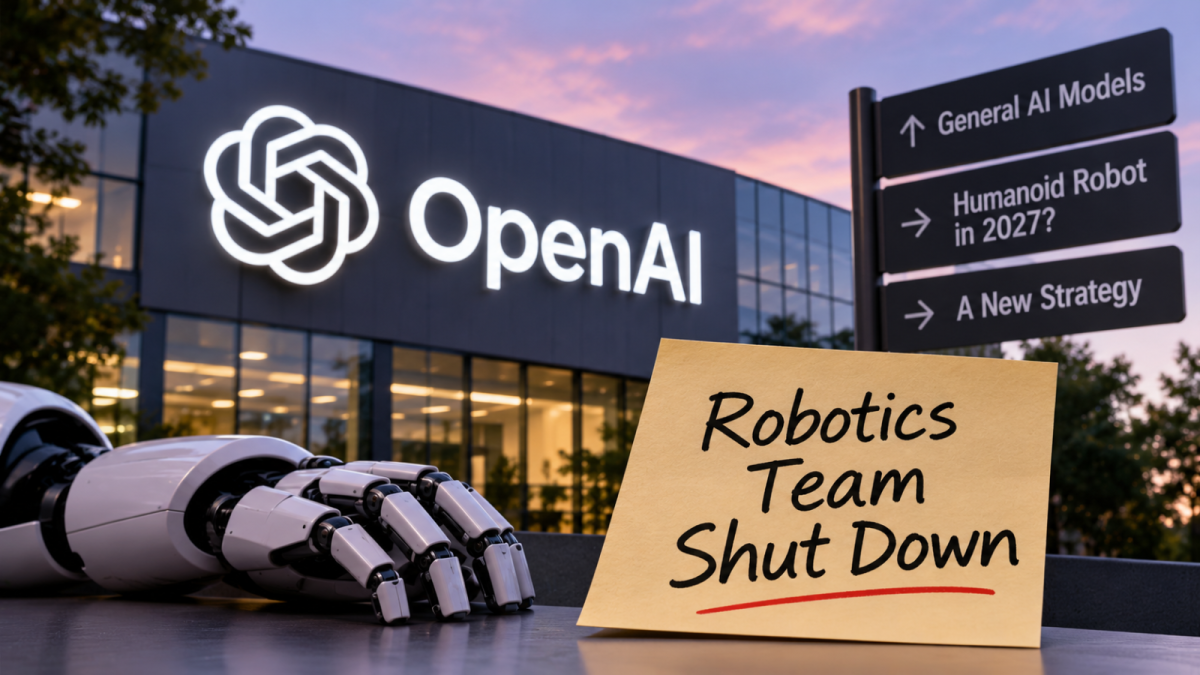
OpenAI has closed its standalone robotics team for the second time. Fortune reported this in an exclusive on November 13, 2026. The researchers from the team were moved to the main research group, which is led by Chief Research Officer Mark Chen. The people who worked on robot hardware and real-world use moved to the Applied group, which is led by President Greg Brockman.
OpenAI’s Big Idea
OpenAI says this doesn’t mean it’s giving up on robots. It says robotics is still an important part of its long-term plan. But it believes the best way to build robots that can do many jobs is to use its biggest AI models, not special robot-only ones. These big models can work with language, code, images, and physical controls all at once.
The company points to its model GPT-6 Astra. It says a general-purpose model like this can be used for robot tasks right away, without a separate training system built just for robots.
The Case for General AI Models
This brings back an old debate. Should robots use a specialist AI built for one job, or a generalist AI that can do many things? People who like the generalist idea point to a study from Nvidia called “Astranomy: An Empirical Study of GPT-6 Astra as a native robot policy.”
In the study, an AI agent powered by Astra tried pick-and-place tasks in a computer simulation. It got a 74.8% success rate on a test called RoboLab-120. The best specialized robot models averaged only 51.0%. So Astra did much better in that test.
The Case Against It: Simulations Aren’t Real Life
Outside robotics experts say a simulation doesn’t show everything. A real factory floor is messier than a computer test. Critics also say big general models are slow. In some setups, they take over 18 seconds to respond to a single call. That’s a problem for robots that have to react fast and handle objects with care. Without a lot of extra tweaking on the robot itself, it would be hard to use them for real-time work.
The Case Against It: A Bumpy History
OpenAI’s robotics story has had a lot of ups and downs:
- 2020: OpenAI shut down its first robotics team because it didn’t have enough training data.
- 2024: It brought back a standalone team and started a high-profile partnership with Figure AI.
- February 2025: The Figure AI partnership ended.
- Now: The robotics team is being spread out across the company.
What Comes Next
Even with these changes, CEO Sam Altman still wants to show a humanoid robot in public in 2027. Meanwhile, other companies are choosing a different path. Google, for example, is putting more effort into AI models built just for the physical world, like Gemini Robotics 2.5.
So OpenAI is making a big bet. It wants to find out if a smart general AI can do the job without a special robot brain built for it. If the bet works, it could change how robots are built. If it doesn’t, OpenAI may end up having to bring back a dedicated robotics team once again.


