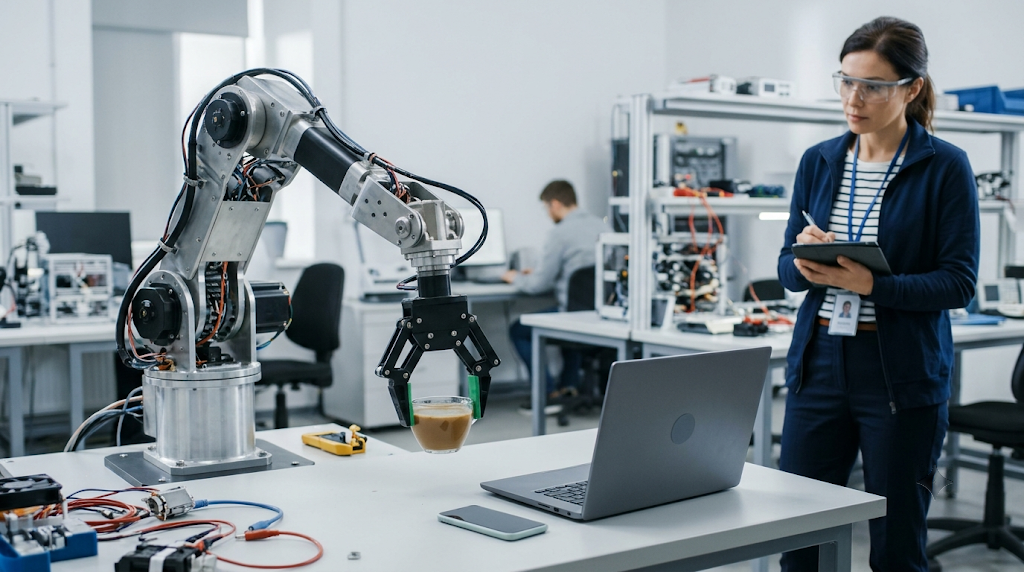
Imagine a robot carrying hot coffee across a table. You tell it, "Don't spill coffee on my laptop!" But what about the phone next to it? Coffee could damage that too. A new AI system called FLEX, developed by researchers from MIT and New York University, aims to help robots understand what people really mean instead of just following their exact words.
How Does FLEX Help Robots Understand People?
On November 9, 2026, MIT shared information about a new AI system called FLEX.
FLEX stands for Flexible Feature Editing Pipeline. It helps robots understand simple instructions and make better decisions without people explaining every small detail.
The main idea is to help robots understand why something is important, not just what they are told to do.
For now, FLEX is still a research project. Most of its testing has been done using computer simulations.
How Does FLEX Work?
FLEX uses AI to help robots recognize objects, understand instructions and plan their movements.
It works in three steps: Add, Generalize and Mask.
First, Add helps the robot notice important objects. For example, if someone tells it to avoid a laptop, the robot considers the laptop while moving.
Next, Generalize helps the robot understand similar situations. If hot coffee can damage a laptop, it may also damage a nearby phone. The robot learns to consider both objects.
Finally, Mask removes information that is no longer needed. This helps the robot focus on important things.
According to MIT News, FLEX takes around five seconds to complete these steps.
How Was FLEX Tested?
Researchers tested FLEX using three computer simulations.
In the first test, a robot carried coffee near electronic devices. In another test, it moved a candle near objects that could catch fire. The third test involved moving a bowling ball near fragile objects.
Researchers also studied how robots move through different spaces and collected information using a real robotic arm.
FLEX performed better than some other methods in these tests. However, this does not mean it can handle every real-world situation safely.
Why Is FLEX Important?
People usually give robots short instructions. They do not want to explain every possible problem.
For example, a hospital worker might tell a robot to stay away from expensive equipment. A smart robot should also notice other nearby objects that could be damaged.
FLEX could help robots understand these kinds of instructions.
However, robots might sometimes misunderstand what people mean and make wrong decisions.
What Are the Challenges?
FLEX still needs more testing in real environments.
Its five-second processing time may be too slow when a robot needs to react immediately. Researchers also need to check how it handles confusing instructions and unexpected situations.
In the future, robots may need to ask questions when they do not understand something.
FLEX is an interesting step toward making robots easier to communicate with. But researchers must first prove that it can work safely and reliably in everyday situations.