On October 15, 2026, Mistral released Timestral, its first family of time-series foundation models. A time-series model forecasts numbers that change over time, such as sensor readings, energy demand, or sales. Mistral says in its launch post and model card that its largest model, with 209 million parameters, ranks first among pretrained zero-shot models on three public benchmarks: GIFT-Eval, TIME, and fev-bench. It also says it beats Google's TimesFM-3 with about two-thirds of the parameters. These results are Mistral's own, the margins are thin, and the technical report is still pending.
What Timestral Is
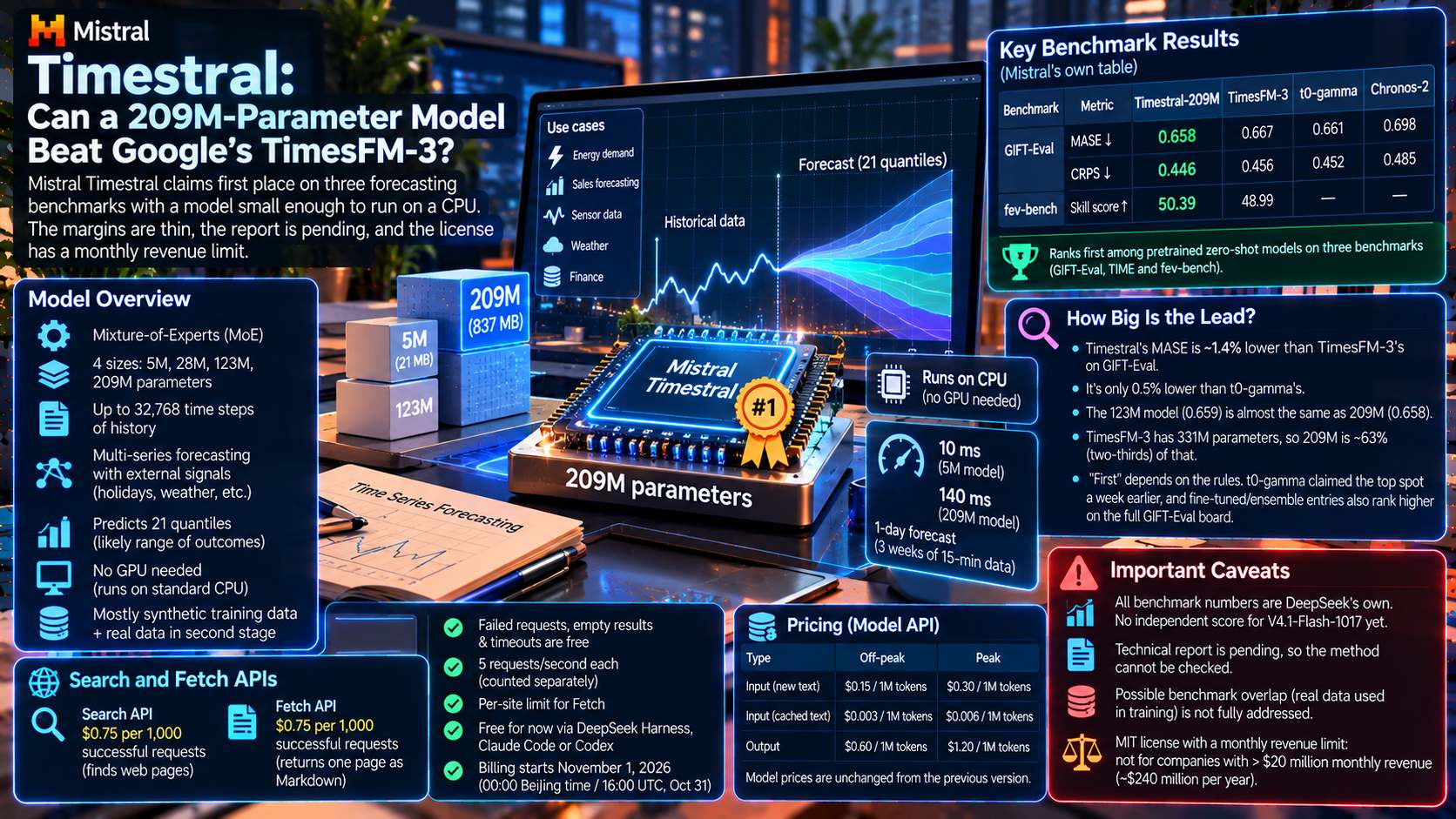
"Zero-shot" means the model forecasts a new series without any training on it first. Timestral comes in four sizes: 5M, 28M, 123M, and 209M parameters. The models read up to 32,768 time steps of history. They forecast several linked series together, and they can use outside signals that are known in advance, such as a holiday calendar or weather forecast.
Instead of one guess, Timestral predicts 21 quantiles. That gives a range of likely outcomes, so a team can see how uncertain a forecast is. Mistral's launch post says no GPU is needed. It reports that on a standard server CPU with 8 threads, a one-day forecast from three weeks of 15-minute history takes 10 milliseconds with the 5M model and 140 milliseconds with the 209M model. These are Mistral's own measurements.
Most training data was synthetic, meaning generated by computer. The models were first trained on synthetic data alone, then on a mix of real and synthetic data with a longer context. Mistral offers fine-tuning through Mistral Forge, including air-gapped setups.
What Mistral Claims
Mistral's launch post says Timestral-209M ranks first among pretrained zero-shot models on all five metrics across the three benchmarks. These are Mistral's own tallies. The post says the results come from a single checkpoint, without ensembling, and that they have been submitted to the GIFT-Eval and TIME leaderboards, not that they are listed. The Hugging Face model card tags the scores as results on all three leaderboards, but as of October 19 a listing for Timestral on those boards was not found, so the ranking has not been confirmed independently.
Two metrics matter here, and lower is better for both. MASE measures how far the median forecast is from the truth, compared with a simple baseline. CRPS scores the whole range of the forecast. The model card's table, dated October 15, 2026, gives these figures. On GIFT-Eval, Timestral-209M scores 0.658 on MASE, against 0.661 for t0-gamma, 0.667 for TimesFM-3, and 0.698 for Chronos-2. On TIME, it scores 0.626, against 0.637, 0.640, and 0.662. On GIFT-Eval CRPS it scores 0.446, against 0.452, 0.456, and 0.485. On fev-bench, its skill score is 50.39 against 48.99 for TimesFM-3, where higher is better. Mistral also says its 28M model beats Chronos-2, which is about four times larger, on GIFT-Eval and TIME.
How Big Is the Lead?
Small. Timestral's MASE is about 1.4% lower than TimesFM-3's, by simple arithmetic, and 0.5% lower than t0-gamma's. The 123M model scores 0.659, almost the same as the 209M, so the extra size buys very little at the top.
The two-thirds claim holds up. The technical report for t0, a rival model from The Forecasting Company, lists TimesFM-3.0 at 331 million parameters in its GIFT-Eval table, citing Google's Hugging Face release page. Google has not published a standalone paper for it. 209 is about 63% of 331.
"First" also depends on the rules. A rival, The Forecasting Company's t0-gamma, claimed the top spot on the same three benchmarks two days earlier, on October 13. In that post's figure notes, the company says GIFT-Eval's default view sorts by mean per-configuration rank, where t0-gamma is second to TimesFM-3. Mistral counts only pretrained zero-shot models. Another paper reports that fine-tuned and ensemble entries top the full GIFT-Eval board.
What Cannot Be Checked Yet
A technical report is promised but not out, so the method cannot be checked. The results are self-reported. No public leaderboard listing for Timestral was found. Benchmark overlap is also an open question. Real data entered the second training stage, and Mistral has not said how it kept benchmark datasets out. Mistral says Forge lets customers control training data so nothing they backtest was seen in pretraining. That describes a product feature, not proof about the public benchmarks.
The License Catch
The weights use a Modified MIT license, and the inference code uses Apache 2.0. The weights license allows free use, copying, modification, and distribution with an attribution notice. But you are not authorized to use them if your company's global consolidated revenue for the previous month exceeds $20 million. That is roughly $240 million a year, by simple arithmetic. The limit also covers derivatives. Large companies must ask Mistral for a commercial license or use its hosted service.
One report says TimesFM-3's weights are non-commercial, and lists Chronos-2 as Apache 2.0. For a large company, Timestral's license may be no easier than the alternatives.
What Could Come Next
In the near term, watch for the technical report, public leaderboard listings, and tests on real company data. Benchmark averages do not predict how a model handles one plant's sensors. The long-term picture is speculation. If small CPU-based forecasters keep matching larger ones, forecasting could move onto edge devices and into existing monitoring tools.