Copilotforce: Microsoft, Salesforce and Accenture Team Up
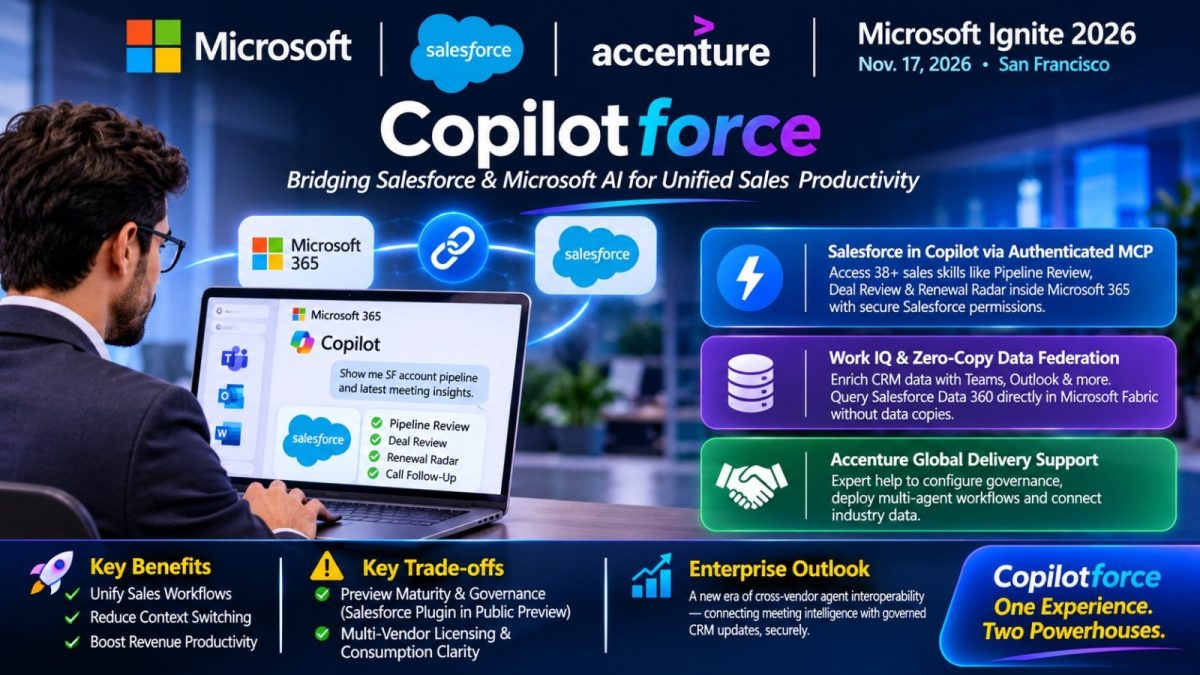
Sales reps at big companies waste a lot of selling time jumping between CRM dashboards, email threads and meeting transcripts just to get ready for a client call. At Microsoft Ignite on November 17, 2026, Microsoft, Salesforce and Accenture announced Copilotforce, a partnership that brings Salesforce workflows right inside Microsoft’s AI tools. Instead of making sales teams choose one company’s workspace, the deal links both agent platforms using open protocol standards and zero-copy data federation.
By putting CRM actions that need a login inside the apps people already use every day, work context and customer records come together in one place.
How Copilotforce connects the two platforms
According to Microsoft’s November 17 announcement, Copilotforce covers workplace plugins, zero-copy analytics and enterprise systems integration, with three main parts.
Salesforce in Copilot through authenticated MCP
This plugin is now in public preview. It comes with more than 38 ready-made sales skills, like Pipeline Review, Deal Review, Renewal Radar and Call Follow-Up. Sellers can pull up account data and do supported actions inside Microsoft 365 Copilot and Microsoft Teams, using authenticated Salesforce Model Context Protocol (MCP) access. Every query follows the user’s existing Salesforce permissions. Any change written back to the CRM needs a person to confirm it first, and it still follows Salesforce’s built-in validation rules.
Work IQ context and zero-copy data federation
Microsoft’s Work IQ layer adds signals from Teams meetings, Outlook emails and shared documents to the CRM records. Underneath, Data Federation is now generally available. It lets Salesforce Data 360 search Microsoft Fabric OneLake directly, without copying datasets between clouds.
Accenture’s role
Accenture is joining as the main systems integrator. It will help joint customers set up their governance limits, launch workflows with multiple agents, and connect industry data pipelines.
Why it matters, and the trade-offs
In our own analysis, Copilotforce shows a practical change in how companies compete on enterprise AI. Even big rivals now see that corporate buyers won’t rebuild their data pipelines or retrain staff on one single interface. Using MCP and zero-copy OneLake queries keeps current security rules in place and cuts down on switching between apps.
Still, enterprise architects need to think about two things before using Copilotforce widely.
Preview maturity and governance scope
Data Federation is generally available, but the Salesforce in Copilot plugin is still in public preview. IT admins should check the MCP permission scopes and test custom Salesforce validation rules carefully. If they don’t, preview workflows might get stuck on complicated opportunity updates.
Multi-vendor licensing and clear costs
Running workflows across both platforms involves Microsoft 365 Copilot licenses, Salesforce Data 360 query credits and Fabric compute capacity. Finance and IT leaders need to watch the combined usage across both clouds so they don’t pay twice for overlapping seats or API calls.
What to expect for adoption
Combining open MCP connections, required confirmation for writebacks and zero-copy data federation gives a practical example of how different vendors’ agents can work together. For revenue operations teams, joining meeting insights with managed CRM updates could boost productivity right away without hurting data security.


