JARVIS AI Agent Can Design, Build and Test Circuit Boards on Its Own
What if you could tell a computer to make an electronic circuit, and a few hours later, the circuit was ready to use? It sounds like science fiction, but researchers have developed an AI system called JARVIS that can do something similar.
On November 19, 2026, four researchers published a paper on arXiv explaining how JARVIS designs circuits, uses robots to build them and checks whether they work. The research is still in its early stages and has not been peer reviewed.
What Did the Researchers Create?
The researchers, Shibo Zhou, Tianqi Hong, Zheng Yan and He Yang, developed JARVIS to automate circuit development.
They tested it by making a 60 Hz notch filter. This is a small electronic circuit that removes unwanted electrical noise from signals.
According to the paper, JARVIS completed the entire experiment in just 2 hours and 39 minutes without human help.
How Does JARVIS Work?
The process starts when someone gives JARVIS a simple text instruction.
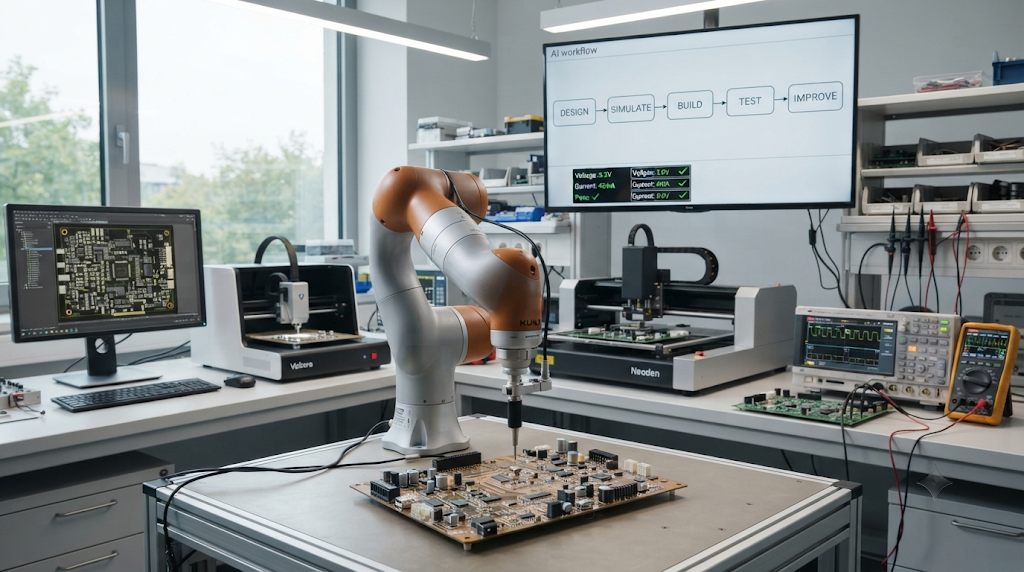
First, a robot scans the workspace using a 3D scanner. JARVIS then creates a digital copy of the laboratory, called a digital twin.
This is similar to creating a virtual version of a real place in a video game.
Before building anything, JARVIS tests its plans in this virtual environment. This helps it find possible mistakes without wasting materials.
Once everything is ready, the real machines begin working.
A robotic arm, PCB printer and pick-and-place machine help create the circuit board. The printer uses conductive silver ink and solder paste, while cameras and sensors monitor the process.
After construction, testing equipment checks whether the circuit works correctly. If something goes wrong, JARVIS can update the design using KiCad software.
What Were the Results?
The researchers reported that JARVIS found five problems during its virtual testing before building the actual board.
The completed circuit had a notch frequency of 60.3 Hz and reduced the unwanted 60 Hz signal by 50.6 dB.
These results show that the circuit performed its main job successfully.
The researchers also reported that JARVIS handled problems that appeared during the experiment.
Is JARVIS Ready for Real-World Use?
Not yet.
The researchers tested JARVIS on only one circuit in a specially prepared laboratory.
There is still no proof that it can build complicated electronics or work reliably in different environments.
Researchers also need to study its cost, safety and ability to handle unexpected problems.
What Could Happen Next?
JARVIS could become useful for engineers who spend hours designing, building and testing electronic circuits.
If the technology improves, it might help researchers develop new electronics faster and reduce repeated manual work.
For now, JARVIS is an interesting research project rather than a commercial product.
The biggest achievement is that one AI system managed the whole process, from designing a circuit to testing the finished board.
The real challenge is finding out whether it can do the same thing successfully with many different circuits.