IBM and Microsoft Teamed Up to Help Big Companies Actually Use AI Agents
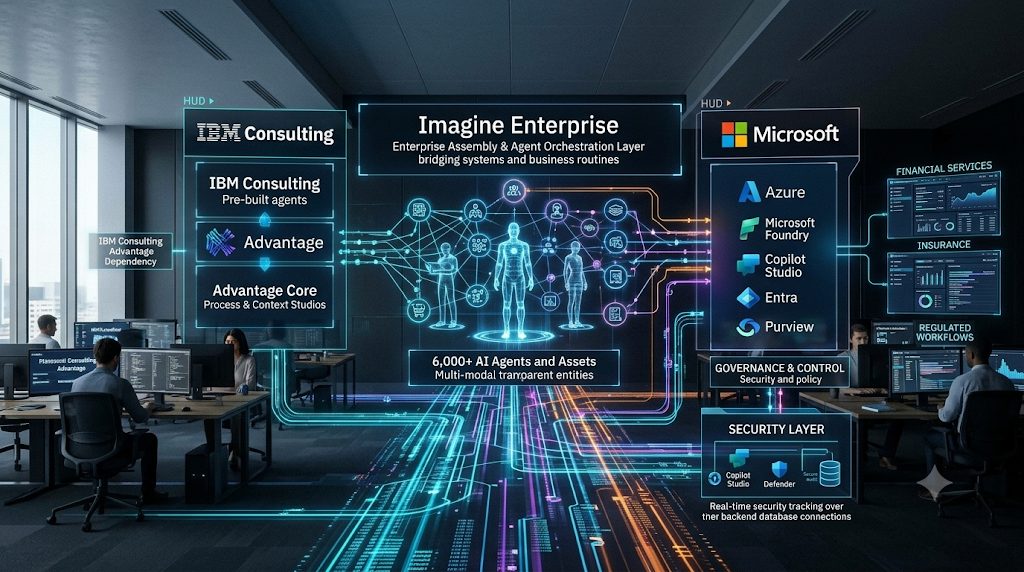
A lot of big companies are stuck testing AI and can’t get it into real use. It’s hard to get a general chatbot to work inside strict, heavily regulated business processes. So on November 10, 2026, IBM and Microsoft announced Imagine Enterprise, a platform they built together to set up, manage, and control “digital workers” in regulated industries like banking and insurance.
The deal puts together IBM Consulting’s library of over 6,000 prebuilt AI agents and industry templates with Microsoft’s cloud, security, and agent-building tools. One early partner exploring it is SEI, an asset management company that handles about $2 trillion in assets.
How does it work?
It’s not a chatbot app. It’s more like a layer that connects a company’s own data to multi-step work routines. Everything starts with industry blueprints, which are ready-made starting plans for a specific type of business. There are three main parts:
- Workflow orchestration: IBM Consulting Advantage’s tools, like Process Studio and Context Studio, map out the business rules and connect the agents to the company’s older databases.
- Reasoning and doing: Microsoft Foundry and Copilot Studio help the agents think, use tools, and learn from feedback, all running on Microsoft Azure.
- Security: Microsoft Entra, Purview, and Defender handle identity, governance, and security. They set who the agents are, watch what they do, and block data they shouldn’t touch.
At first the blueprints are for financial services, insurance, and retail. Later they’re planning ones for other fields like manufacturing, energy, and public services. Both companies are also offering engineers who work right with the customer to build and adjust the agents, for qualifying projects.
The strategy and the trade-offs
This shows how enterprise tech is changing. Companies aren’t just competing on who has the smartest AI model. They’re bundling cloud services with lots of human consulting to get into complicated company workflows. Prebuilt blueprints save companies from building everything from zero. But there are some downsides:
- Complicated setup: IBM’s tools sit on top of Microsoft’s, so IT teams may need to handle two control systems and keep updates in sync across two giant companies.
- Depending on consultants: Having engineers on site speeds things up, but a company could get stuck needing them if its own staff can’t keep the agents running.
- No proof yet: SEI is only exploring this. IBM and Microsoft haven’t shared independently checked performance numbers, prices, or real results from companies using it in production.
My takeaway
IBM and Microsoft are betting that regulated companies would rather buy AI that already comes with rules and security than put the pieces together themselves. Whether it works depends on how well they actually deliver.


